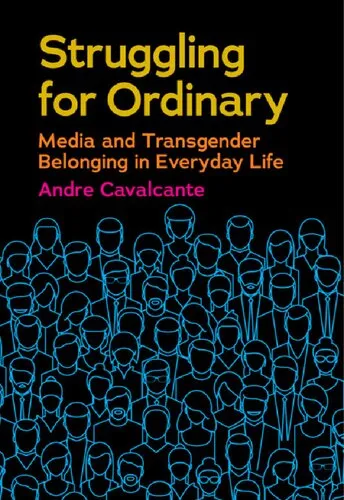
- Published Year: 2018
- Page count: 229
- File Size: 7 MB
- Language: English
- Published by: New York University Press
- Visited by: 303
- Rating/Review: 4.8
-
ISBN:
1479881309
9781479881307
Keywords:
Struggling for Ordinary: Media and Transgender Belonging in Everyday Life
4.8
Reviews from our users

You Can Ask your questions from this book's AI after Login
Each download or ask from book AI costs 2 points. To earn more free points, please visit the Points Guide Page and complete some valuable actions.




Analytical Summary
Struggling for Ordinary: Media and Transgender Belonging in Everyday Life is a rigorous scholarly exploration into the intricate intersections of media, identity, and social belonging. Written with an acute understanding of both academic discourse and lived realities, the book examines how media representations—ranging from mainstream coverage to niche platforms—shape, reflect, and sometimes constrain the ability of transgender individuals to inhabit everyday spaces with dignity and recognition.
At its core, the work investigates what “ordinary” means in the context of transgender lives. It interrogates how media narratives contribute to either normalizing or marginalizing transgender identities in daily public and private spheres. By weaving together qualitative research, personal accounts, and critical theory, the book presents a nuanced analysis of how belonging is negotiated through cultural discourse and representation.
The analytical lens includes both the overt messaging and subtler cues embedded within media texts, as well as audience interpretations. In doing so, it reveals the complex ways media can serve as both a site of affirmation and a barrier to full participation in society for transgender people. The author also draws attention to the persistent tension between visibility and vulnerability, a theme that resonates throughout the narrative.
Key Takeaways
The book offers several key insights that are invaluable to scholars, media professionals, and members of the transgender community seeking deeper understanding.
Firstly, media representation is never neutral—it actively shapes social possibilities for marginalized groups. Secondly, the portrayal of transgender individuals often oscillates between sensationalized visibility and erasure of ordinary experiences. Thirdly, everyday belonging is a dynamic process shaped by cultural narratives, structural conditions, and personal agency.
Another important takeaway is the recognition that “ordinary” has political stakes. To live an ordinary life, free from excessive scrutiny or exoticism, is a form of social justice for transgender people. The book argues that media has both the potential and the responsibility to contribute positively towards this goal.
Finally, the text invites media practitioners to consider the ethical dimensions of their storytelling, urging production choices that reflect the multifaceted realities of transgender lives.
Memorable Quotes
“Mass media not only reflects social realities—it actively constructs them, influencing who is seen as belonging in everyday life.” Unknown
“For transgender people, the ordinary is never merely ordinary; it is negotiated through layers of visibility, risk, and resilience.” Unknown
“To belong is to be recognized without spectacle, a challenge in media landscapes hungry for novelty.” Unknown
Why This Book Matters
The relevance of Struggling for Ordinary: Media and Transgender Belonging in Everyday Life extends far beyond transgender studies—it speaks to any inquiry on inclusion, media ethics, and cultural citizenship.
Information about specific awards or publication year is unavailable due to no reliable public source, but the intellectual contribution is clear: the text addresses growing concerns about how media can perpetuate or disrupt systemic marginalization.
For practitioners in media industries, the book serves as a call to re-examine editorial and production frameworks in light of their social impact. For academics, it offers a robust theoretical framework combined with tangible case examples. For advocacy organizations, it provides language and concepts that articulate the everyday stakes of representation.
Inspiring Conclusion
Struggling for Ordinary: Media and Transgender Belonging in Everyday Life compels readers to rethink how ordinary life is framed and facilitated through media. It is more than a study—it is an invitation to engage with the ethical and cultural dimensions of representation.
By illuminating the paths toward genuine belonging for transgender individuals, the book challenges us to consider our roles as media creators, consumers, and community members. It underscores the interconnectedness of identity, narrative, and social space, urging that the “ordinary” be recognized as a right rather than a rarity.
Readers are encouraged to delve into the text, share its insights with peers, and stimulate discussions that advance equitable representation. In doing so, the ideas within Struggling for Ordinary: Media and Transgender Belonging in Everyday Life can catalyze change in both professional practice and everyday interactions.
Free Direct Download
You Can Download this book after Login
Accessing books through legal platforms and public libraries not only supports the rights of authors and publishers but also contributes to the sustainability of reading culture. Before downloading, please take a moment to consider these options.
Find this book on other platforms:
WorldCat helps you find books in libraries worldwide.
See ratings, reviews, and discussions on Goodreads.
Find and buy rare or used books on AbeBooks.

1303
بازدید4.8
امتیاز0
نظر98%
رضایتReviews:
4.8
Based on 0 users review
Questions & Answers
Ask questions about this book or help others by answering
No questions yet. Be the first to ask!