
Discover references
Monolithic Architecture
Understanding Monolithic Architecture
Monolithic architecture is a traditional model for the design of software applications. This approach is known for its simplicity, reliability, and focus on a single unified unit but also for its challenges in scalability and adaptation to rapidly changing technological needs.
The Basics of Monolithic Architecture
Monolithic architecture represents a software design pattern where an application is built as a single, indivisible unit. This structure inherently includes all the application's functions and capabilities in one interdependent file or package. Websites and enterprise applications often deploy this type of architecture due to its ease of development and testing, as every functionality is housed in a single environment.
Key Features
- Cohesion: All components of the application are tightly coupled, ensuring efficient communication within a single module.
- Unified Code Base: Maintenance and deployment often become straightforward since everything resides in a single framework.
- Ease of Initial Development: Suitable for smaller teams or projects aiming for rapid deployment, given its straightforward structure.
Advantages of Monolithic Architecture
Despite the trend towards microservices, monolithic architecture still presents numerous advantages, particularly at the outset of the project lifecycle:
- Simplicity: Having all components in one place simplifies the development process and provides ease of understanding for new developers or team members learning the system.
- Performance: As components are within the same unit, performance issues caused by network latency or inter-service communication are minimized.
- Deployment: The straightforward nature of deploying a single application translates into fewer complications during application roll-out, reducing technical overhead.
Challenges and Limitations
While advantageous in many respects, monolithic architecture does have notable drawbacks, particularly as systems scale and evolve:
- Scalability: Increasing the capacity or functionality often requires redeploying the entire application, which can be inefficient and resource-heavy.
- Flexibility: Tight coupling of services and components can impede agility and adaptation to technological or business changes.
- Reliability: A failure in one part of the application might affect the entire system, leading to potential downtimes.
Use Cases for Monolithic Architecture
Monolithic architecture is best suited for small, simple applications where the workload is predictable and the need for immediate transition between development to deployment phases is paramount. It finds extensive use in:
- Small to Medium Enterprises: Where budget constraints demand the simplicity of a single codebase and rapid initial development.
- Legacy Systems: Older systems that were initially developed as monolithic due to prevailing technological constraints.
- Start-ups: Ideal for startups that require swift proof-of-concept to product deployment without extensive investment in complex architectures.
Conclusion
Monolithic architecture remains an essential part of software development, offering a straightforward and cohesive development approach. Its advantages in simplicity and performance make it a viable choice for numerous scenarios, particularly when development teams seek a clear path from conception to functional deployment.
As the field evolves, understanding the balance between monolithic and other architectures, such as microservices, will continue to be critical. Developers must weigh the benefits of an all-encompassing application against the potential need for greater flexibility and scalability available through emerging architectural patterns.
Books
71 results
English
Beginner
The Architecture Of Open Source Applications
Amy BrownandGreg Wilson (eds.)
2011
View book

English
Beginner
Web scalability for startup engineers : tips & techniques for scaling your Web application
Ejsmont,Artur
2015
View book
English
Beginner
Fundamentals of Computer-Aided Circuit Simulation
William J. McCalla (auth.)
1987
View book
English
Beginner
Compiler Construction: 11th International Conference, CC 2002 Held as Part of the Joint European Conferences on Theory and Practice of Software, ETAPS 2002 Grenoble, France, April 8–12, 2002 Proceedings
Marjan Mernik,Mitja Lenič,Enis Avdičaušević,Viljem Žumer (auth.),R. Nigel Horspool (eds.)
2002
View book
English
Beginner
97 Things Every Software Architect Should Know: Collective Wisdom from the Experts
Richard Monson-Haefel
2009
View book

English
Beginner
Engineering Long-Lasting Software: An Agile Approach Using SaaS and Cloud Computing, Beta Edition
David Patterson,Armando Fox
2012
View book
English
Beginner
The Architecture of Computer Hardware, Systems Software, and Networking: An Information Technology Approach
Irv Englander
2014
View book
English
Beginner
Hands-On Software Architecture with Java - Learn key architectural techniques and strategies to design efficient and elegant Java applications
Giuseppe Bonocore
2022
View book
English
Beginner
Applied Software Architecture
Christine Hofmeister,Robert Nord,Dilip Soni
1999
View book
English
Beginner
Modeling Software with Finite State Machines: A Practical Approach
Ferdinand Wagner,Ruedi Schmuki,Thomas Wagner,Peter Wolstenholme
2006
View book
English
Beginner
Compiler Construction: 12th International Conference, CC 2003 Held as Part of the Joint European Conferences on Theory and Practice of Software, ETAPS 2003 Warsaw, Poland, April 7–11, 2003 Proceedings
Neil Johnson,Alan Mycroft (auth.),Görel Hedin (eds.)
2003
View book
English
Beginner
High-Performance and Time-Predictable Embedded Computing
Luis Miguel Pinho (editor),Eduardo Quinones (editor),Marko Bertogna (editor),Andrea Marongiu (editor),Vincent Nelis (editor),Paolo Gai (editor),Juan Sancho (editor)
2018
View book
English
Advanced
Fundamentals of Software Architecture: An Engineering Approach
Mark Richards,Neal Ford
2020
View book
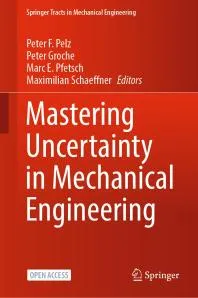
English
Beginner
Mastering Uncertainty in Mechanical Engineering
Peter F. Pelz;Peter Groche;Marc E. Pfetsch;Maximilian Schaeffner
2021
View book
English
Beginner
Embedded Computing for High Performance. Efficient Mapping of Computations Using Customization, Code Transformations and Compilation
João M.P. Cardoso, José Gabriel F. CoutinhoandPedro C. Diniz (Auth.)
2017
View book
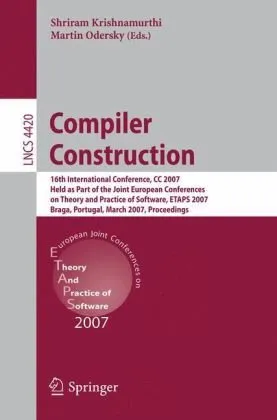
English
Beginner
Compiler Construction: 16th International Conference, CC 2007, Held as Part of the Joint European Conferences on Theory and Practice of Software, ETAPS 2007, Braga, Portugal, March 26-30, 2007. Proceedings
Liza Fireman,Erez Petrank,Ayal Zaks (auth.),Shriram Krishnamurthi,Martin Odersky (eds.)
2007
View book
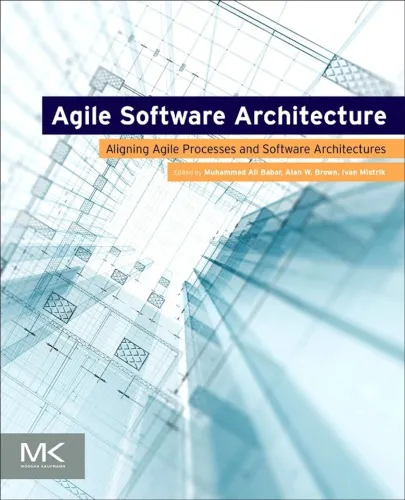
English
Beginner
Agile Software Architecture
Babar, Muhammad;Brown, Alan;Mistrik, Ivan
2013
View book
English
Beginner
The Architecture Of Open Source Applications, Volume II
Amy Brown,Greg Wilson
2013
View book
English
Intermediate
Clean Architecture: a Craftsman's Guide to Software Structure and Design
Martin,Robert
2017
View book
English
Beginner
High Performance Embedded Computing Handbook: A Systems Perspective
David R. Martinez,Robert A. Bond,M. Michael Vai
2008
View book
English
Intermediate
Patterns for parallel programming
Timothy G. Mattson,Beverly A. Sanders,Berna L. Massingill
2005
View book
English
Beginner
Scaling Software Agility: Best Practices for Large Enterprises
Dean Leffingwell
2007
View book
English
Beginner
Compiler construction: 18th international conference, CC 2009, held as part of the Joint European Conferences on Theory and Practice of Software, ETAPS 2009, York, UK, March 22-29, 2009: procAuthor: Oege de Moor; Michael I Schwartzbach''
Oege de Moor,Michael I. Schwartzbach
2009
View book
English
Beginner
Compiler Construction: 10th International Conference, CC 2001 Held as Part of the Joint European Conferences on Theory and Practice of Software, ETAPS 2001 Genova, Italy, April 2–6, 2001 Proceedings
Ole Lehrmann Madsen (auth.),Reinhard Wilhelm (eds.)
2001
View book
English
Beginner
Compiler Construction: 13th International Conference, CC 2004, Held as Part of the Joint European Conferences on Theory and Practice of Software, ETAPS 2004, Barcelona, Spain, March 29 - April 2, 2004. Proceedings
Mary Lou Soffa (auth.),Evelyn Duesterwald (eds.)
2004
View book