

High Performance Parallelism Pearls Volume One: Multicore and Many-core Programming Approaches
James Reinders,James Jeffers
2014
View book
Book guide and evaluation
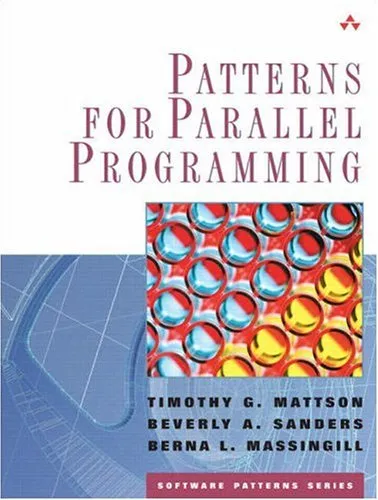
Timothy G. Mattson,Beverly A. Sanders,Berna L. Massingill
0 reviews
Published
pages
views
Introduction to 'Patterns for Parallel Programming' In the ever-evolving landscape of computing technology, parallel programming stands at the forefront of cutting-edge innovation, driving performance enhancements and enabling complex calculations t
Before you read
In the ever-evolving landscape of computing technology, parallel programming stands at the forefront of cutting-edge innovation, driving performance enhancements and enabling complex calculations that were once unimaginable. "Patterns for Parallel Programming," authored by Timothy G. Mattson, Beverly A. Sanders, and Berna L. Massingill, serves as an indispensable guide for programmers navigating the intricacies of parallel computing. This comprehensive guide delves into the theoretical underpinnings and practical implementations, equipped with patterns that empower coders to exploit parallelism efficiently.
"Patterns for Parallel Programming" is structured to enhance your understanding of how to apply patterns to achieve efficient parallel computing. The book kicks off with an exploration of the fundamental principles that govern parallel architectures and algorithms. It stresses the importance of recognizing parallelizable tasks and choosing the appropriate parallel structure.
The authors introduce a catalog of design patterns specifically tailored to parallel computing, categorized into structural, computational, and coordination patterns. The structural patterns concentrate on the organization of parallel computations, while computational patterns focus on algorithmic strategies. Coordination patterns guide the effective management of interactions among parallel tasks.
Each pattern is described in detail with respect to its applicability, structure, trade-offs, and implementation techniques. The book further discusses specific case studies demonstrating successful application of these patterns, thereby providing readers with illustrative guides that bridge theory and practice.
"The power of parallelism is at the heart of engineering computation—unlocking that power requires understanding, creativity, and discipline."
"Patterns offer a means to organize thoughts and solutions, making complex tasks in parallel programming manageable."
The significance of "Patterns for Parallel Programming" lies in its structured approach to demystifying complex parallel programming concepts. As computing demands continue to escalate, the ability to exploit multiple cores and processors sustainably becomes a requisite skillset. This book equips engineers and developers with the expertise to harness the full potential of parallel systems, crucial for software application optimization in diverse domains, including scientific computing, big data, and machine learning.
By framing the discussion around recognized and reusable patterns, the authors not only streamline the learning process but also inspire innovation, enabling solutions that are both efficient and scalable. Whether you are a novice in parallel programming or an experienced professional seeking to refine your skills, "Patterns for Parallel Programming" stands as an authoritative resource that guides you towards engineering excellence in the realm of parallel computation.
Your question is answered in the context of this title and author. Each answer uses 2 points.
0 reviews, 4.5 average out of 5
Sign in to publish a review.
Ask a focused question and learn from the community.
Related references that continue this learning path.
James Reinders,James Jeffers

Mark Richards,Neal Ford