
Book guide and evaluation
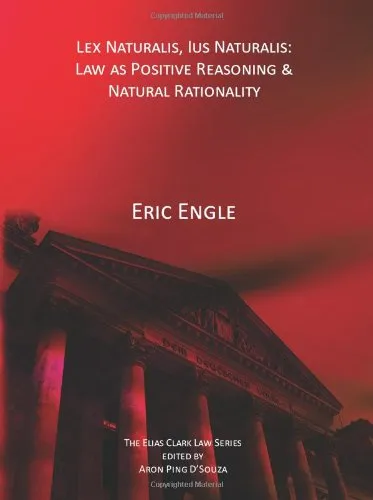
Lex Naturalis, Ius Naturalis: Law as Positive Reasoning & Natural Rationality
Eric Engle,Donna M Lyons,Jacob D Zilhardt,Aron Ping D'Souza
English
Beginner
Monolithic Architecture
4.2 / 5
0 reviews
2010
Published
429
pages
520
views
Lex Naturalis presents a unique theory of law. The work is structured as a series of interrelated essays which, taken together, constitute a new theory of law. The work argues: First, that positive law and natural law are complementary, not competing. Second, that normative infer
Before you read
What will you get from this book?
Lex Naturalis presents a unique theory of law. The work is structured as a series of interrelated essays which, taken together, constitute a new theory of law. The work argues: First, that positive law and natural law are complementary, not competing. Second, that normative inference (is-to-ought) can be a logically valid form or reasoning. Thus, the work presents resolutions to the two leading questions of contemporary legal theory. This book also provides a dialectical synthesis of competing ontological, epistemological and axiological theories. Breaking both from Catholic natural law neo-platonic idealism and from international relations theory realism (nominalism), the work argues for a monist (not dualist), materialist (not idealist), cognitivist (not relativist) and wholist (not atomist) view. Thus the work combines the best aspects of both Catholic neoplatonism (moral cognitivism, wholism) and the best of nominalism (materialism) to present a powerful scientific theory of law which sees positive law and natural law as complementary (some laws are natural, such as the prohibition of murder, others are positive such as parking regulations). Finally, the work argues that logic must be understood as consisting of practical reasoning and theoretical rationality, and that a binary logic of either true or false, only is inadequate to explain legal phenomenon and that binary logic generates paradoxes which can be avoided in multivariate logics. The work addresses classical questions of the relationship between positive and natural law, normative inferencing, and social contract theory, as well as providing a friendly critique of contemporary legal theorists, notably Professor Duncan Kennedy at Harvard Law School. Scholars, Judges and even practitioners will find many interesting and useful ideas in these pages.
Ask this book
Your question is answered in the context of this title and author. Each answer uses 2 points.
Sign in to ask the book assistant.
Reader reviews
0 reviews, 4.2 average out of 5
No reviews yet
If you have read this book, help the next reader with your experience.
Write a review
Sign in to publish a review.
Reader questions and answers
Ask a focused question and learn from the community.
Sign in to ask or answer a question.
No questions yet
Be the first to ask a clear, useful question.
What to read next
Related references that continue this learning path.
Embedded Computing for High Performance. Efficient Mapping of Computations Using Customization, Code Transformations and Compilation
João M.P. Cardoso, José Gabriel F. CoutinhoandPedro C. Diniz (Auth.)
2017
View book

System architecture strategy and product development for complex systems
Crawley, Edward;Cameron, Bruce;Selva, Daniel
2015;2016
View book