English
Beginner
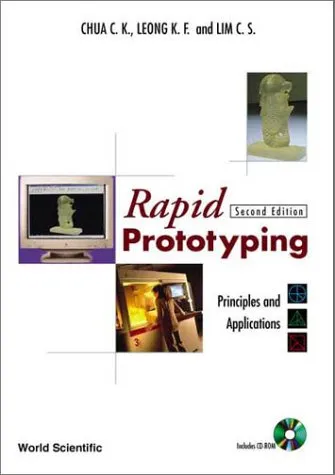
Rapid Prototyping: Principles and Applications (2nd Edition)
Chua Chee Kai,Leong Kah Fai,Lim Chu-Sing
2003
View book
Discover references
Prototyping is an essential phase in product development and design that focuses on creating an early model or sample of a product. This stage is pivotal for visualizing ideas and transforming them into tangible forms, allowing for effective testing and iteration. In the scope of design thinking and agile methodologies, prototyping holds a significant place as it bridges the gap between conceptualization and final product realization.
Prototyping plays a crucial role in the development process as it enables teams to explore different concepts, gather feedback, and make data-driven decisions. It aids in minimizing risks associated with product innovation by highlighting potential flaws and challenges at an early stage. Whether in software development, engineering, fashion, or any other industry, prototyping offers invaluable insights and direction that can significantly enhance the quality and usability of the final product.
Within the realm of prototyping, various types can be employed depending on the project needs and goals:
A typical prototyping process can be broken down into several stages:
A variety of tools and software are available to assist in the prototyping process, ranging from simple sketching tools to sophisticated interactive design platforms. Popular options include:
As technology continues to evolve, the field of prototyping will also witness significant transformations. The integration of augmented reality (AR) and virtual reality (VR) into prototyping workflows is expected to revolutionize how prototypes are developed and tested. These technologies offer immersive environments for users to explore product designs in depth, enabling more comprehensive testing and feedback collection.
In conclusion, prototyping is an indispensable part of the product development lifecycle. It not only enhances creativity and innovation but also significantly reduces the risks associated with new product launches. By embracing various prototyping techniques and utilizing advanced tools, teams can ensure their products align closely with market needs and user expectations, paving the way for successful launches and customer satisfaction.
Chua Chee Kai,Leong Kah Fai,Lim Chu-Sing

Mario A. Pfannstiel,Christoph Rasche
Diana Brown (Eds.)

Hector Guerrero (auth.)
R. Krishnan


Ernest E. Ludwig (Eds.)
Henning Breuer,Zeno Wolze,Elisabeth Umbach (auth.),Aaron Marcus (eds.)

Escoe A. Keith

Douglas C. Montgomery

George S. Fishman (auth.)


Paul A. Fishwick (auth.),Paul A. Fishwick,Paul A. Luker (eds.)
Bert Haskell

Rudolf Avenhaus,Reiner K. Huber (auth.),Rudolf Avenhaus,Reiner K. Huber (eds.)
Nevin Berger,Michael Arent,Jonathan Arnowitz,Fred Sampson

Roberto Bruni (auth.),Marco Bernardo,Luca Padovani,Gianluigi Zavattaro (eds.)
Alison Beazley,Terry Bond

John Priest,Jose Sanchez

Howard R. Moskowitz,Jacqueline H. Beckley,Anna V. A. Resurreccion(auth.)

P.D. McKenna,R.M. Lawson

Wei Ding (auth.),Aaron Marcus (eds.)
Mark Baskinger,William Bardel
S. Ghosh,C. R. Rao

Jo-Anne Bichard,Catherine Greene,Gail Ramster,Tom Staples (auth.),Constantine Stephanidis,Margherita Antona (eds.)

Jan Muntermann

Robert L. Mason,Richard F. Gunst,James L. Hess

Escoe A.K.

Margherita Antona,Constantine Stephanidis (eds.)

Christian Kraft

Samuel M. Scheiner,Jessica Gurevitch

Pål Johan From,Jan Tommy Gravdahl,Kristin Ytterstad Pettersen (auth.)

Anil Mital, Anoop Desai, Anand SubramanianandAashi Mital (Auth.)
Mascitelli, Ronald;Mascitelli, Ronald

Dayu Jiang

Margaret A. White,Garry D. Bruton