

DNA Microarrays and Related Genomics Techniques: Design, Analysis, and Interpretation of Experiments (Biostatistics)
David B. Allison (Editor),Grier P. Page (Editor),T. Mark Beasley (Editor),Jode W. Edwards (Editor
2005
View book
Book guide and evaluation
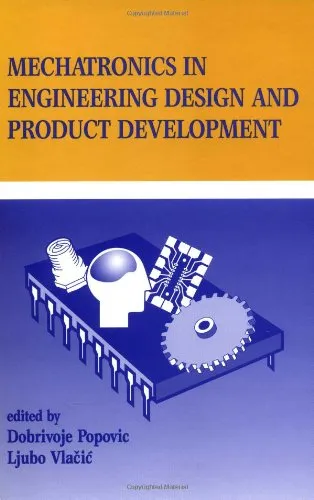
Dobrivojie Popovic
0 reviews
Published
pages
views
Introduction to "Mechatronics in Engineering Design and Product Development" The fusion of mechanics, electronics, control systems, and computer science is a revolutionary trend in modern engineering, and it has paved the way for a multidisciplinary domain called m
Before you read
The fusion of mechanics, electronics, control systems, and computer science is a revolutionary trend in modern engineering, and it has paved the way for a multidisciplinary domain called mechatronics. In "Mechatronics in Engineering Design and Product Development," I sought to deliver a comprehensive guide tackling both the theoretical underpinnings and the practical applications of this exciting field. Whether you're an industry professional or an academic looking to integrate mechatronics into engineering designs, this book provides a structured roadmap to understanding and implementing innovative solutions.
From intelligent design processes to real-world product development examples, this book equips readers with the tools and knowledge required to streamline complex systems, optimize functionality, and achieve cutting-edge engineering breakthroughs. Dive into this text to explore the harmonious interplay between hardware and software as you unlock the full potential of mechatronic systems.
"Mechatronics in Engineering Design and Product Development" is divided into meticulously crafted chapters, each targeting a unique aspect of the discipline. The initial sections lay the groundwork by exploring fundamental concepts such as mechanics, electronics, and system design integration. These chapters are coupled with practical insights that emphasize bridging theoretical concepts to real-world applications.
In later chapters, the book delves into state-of-the-art topics like embedded systems, smart sensors, and robotics. Particular emphasis is placed on the role of computer-aided design (CAD) in modern engineering workflows and the importance of system-level thinking during the product development lifecycle. Through detailed explanations and illustrative examples, readers are guided in applying these advancements to develop intelligent devices and processes.
The book also discusses the integration challenges and solutions involved in creating adaptive and responsive systems, including the use of mechatronic principles in autonomous systems and Industry 4.0. Through case studies and hands-on exercises, the concepts presented become both accessible and actionable for readers of varying expertise levels.
Overall, this text strives to balance depth with clarity, covering a broad spectrum of topics while maintaining an unwavering focus on real-world applicability.
Readers of "Mechatronics in Engineering Design and Product Development" will leave with a robust understanding of:
Each takeaway is designed to build domain expertise, enabling readers to envision and execute innovative projects with confidence.
Here are some thought-provoking insights from the book that encapsulate the spirit of mechatronics:
"Mechatronics is not the sum of its parts; it is the synergy that arises when those parts converge to create something greater."
"In the era of smart systems, the boundary between hardware and software is not a wall but a bridge."
"The true art of mechatronic design lies in solving the puzzle of integration, where engineering disciplines meet and harmonize."
As engineering continues to evolve in the face of rapid technological progress, the demand for innovative, adaptable, and efficient systems is greater than ever. "Mechatronics in Engineering Design and Product Development" aims to address this demand by equipping readers with the knowledge to design and develop next-generation technologies.
This book is not just a primer for mechatronics enthusiasts but a critical resource for anyone seeking to stay ahead in today’s competitive engineering landscape. By fostering a multidisciplinary mindset, the book unlocks new possibilities for creativity and advancement in product design and development.
Ultimately, this text matters because it has the potential to inspire the next wave of engineers and innovators, empowering them to tackle complex challenges and shape the future of engineering.
Your question is answered in the context of this title and author. Each answer uses 2 points.
0 reviews, 4.5 average out of 5
Sign in to publish a review.
Ask a focused question and learn from the community.
Related references that continue this learning path.
David B. Allison (Editor),Grier P. Page (Editor),T. Mark Beasley (Editor),Jode W. Edwards (Editor

Frank C. Hoppensteadt,Charles S. Peskin (auth.)

Howard R. Moskowitz PhD,Sebastiano Porretta,Matthias Silcher