
Book guide and evaluation
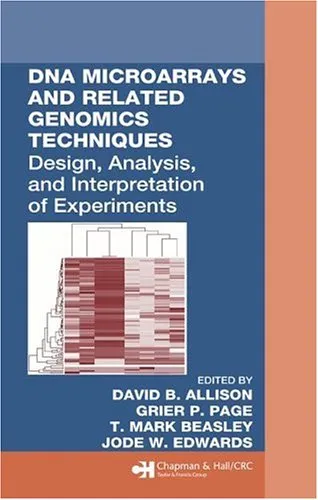
DNA Microarrays and Related Genomics Techniques: Design, Analysis, and Interpretation of Experiments (Biostatistics)
David B. Allison (Editor),Grier P. Page (Editor),T. Mark Beasley (Editor),Jode W. Edwards (Editor
English
Beginner
Prototyping
5.0 / 5
0 reviews
2005
Published
391
pages
351
views
Introduction to "DNA Microarrays and Related Genomics Techniques: Design, Analysis, and Interpretation of Experiments (Biostatistics)" "DNA Microarrays and Related Genomics Techniques: Design, Analysis, and Interpretation of Experiments (Biostatistics)" is an essential gui
Before you read
What will you get from this book?
Introduction to "DNA Microarrays and Related Genomics Techniques: Design, Analysis, and Interpretation of Experiments (Biostatistics)"
"DNA Microarrays and Related Genomics Techniques: Design, Analysis, and Interpretation of Experiments (Biostatistics)" is an essential guide that bridges the powerful worlds of genomics and statistical science. It is crafted to aid researchers, scientists, biostatisticians, and students in understanding how to design, analyze, and interpret experiments involving DNA microarrays and related genomic methodologies. The book is co-edited by a group of distinguished authors, including David B. Allison, Grier P. Page, T. Mark Beasley, and Jode W. Edwards, all renowned experts in their respective fields.
In today’s era of genomics, advancements in DNA microarray and subsequent technologies have revolutionized how we approach the study of gene expression, biomarker discovery, and other critical biological phenomena. However, these technologies often generate complex, high-dimensional data that can be challenging to navigate. This book acts as a comprehensive roadmap, offering both theoretical foundations and practical insights into how to approach genomic experiments statistically and infer robust, reproducible conclusions.
Designed for both novice and experienced researchers, the book elucidates key concepts around genomic data while addressing common pitfalls in experimental design, data preprocessing, and the interpretation of results. With detailed examples, the authors provide clarity on intricate topics, ensuring that readers can conduct reproducible and statistically sound research that withstands rigorous scientific scrutiny.
Detailed Summary of the Book
This book is structured into multiple sections, each dedicated to unraveling core principles of genomic experimentation and the associated analytical techniques. It begins by introducing readers to the fundamental design principles necessary for conducting valid experiments using DNA microarrays and related techniques. The initial chapters provide readers with a firm grasp of the critical role of experimental design in ensuring unbiased, replicable results.
As the book progresses, readers are guided through the statistical methodologies required for preprocessing raw genomic data to eliminate noise and ensure accuracy. Techniques such as normalization, batch correction, and missing data imputation are discussed in detail, enabling readers to clean and prepare their data for meaningful analysis.
Subsequent chapters cover core data analysis techniques, including clustering, classification, and machine learning methods applied within the genomic context. In addition, the book delves into supervised and unsupervised learning approaches, pathway enrichment analysis, and meta-analysis methods for combining datasets from multiple studies. The importance of replicability and avoiding overfitting in genomic research is addressed throughout these sections, emphasizing the critical need for rigor in today’s science.
In the later sections, the book shifts its focus to the interpretation of results and their real-world implications in genomics, such as identifying biomarkers for disease, understanding biological networks, and exploring precision medicine applications. The authors also highlight how genomic data can be integrated with other omics data types, such as proteomics and metabolomics, to gain deeper insights into biological systems.
Key Takeaways
- The importance of robust experimental design in genomic research.
- How to preprocess and clean high-dimensional genomic datasets effectively.
- Core statistical methods for analyzing microarray data, including clustering and classification.
- How to interpret genomic study results and derive actionable biological insights.
- Techniques to integrate genomic data with other biological data types for holistic understanding.
- Guidelines for reproducibility and transparency in genomics research.
Famous Quotes from the Book
"The integrity of genomic research lies not just in the data collected but in the thoughtful design and rigorous analysis that underpin the study."
"Microarrays and modern genomics provide an unprecedented lens into the biological complexity of life. But with this power comes the responsibility to ensure accuracy, reproducibility, and meaningful interpretation."
Why This Book Matters
The relevance of "DNA Microarrays and Related Genomics Techniques" cannot be overstated. As genomics continues to shape the future of healthcare, agriculture, and biotechnology, the need for scientifically robust and statistically sound methodologies has never been greater. This book addresses the gap between understanding complex genomic technologies and applying rigorous statistical methodologies for meaningful insights.
Researchers from diverse fields, including molecular biology, bioinformatics, and statistics, will find this book an indispensable resource. Its detailed explanations on study design, data analysis, and interpretation equip readers with the tools needed to excel in genomic research. Moreover, its emphasis on reproducibility aligns with the growing movement toward open and transparent science.
For educators, this book serves as an excellent teaching resource, offering clear and insightful explanations of foundational and advanced topics in genomic analysis. It empowers students and trainees to think critically and apply their knowledge to solve real-world problems.
In an era of precision medicine and genomics-driven innovation, this book stands as a cornerstone for researchers dedicated to unlocking the mysteries of life through data and science.
Ask this book
Your question is answered in the context of this title and author. Each answer uses 2 points.
Sign in to ask the book assistant.
Reader reviews
0 reviews, 5.0 average out of 5
No reviews yet
If you have read this book, help the next reader with your experience.
Write a review
Sign in to publish a review.
Reader questions and answers
Ask a focused question and learn from the community.
Sign in to ask or answer a question.
No questions yet
Be the first to ask a clear, useful question.
What to read next
Related references that continue this learning path.
Modeling and Simulation in Medicine and the Life Sciences
Frank C. Hoppensteadt,Charles S. Peskin (auth.)
2002
View book

Concept Research in Food Product Design and Development 0813824249
Howard R. Moskowitz PhD,Sebastiano Porretta,Matthias Silcher
2005
View book