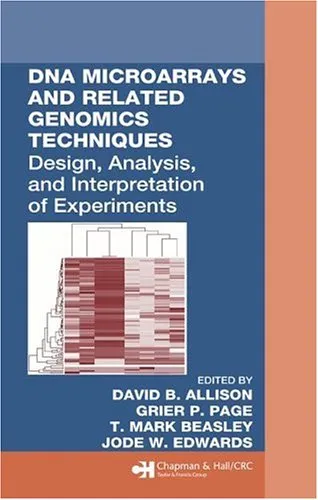
DNA Microarrays and Related Genomics Techniques: Design, Analysis, and Interpretation of Experiments (Biostatistics)
David B. Allison (Editor),Grier P. Page (Editor),T. Mark Beasley (Editor),Jode W. Edwards (Editor
2005
View book
Book guide and evaluation
Frank C. Hoppensteadt,Charles S. Peskin (auth.)
0 reviews
Published
pages
views
Introduction to "Modeling and Simulation in Medicine and the Life Sciences" "Modeling and Simulation in Medicine and the Life Sciences" is a comprehensive work by Frank C. Hoppensteadt and Charles S. Peskin that delves into the fascinating intersection of mathematics, medi
Before you read
"Modeling and Simulation in Medicine and the Life Sciences" is a comprehensive work by Frank C. Hoppensteadt and Charles S. Peskin that delves into the fascinating intersection of mathematics, medicine, and biology. This book serves as a valuable resource for understanding how mathematical modeling and computational simulations can be applied to solve complex problems in both medicine and the life sciences. It is widely regarded as a pioneering text in bridging theoretical models with real-world biological and medical phenomena, making it suitable for researchers, educators, and students alike.
The book draws its foundation from the inherent connection between biological systems and mathematical principles. It introduces a variety of classical and modern modeling techniques, providing readers with tools to analyze, simulate, and predict the behavior of systems in medicine and the life sciences. The authors focus on making abstract mathematical concepts comprehensible and show how these tools can be applied practically to medical diagnoses, treatments, and biological processes.
The content ranges from simpler models, like systems of differential equations used in population dynamics and disease spread, to more intricate approaches such as stochastic methods for understanding random processes in biological systems. A critical component of the book is its emphasis on simulation—tools that provide hands-on, computational experimentation for readers to test and refine their models.
Topics include cellular mechanics, nerve signal propagation, blood flow dynamics, epidemiological studies, and models of diseases. Each chapter introduces a problem or phenomenon, explains its biological or medical relevance, and explores how mathematical models and simulations can uncover deeper insights. The text is bolstered by clear explanations, detailed steps for deriving key equations, and illustrative examples to help solidify these concepts.
"Mathematics is not merely a language for describing the natural world; it is an indispensable tool for uncovering its intricate workings and underlying principles."
"In the life sciences, modeling is not an endpoint but a process—one that informs experimentation, guides understanding, and drives discovery."
"Simulation is our bridge between the theoretical and the tangible, enabling us to test hypotheses and refine our theories in ways previously unimaginable."
In an age where science is becoming increasingly interdisciplinary, "Modeling and Simulation in Medicine and the Life Sciences" stands as a landmark resource. It equips readers with the mathematical tools and simulation techniques necessary to tackle some of the most pressing issues in science and healthcare.
The growing role of computational tools in biological research highlights the need for such a comprehensive guide. Diseases like cancer, diabetes, and neurological disorders demand more than experimental approaches; they require predictive tools that only modeling can offer. Similarly, public health challenges such as pandemics call for epidemiological models that inform policy and intervention strategies.
Furthermore, this book is not just for scientists. Doctors, engineers, and educators will find it equally enriching as it connects complex medical phenomena with underlying mathematical insight. It fosters a deeper appreciation of how theoretical methods and computational power can work harmoniously to change the future of life sciences and medicine.
Whether you are a student delving into mathematical biology for the first time or a researcher looking for advanced computational techniques to apply to pressing challenges, this text offers unparalleled value. It inspires curiosity, fuels discovery, and lays the foundation for future advancements at the cutting edge of science.
Your question is answered in the context of this title and author. Each answer uses 2 points.
0 reviews, 4.9 average out of 5
Sign in to publish a review.
Ask a focused question and learn from the community.
Related references that continue this learning path.
David B. Allison (Editor),Grier P. Page (Editor),T. Mark Beasley (Editor),Jode W. Edwards (Editor
Howard R. Moskowitz PhD,Sebastiano Porretta,Matthias Silcher