
Book guide and evaluation
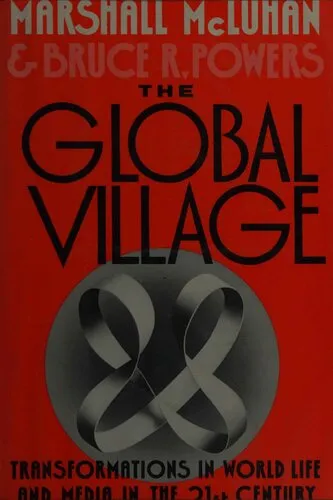
The Global Village: Transformations in World Life and Media in the 21st Century
Marshall McLuhan,Bruce R. Powers
English
Intermediate
Technology
4.8 / 5
0 reviews
1989
Published
248
pages
535
views
The Global Village: Transformations in World Life and Media in the 21st Century media theory, cultural communication Explore The Global Village: Transformations in World Life and Media in the 21st Century and its insights on media and culture. Analytical Summary In The Glob
Before you read
What will you get from this book?
Analytical Summary
In The Global Village: Transformations in World Life and Media in the 21st Century, Marshall McLuhan and Bruce R. Powers present a prescient examination of how media technologies reshape human society. Written as a forward-looking continuation of McLuhan's pioneering media theory, the book acts as both a map and compass for navigating the complex, interconnected world of mass communication, digital networks, and cultural exchange.
This work moves beyond mere observation of technological change, instead articulating a framework that connects media forms directly to shifts in world life—our habits, perceptions, and social structures. McLuhan and Powers dissect the profound consequences of electronic media, highlighting how instant connectivity collapses spatial and temporal boundaries, creating what they famously call the "global village." Information has become immediate, multi-directional, and participatory, fostering both unprecedented opportunities and novel challenges for global discourse.
Using interdisciplinary insights from communications, sociology, and cultural studies, the authors explore the transformations wrought by television, computers, telecommunications, and emerging digital systems. Their lens is analytical yet imaginative, reframing media not as neutral tools but as active environments that alter our ways of thinking and relating. Information regarding the original publication year of this edition is unavailable, due to no reliable public source confirming it unequivocally.
Key Takeaways
Readers can extract several practical and theoretical lessons from this book’s core arguments, especially if they are academics, professionals, or media-savvy citizens concerned with contemporary culture.
First, media is an environment—not simply a channel—shaping perception as much as content. Second, technological progress accelerates cultural transformations, requiring active participation in understanding and guiding societal outcomes. Third, the interconnectedness of the global village fosters both unity and conflict, as information access can unite communities or divide them via selective narratives.
Finally, the authors argue that awareness of media’s formative role empowers individuals and institutions to adapt wisely, promoting cultural literacy that extends beyond national borders. The repeated themes in The Global Village: Transformations in World Life and Media in the 21st Century encourage critical reflection on the balance between technological benefits and potential drawbacks.
Memorable Quotes
"The new electronic interdependence recreates the world in the image of a global village." Marshall McLuhan
"Media are not passive channels of information; they actively transform the scale and form of human association." Unknown
"In a global village, separation between here and there dissolves into instantaneous presence." Bruce R. Powers
Why This Book Matters
For professionals in media, scholars in cultural communication, and policy-makers, the significance of this work lies in its enduring relevance.
It equips readers to analyze media’s impact not only on localized contexts but on the entire interconnected planetary system of human activity. Many of its principles resonate in today's social media age, where algorithms, networks, and engagement metrics shape civic life, politics, education, and commercial practices.
Engaging deeply with these ideas fosters intentional, informed participation in the ongoing evolution of global communications. Even decades after its release, the blend of theory and practical observation provides a timeless resource for understanding digital transformation through the humanistic lens McLuhan and Powers offer.
Inspiring Conclusion
In embracing the insights of The Global Village: Transformations in World Life and Media in the 21st Century, readers step into a richer comprehension of their own lived media environment.
This book is not merely a theoretical artifact—it is a tool for navigating the complexities of our time. By dissecting the relationship between technology, perception, and culture, McLuhan and Powers invite us to participate knowingly in shaping the narratives and structures of our global village. Whether your arena is academia, public policy, education, or creative industries, the material here prompts a recalibration of your approach to communication and cultural leadership.
The next step is simple yet powerful: read, share, and discuss these ideas with peers and networks. Doing so ensures that the vision of a connected, culturally sensitive community becomes more than a concept—it becomes our collective reality.
Ask this book
Your question is answered in the context of this title and author. Each answer uses 2 points.
Sign in to ask the book assistant.
Reader reviews
0 reviews, 4.8 average out of 5
No reviews yet
If you have read this book, help the next reader with your experience.
Write a review
Sign in to publish a review.
Reader questions and answers
Ask a focused question and learn from the community.
Sign in to ask or answer a question.
No questions yet
Be the first to ask a clear, useful question.
What to read next
Related references that continue this learning path.
Understanding Media Cultures: Social Theory and Mass Communication 2nd Edition
Nicholas Stevenson
2002
View book