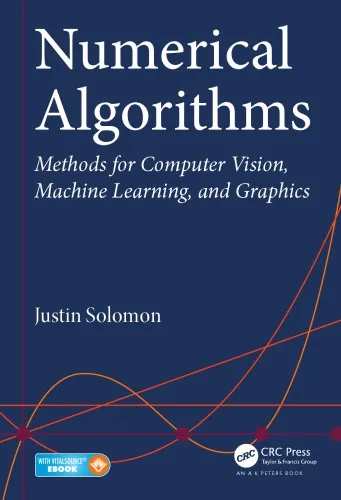
- Published Year: 2015
- Page count: 392
- File Size: 10 MB
- Language: English
- Published by: CRC Press
- Visited by: 186
- Rating/Review: 4.3
-
ISBN:
1482251884
978-1482251883
Keywords:
Numerical Algorithms: Methods for Computer Vision, Machine Learning, and Graphics
4.3
Reviews from our users

You Can Ask your questions from this book's AI after Login
Each download or ask from book AI costs 2 points. To earn more free points, please visit the Points Guide Page and complete some valuable actions.

![The Ultimate iOS Interview Playbook: Conquer Swift, frameworks, design patterns, and app architecture [Team-IRA]](https://s3.refhub.ir/images/thumb/The_Ultimate_iOS_Interview_Playbook__Conquer__29925.webp)



Numerical algorithms form the foundation of numerous advancements in computer science and engineering. My book, Numerical Algorithms: Methods for Computer Vision, Machine Learning, and Graphics, is crafted to address the core computational strategies that drive modern fields like computer vision, machine learning, and computer graphics. This comprehensive text serves as both a guide and a reference, blending theoretical depth with practical applications designed for researchers, practitioners, and students.
As the boundaries of technology continue to expand, the demand for efficient computational techniques becomes even more critical. In this book, I cover a range of numerical methods that bridge academic concepts to industrial applications. Together, the content empowers readers to not only understand but also harness these tools to solve complex computational problems in real-world contexts.
Summary of the Book
The book dives into the theory, algorithms, and practical challenges associated with numerical computation. It opens with essential mathematical foundations, including vector calculus, linear algebra, and optimization, which are key to understanding the mechanics behind many algorithms. The subsequent chapters are divided into approachable, thematic sections, covering techniques particularly relevant to computer vision, machine learning, and graphics.
For computer vision, the book focuses on methods like feature extraction, image processing, and 3D reconstruction, with an emphasis on algorithms capable of handling large-scale data efficiently. In the domain of machine learning, topics range from fundamental gradient-based optimization to modern frameworks like support vector machines and neural networks. When it comes to computer graphics, the content explores mesh generation, simulation, and physically-based modeling, equipping readers with the skills to solve rendering and animation challenges.
At its core, the book balances three components: theoretical rigor, algorithmic implementation, and real-world applications. Each chapter is infused with practical examples and detailed pseudo-code, ensuring the material resonates with readers across different expertise levels.
Key Takeaways
- Master the essential mathematical foundations behind numerical computation, such as linear algebra, calculus, and optimization techniques.
- Understand how numerical methods power core tasks in computer vision, from image processing to 3D scene reconstruction.
- Gain experience with scalable algorithms in machine learning, ranging from regression techniques to deep learning frameworks.
- Learn state-of-the-art methodologies for solving real-world problems in computer graphics, including rendering and physically-based simulation.
- Develop a deep appreciation for the interplay between mathematical theory, algorithm design, and practical implementation.
Famous Quotes from the Book
"Numerical algorithms are the bridge between problem formulation and computational insight."
"Understanding the numerical landscape is a prerequisite for building robust, scalable, and transformative computer systems."
"Optimization is not just the art of finding the best solution; it’s about knowing when and where to trade off precision for performance."
Why This Book Matters
The world today runs on computations, with numerical algorithms serving as the backbone of technologies that touch every sphere of life. From facial recognition to predictive analytics, from immersive gaming graphics to groundbreaking autonomous systems, these algorithms are the unsung heroes enabling innovation. By demystifying this vast landscape, Numerical Algorithms: Methods for Computer Vision, Machine Learning, and Graphics provides readers with the knowledge and tools necessary to contribute to this innovation.
Unlike many other texts, this book provides a clear roadmap that ties together the mathematical, algorithmic, and application-driven aspects of computation. Its unique focus on computer vision, machine learning, and graphics ensures it remains relevant to some of the fastest-growing fields in computing. Whether you’re a student eager to explore these domains or an experienced developer seeking to deepen your computational expertise, this book offers a timeless resource for your journey.
By bridging the gap between theory and implementation, it empowers readers to tackle practical challenges while remaining grounded in sound mathematical principles. This, in essence, is why the book matters—not just for understanding today’s breakthroughs but for enabling the breakthroughs of tomorrow.
Free Direct Download
You Can Download this book after Login
Accessing books through legal platforms and public libraries not only supports the rights of authors and publishers but also contributes to the sustainability of reading culture. Before downloading, please take a moment to consider these options.
Find this book on other platforms:
WorldCat helps you find books in libraries worldwide.
See ratings, reviews, and discussions on Goodreads.
Find and buy rare or used books on AbeBooks.

1186
بازدید4.3
امتیاز0
نظر98%
رضایتReviews:
4.3
Based on 0 users review
Questions & Answers
Ask questions about this book or help others by answering
No questions yet. Be the first to ask!