adeyiwola success
2025/12/27
5 / 5
Great recommendation
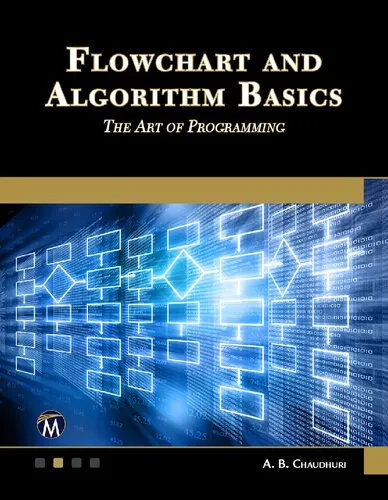
Book guide and evaluation
A. B. Chaudhuri
1 reviews
Published
pages
views
Introduction to "Flowchart and Algorithm Basics: The Art of Programming" Welcome to "Flowchart and Algorithm Basics: The Art of Programming", a foundational guide to mastering the principles of computer programming for beginners, intermediates, and aspiring software enthus
Before you read
Welcome to "Flowchart and Algorithm Basics: The Art of Programming", a foundational guide to mastering the principles of computer programming for beginners, intermediates, and aspiring software enthusiasts. This book is not merely a technical manual; it is an exploration of the core building blocks of programming, presented in a simple, systematic, and application-focused approach. By demystifying flowcharts and algorithms, the book provides readers with the tools they need to think algorithmically, design programs efficiently, and solve problems logically.
"Flowchart and Algorithm Basics: The Art of Programming" is a unique guide designed to introduce the concepts behind programming in an intuitive and visual manner. Understanding that algorithms are at the heart of every software solution, the book uses flowcharts and pseudocode to simplify complex programming concepts. It progresses step-by-step, starting from the basics of what an algorithm is, how it works, and why visualizing it through flowcharts makes it more understandable.
The book covers the essentials of flowcharting, including flowchart symbols, drawing techniques, and interpretation rules. Thorough examples are provided to show how a real-world problem can be translated into a logical diagram. It teaches how to think in terms of steps, decisions, loops, and conditions — the very essence of programming.
Moving beyond flowcharts, the book delves into algorithms, covering foundational topics such as sequential logic, iteration, conditional branching, and recursion. It emphasizes problem-solving skills by including numerous exercises and challenges to test the reader's understanding. The book serves as a vital prelude to coding in any programming language by ensuring that readers are confident with program logic and design before plunging into code.
Whether you are an educator seeking teaching resources or a student aspiring to build strong programming fundamentals, this book delivers everything necessary to bridge the gap between theory and practice.
"A programmer's true skill lies not in writing code, but in breaking down complexity into logical, manageable steps."
"Flowcharts are the language of logic — universal, clear, and indispensable for building any great program."
"Algorithms don't just solve problems; they teach us how to think systematically."
As technology increasingly dominates the modern world, programming is no longer a niche skill reserved for computer scientists. It is a core competency required in various disciplines, from engineering and data analysis to education and business operations. However, the journey to becoming a skilled programmer often starts with confusion and frustration. Many learners dive straight into coding without a strong foundation in logic and algorithmic thinking, leading to unnecessary roadblocks.
"Flowchart and Algorithm Basics: The Art of Programming" fills this void, providing a structured and easy-to-follow foundation for learners. By focusing on the art of problem-solving rather than syntax or specific programming languages, the book prepares readers for success in any coding environment. The importance of understanding algorithms and visualizing solutions through flowcharts cannot be overstated — these are skills that transcend languages and fields.
This book matters because it unlocks the fundamental way computers "think" and operate. By mastering flowcharts and algorithms, readers develop the mental framework they need to excel in programming and beyond. Whether you are planning your first steps into the programming world or looking to refine your logical thinking, this book stands as a timeless guide to the art and science of algorithmic problem-solving.
Your question is answered in the context of this title and author. Each answer uses 2 points.
1 reviews, 5.0 average out of 5
2025/12/27
5 / 5
Great recommendation
Sign in to publish a review.
Ask a focused question and learn from the community.
Related references that continue this learning path.
Michael T. Goodrich,Roberto Tamassia,Michael H. Goldwasser
Narasimha Karumanchi