
Raul Suarez
2025/03/12
5 / 5
Excellent book for .Net developers
RefHub featured
Book guide and evaluation
Joshua Garverick,Omar Dean McIver
1 reviews
Published
pages
views
Introduction Welcome to "Implementing Event-Driven Microservices Architecture in .NET 7: Develop event-based distributed apps that can scale with ever-changing business demands using C# 11 and .NET 7." This book is a comprehensive guidecrafted to help developers, a
Before you read
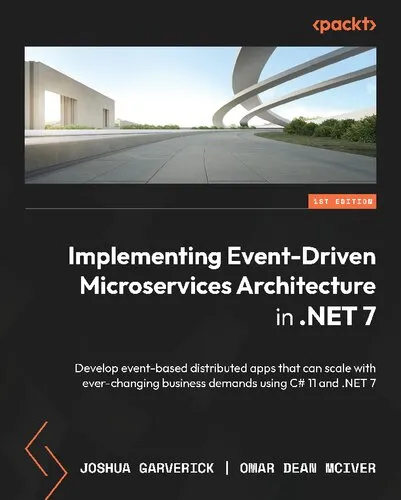
Welcome to "Implementing Event-Driven Microservices Architecture in .NET 7: Develop event-based distributed apps that can scale with ever-changing business demands using C# 11 and .NET 7." This book is a comprehensive guidecrafted to help developers, architects, and technology leaders build resilient, flexible, and highly scalable distributed systems using the power of event-driven architecture (EDA).
The modern digital age demands systems that can adapt to fast-changing business requirements, handle complex workflows, and process huge volumes of data in near real-time. This is where event-driven microservices shine. By decoupling services and utilizing asynchronous communication, you can achieve agility, scalability, and maintainability—all fundamental aspects of modern software systems.
Built around the latest advancements in .NET 7 and C# 11, this book marries essential theoretical concepts of event-driven architecture with practical, hands-on implementations. By the end of this book, you'll have a robust understanding of how to approach challenges in distributed systems, implement event-driven solutions, and take full advantage of the .NET ecosystem.
The book begins with an overview of event-driven architecture, introducing its core principles, key components, and the problems it solves. It provides real-world use cases for why organizations are turning to this architectural pattern and how it aligns with the microservices paradigm. Whether you’re building a new system or modernizing a monolith, this book offers a clear path forward.
The foundational chapters delve into the mechanics of message brokers, event sourcing, CQRS (Command Query Responsibility Segregation), and data consistency challenges inherent in distributed systems. Practical examples are demonstrated using .NET 7, illustrating how developers can harness tools like Azure Event Grid, Apache Kafka, RabbitMQ, and Dapr to orchestrate microservices efficiently.
As you progress through the chapters, you’ll gain experience designing loosely coupled systems, implementing asynchronous communication, handling failures gracefully, and deploying and monitoring distributed applications. Additionally, chapters cover essential topics such as domain-driven design (DDD) in microservices, eventual consistency patterns, and even how to test event-driven applications effectively.
Moving toward advanced topics, the book explores edge cases like managing complex workflows, troubleshooting distributed tracing issues, and integrating Third-Party APIs into EDA systems. The book culminates with a focus on best practices, design trade-offs, and strategies for scaling event-driven applications in cloud-native environments.
"An event is not just a notification of state change—it's the lifeblood of a scalable, resilient system."
"Distributed systems start with trust—not just in your code, but in the contracts between your services."
"Event-driven architecture doesn't remove complexity; it shifts it to where your system can handle it best."
As businesses strive to deliver faster, better, and more reliable systems, the role of technology has never been more critical. With the explosive growth of cloud computing, containerization, and real-time data processing, architects and developers need practical solutions to build systems that can handle these demands. This book addresses those needs.
By focusing on .NET 7 and C# 11, the book leverages the latest advancements in Microsoft’s modern development stack, equipping you to build production-ready event-driven systems. Whether you're an experienced software professional or someone new to building distributed systems, this book distills years of architectural best practices into digestible, actionable insights.
Developers who read this book will not only improve their technical skillset but also gain a broader understanding of the evolving software landscape. This will enable them to stay competitive and relevant in a technology-driven world. By mastering the patterns and practices detailed here, you'll be ready to guide your teams confidently into the future of software development.
Your question is answered in the context of this title and author. Each answer uses 2 points.
1 reviews, 5.0 average out of 5
2025/03/12
5 / 5
Excellent book for .Net developers
Sign in to publish a review.
Ask a focused question and learn from the community.
Related references that continue this learning path.
Holden Karau,Rachel Warren