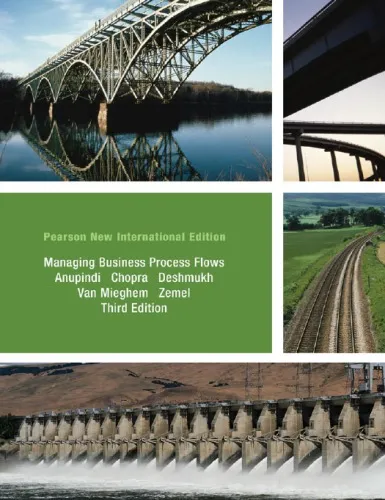
- Published Year: 2013;2014
- Page count: 349
- File Size: 9 MB
- Language: English
- Published by: Pearson
- Visited by: 132
- Rating/Review: 4.9
-
ISBN:
1292023112
9781292023113
Keywords:
Managing Business Process Flows: Principles of Operations Management
4.9
Reviews from our users

You Can Ask your questions from this book's AI after Login
Each download or ask from book AI costs 2 points. To earn more free points, please visit the Points Guide Page and complete some valuable actions.



![The Ultimate iOS Interview Playbook: Conquer Swift, frameworks, design patterns, and app architecture [Team-IRA]](https://s3.refhub.ir/images/thumb/The_Ultimate_iOS_Interview_Playbook__Conquer__29925.webp)





Introduction to 'Managing Business Process Flows: Principles of Operations Management'
‘Managing Business Process Flows: Principles of Operations Management’ is an insightful resource for understanding the underlying principles that govern modern operations management and process flows. Written by Ravi Anupindi along with co-authors Sunil Chopra and Sudhakar Deshmukh, this book has become a definitive guide for students, professionals, and practitioners who are keen to improve efficiency, productivity, and innovation in various organizational settings. Whether you're in manufacturing, services, logistics, or supply chain management, this book equips you with the essential tools to analyze and optimize business process flows effectively.
The book emphasizes a structured, process-oriented approach to understanding and addressing complex operational challenges. By providing robust theoretical models interspersed with real-world applications, it bridges the gap between abstract concepts and practical execution. With clear and systematic explanations, the book reinforces the importance of integrating operations management into the strategic framework of an organization to create sustainable competitive advantages.
Detailed Summary of the Book
At its heart, the book tackles the intricate relationship between process flows and operational excellence. It begins by defining the fundamental concepts of operations management and links them to an organization's broader strategic goals. The authors introduce key metrics and methodologies, such as capacity analysis, queuing theory, inventory models, and supply chain design, to unravel the core dynamics of operational processes.
Throughout its well-structured chapters, the book emphasizes data-driven decision-making and offers quantitative tools to analyze various process flow challenges. This analytical approach is supplemented with a range of case studies and examples, showcasing scenarios from both manufacturing and service industries. The interplay of supply, demand, and capacity is delved into in detail, helping readers to grasp the critical aspects of balancing these elements to enhance organizational performance.
Moreover, ‘Managing Business Process Flows’ covers advanced topics like variability in processes, risk pooling, sourcing decisions, and lean operations, ensuring readers are equipped with comprehensive knowledge. Each concept is supported with examples and exercises, making it an ideal textbook for students and a practical guide for professionals.
Key Takeaways
- Understand the core principles of operations management and their role in achieving business success.
- Gain expertise in analyzing and optimizing capacity, inventory, and process variability.
- Master key tools such as Little's Law, process analysis techniques, and inventory models for effective decision-making.
- Develop the ability to tackle real-world challenges across industries using a structured, process-oriented framework.
- Learn to align your organization's operational strategies with its business goals for sustainable growth.
Famous Quotes from the Book
"Managing business processes effectively means creating value out of every resource and activity while minimizing inefficiencies."
"Capacity, inventory, and time are the lifelines of any business process. Understanding their interplay is the foundation of operations management."
Why This Book Matters
Operations management is the cornerstone of an efficient and competitive organization. By focusing on flow analysis and process optimization, ‘Managing Business Process Flows’ provides a strong foundation for anyone keen on mastering the art and science of operations management.
Unlike many other books in this domain, this book stands out because of its clear and practical approach to analyzing complex systems. It merges theoretical clarity with actionable insights, making it a must-have resource for academics and business professionals alike. At a time when businesses are striving for efficiency, agility, and sustainability, this book equips readers with the frameworks and tools needed to rise to the occasion.
Whether you're tackling supply chain bottlenecks, optimizing resource allocation, or designing processes for a new product line, this book offers unparalleled guidance. It not only helps you understand "how" to manage business processes, but also "why" these processes are so crucial to your organization’s success.
Free Direct Download
You Can Download this book after Login
Accessing books through legal platforms and public libraries not only supports the rights of authors and publishers but also contributes to the sustainability of reading culture. Before downloading, please take a moment to consider these options.
Find this book on other platforms:
WorldCat helps you find books in libraries worldwide.
See ratings, reviews, and discussions on Goodreads.
Find and buy rare or used books on AbeBooks.