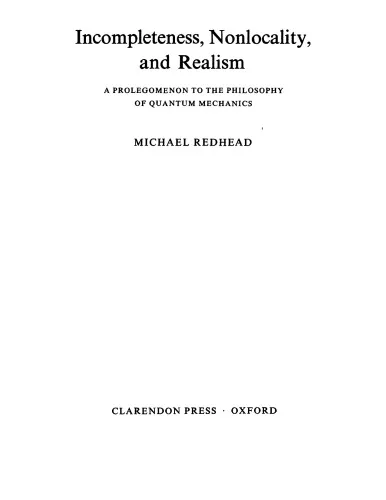
- Published Year: 1987
- Page count: 197
- File Size: 9 MB
- Language: English
- Published by: Oxford
- Visited by: 103
- Rating/Review: 4.6
- ISBN: ISBN information not found.
Keywords:
Incompleteness, Nonlocality, Realism - Prolegomenon to the Phil. of Quantum Mech.
4.6
Reviews from our users

You Can Ask your questions from this book's AI after Login
Each download or ask from book AI costs 2 points. To earn more free points, please visit the Points Guide Page and complete some valuable actions.


![The Ultimate iOS Interview Playbook: Conquer Swift, frameworks, design patterns, and app architecture [Team-IRA]](https://s3.refhub.ir/images/thumb/The_Ultimate_iOS_Interview_Playbook__Conquer__29925.webp)





Introduction
"Incompleteness, Nonlocality, Realism - Prolegomenon to the Philosophy of Quantum Mechanics" is a seminal work that bridges the intricate worlds of physics and philosophy. This book delves deep into the philosophical underpinnings of quantum mechanics, addressing some of the most contentious debates in modern science—questions about reality, locality, and the completeness of quantum theories. Whether you're a physicist, philosopher, or simply someone interested in the mysteries of the universe, this book offers a rigorous, yet accessible roadmap to understanding quantum mechanics' foundational issues.
The book meticulously examines key themes like the incompleteness of quantum descriptions, Einstein's concern with a local realistic universe, and the philosophical implications of nonlocal phenomena such as entanglement. With a scholarly yet lucid style, it challenges readers to rethink the principles that underpin modern physics while engaging them in deep philosophical inquiry.
A Detailed Summary of the Book
"Incompleteness, Nonlocality, Realism" is structured into three central themes that reflect the title of the book.
Incompleteness: The book begins by exploring the incompleteness debate sparked by the famous Einstein-Podolsky-Rosen (EPR) paradox. It carefully examines Einstein's critiques of quantum mechanics and how these critiques challenge the idea that the theory provides a complete description of physical reality. By contrasting their position with Bohr's Copenhagen Interpretation, the text reveals why the quest for completeness has shaped the philosophical discourse on quantum mechanics.
Nonlocality: Moving beyond the EPR argument, the book delves into John Bell's theorem, a cornerstone of modern physics. It explains how Bell's inequality proves that any hidden-variable theory attempting to restore realism must also embrace nonlocality. This section not only unpacks the profound implications of Bell's theory but also situates it in the context of experimental results such as Aspect's experiments, which confirm the "spooky action at a distance" Einstein so famously doubted.
Realism: The final theme of the book grapples with philosophical realism in the age of quantum mechanics. What does it mean to say that something is "real" in a quantum world? Here, the reader is introduced to a spectrum of interpretations beyond Copenhagen, from Bohmian mechanics to many-worlds. This discussion reveals the philosophical diversity surrounding quantum mechanics and the ongoing struggle to reconcile scientific realism with the probabilistic nature of quantum theory.
The book concludes by emphasizing the interconnectedness of these themes and calling for a deeper synthesis of physics and philosophy to resolve the core puzzles of quantum mechanics.
Key Takeaways
- Quantum mechanics, though empirically successful, raises profound philosophical questions about the nature of reality.
- The debate over the completeness of quantum theory highlights the tension between determinism and probabilistic interpretations of the universe.
- Nonlocal phenomena, such as quantum entanglement, challenge our classical intuitions about space and causality.
- Philosophical realism remains a key issue, with interpretations of quantum mechanics varying widely between realist and anti-realist viewpoints.
- Bell's theorem provides a framework for understanding the limits of local hidden-variable theories and the inevitability of nonlocal influences.
Famous Quotes from the Book
"Quantum mechanics is not merely a set of mathematical tools; it is a profound statement about the nature of reality as we perceive and measure it."
"In the face of nonlocal phenomena, we are compelled to abandon the comforting notion of separability that underpins classical physics."
"The search for completeness is not just a scientific endeavor but a philosophical journey into understanding what it means for a theory to describe the world."
Why This Book Matters
Quantum mechanics is not just a field of study; it is a cornerstone of our scientific understanding of the universe. However, the questions it raises go beyond the scope of mathematics and physics—they touch upon the fundamental nature of reality itself. "Incompleteness, Nonlocality, Realism" matters because it provides a philosophical framework for grappling with these questions.
By combining detailed analysis with critical reflection, this book serves as a bridge between scientists and philosophers, offering insights that are essential for anyone interested in the larger implications of quantum theory. It challenges prevailing assumptions, inspires debate, and reminds us that the true exploration of science requires a willingness to confront the unknown. In a world increasingly guided by quantum technologies, understanding the philosophical basis of quantum mechanics has never been more urgent.
Free Direct Download
You Can Download this book after Login
Accessing books through legal platforms and public libraries not only supports the rights of authors and publishers but also contributes to the sustainability of reading culture. Before downloading, please take a moment to consider these options.
Find this book on other platforms:
WorldCat helps you find books in libraries worldwide.
See ratings, reviews, and discussions on Goodreads.
Find and buy rare or used books on AbeBooks.

1103
بازدید4.6
امتیاز0
نظر98%
رضایتReviews:
4.6
Based on 0 users review
Questions & Answers
Ask questions about this book or help others by answering
No questions yet. Be the first to ask!