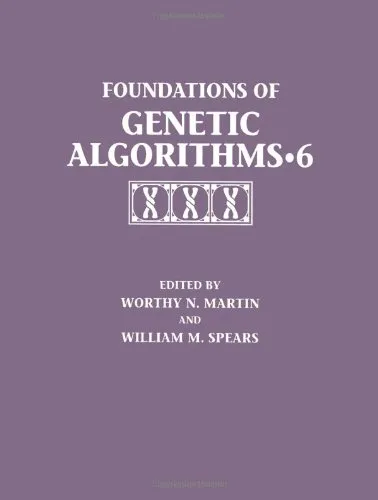
- Published Year: 2001
- Page count: 351
- File Size: 16 MB
- Language: English
- Published by:
- Visited by: 197
- Rating/Review: 4.8
-
ISBN:
155860734X
9781558607347
9780080506876
Keywords:
Foundations of Genetic Algorithms 6 (FOGA-6) (The Morgan Kaufmann Series in Artificial Intelligence)
4.8
Reviews from our users

You Can Ask your questions from this book's AI after Login
Each download or ask from book AI costs 2 points. To earn more free points, please visit the Points Guide Page and complete some valuable actions.

![The Ultimate iOS Interview Playbook: Conquer Swift, frameworks, design patterns, and app architecture [Team-IRA]](https://s3.refhub.ir/images/thumb/The_Ultimate_iOS_Interview_Playbook__Conquer__29925.webp)



Introduction to Foundations of Genetic Algorithms 6 (FOGA-6)
The sixth volume in the highly esteemed series Foundations of Genetic Algorithms (FOGA-6), part of the Morgan Kaufmann Series in Artificial Intelligence, explores the rapidly advancing domain of genetic algorithms (GAs) from foundational theories to cutting-edge applications. Combining the rigor of academic research with practical insights, this volume serves as a platform for a deeper understanding of evolutionary computation and its role in solving complex optimization problems across diverse scientific and industrial sectors.
Through contributions from some of the most prominent scholars in the field, the book investigates core concepts in genetic algorithms and delves into their extensions, such as genetic programming, co-evolution, and multi-objective optimization. The primary aim of this work is to nurture the theoretical and practical synergy that defines the future of evolutionary computation as a crucial tool in artificial intelligence (AI). This detailed introduction lays the foundation for why this book is pivotal to both researchers and practitioners keen on pushing the boundaries of genetic algorithms.
Detailed Summary
FOGA-6 assembles papers that highlight not only the mathematical and theoretical underpinnings of evolutionary computation but also its practical implications in solving global optimization challenges. Topics such as convergence analysis, schema theory, and the dynamics of populations are deeply explored, extending far beyond surface-level understanding. The book also bridges the theoretical gaps by applying these concepts to real-world domains, where genetic algorithms have demonstrated notable success, such as machine learning, logistics, bioinformatics, and robotics.
Throughout this volume, you will find a collection of thought-provoking chapters that dissect the behavior of genetic operators, the intricacies of selection mechanisms, and the trade-offs between exploration and exploitation in evolutionary systems. It also emphasizes a collaborative approach, where researchers are encouraged to integrate ideas across disciplines, blending genetic algorithms with fields like neural networks and fuzzy logic systems.
Each chapter is thoroughly crafted to build on the existing state-of-the-art while paving the way for experimental exploration and bold innovations. Whether you are a theorist developing robust models of evolutionary dynamics or a practitioner trying to tailor genetic algorithms to specific optimization problems, this book is an indispensable resource that delivers valuable insights at every turn.
Key Takeaways
- A comprehensive understanding of the mathematical and theoretical foundations of genetic algorithms.
- Deep dives into the roles of crossover, mutation, and selection in shaping algorithmic behavior and performance.
- Insights into how genetic algorithms can be applied to modern AI paradigms, including large-scale machine learning problems.
- Discussions on hybrid systems that integrate genetic algorithms with other AI techniques like neural networks and swarm intelligence.
- Explorations of open problems and future research directions in evolutionary computation.
Famous Quotes from the Book
"Genetic algorithms are not about mere survival of the fittest; they are about populations of solutions that collaboratively innovate and evolve."
"Optimization through evolution is not random chance; it is the delicate interplay of order and chaos."
Why This Book Matters
Foundations of Genetic Algorithms 6 is not just another book in the series—it is a cornerstone that reshapes how we understand the essence of evolutionary computation. As the field of artificial intelligence continues to influence every facet of modern life, GAs hold the promise of solving some of the most intricate optimization problems that conventional algorithms struggle with. From autonomous systems to healthcare innovations, the principles discussed in FOGA-6 continue to find broad applicability.
Furthermore, the book offers a rare balance between intellectual rigor and accessibility, making it suitable for students, professors, and AI practitioners alike. It is a trusted resource for those who strive to understand the philosophical foundations of GAs while simultaneously exploring how they can be effectively leveraged to build more robust and efficient systems.
Finally, FOGA-6 stands out because of its emphasis on collaboration and multidisciplinary innovation. The evolution of genetic algorithms does not merely belong in the domain of computer science or mathematics—it impacts the way we think about problem-solving as a whole. For anyone with a vision to innovate within AI or optimization, this book is a guiding light.
Free Direct Download
You Can Download this book after Login
Accessing books through legal platforms and public libraries not only supports the rights of authors and publishers but also contributes to the sustainability of reading culture. Before downloading, please take a moment to consider these options.
Find this book on other platforms:
WorldCat helps you find books in libraries worldwide.
See ratings, reviews, and discussions on Goodreads.
Find and buy rare or used books on AbeBooks.

1197
بازدید4.8
امتیاز0
نظر98%
رضایتReviews:
4.8
Based on 0 users review
Questions & Answers
Ask questions about this book or help others by answering
No questions yet. Be the first to ask!