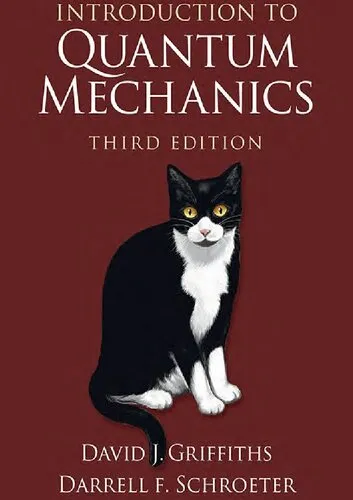
- Published Year: 2018
- Page count: 527
- File Size: 4 MB
- Language: English
- Published by: Cambridge University Press
- Visited by: 191
- Rating/Review: 5.0
-
ISBN:
9781107189638
9781316995433
2018009864
Keywords:
David J. Griffiths, Darrell F. Schroeter - Introduction to Quantum Mechanics - Cambridge University Press (2018)
5.0
Reviews from our users

You Can Ask your questions from this book's AI after Login
Each download or ask from book AI costs 2 points. To earn more free points, please visit the Points Guide Page and complete some valuable actions.
![The Ultimate iOS Interview Playbook: Conquer Swift, frameworks, design patterns, and app architecture [Team-IRA]](https://s3.refhub.ir/images/thumb/The_Ultimate_iOS_Interview_Playbook__Conquer__29925.webp)




Introduction to the Book: "Introduction to Quantum Mechanics (2018)"
"Introduction to Quantum Mechanics" by David J. Griffiths and Darrell F. Schroeter is widely regarded as one of the most authoritative, accessible, and engaging textbooks on quantum mechanics. Designed specifically for upper-division undergraduate students, this book covers the fundamental principles of quantum theory while providing a robust foundation for further exploration of the subject. In this detailed introduction, we’ll discuss what the book offers, its key takeaways, notable quotes, and why it holds such significance in the realm of physics education.
Detailed Summary of the Book
The book spans a comprehensive range of topics fundamental to quantum mechanics. It begins by revisiting the historical context of quantum theory, emphasizing the failures of classical mechanics to explain phenomena such as blackbody radiation and the photoelectric effect. From these seminal problems, the authors introduce the wave-particle duality of matter and photons, paving the way for the development of the formalism of quantum mechanics.
Central to the narrative are the principles of quantum mechanics, including wave functions, probability densities, and the Schrödinger equation. The authors present these concepts in a way that balances rigor with accessibility, enabling readers to grasp even the most abstract ideas effectively. In addition, Griffiths and Schroeter provide a systematic treatment of key applications, such as the hydrogen atom, quantum tunneling, harmonic oscillators, and angular momentum.
The book also ventures into advanced topics, such as perturbation theory, the variational principle, spin, and the fine structure of atomic systems. A notable inclusion in this edition is the introduction of matrix mechanics, allowing students to appreciate the equivalence between wave mechanics and matrix mechanics in quantum theory. Numerous exercises are interspersed throughout the text, offering opportunities for both computational practice and conceptual reflection.
What sets this edition apart is its attention to modern developments and applications of quantum mechanics. The authors integrate discussions on quantum information, entanglement, and Bell’s theorem, which reflect the ever-evolving landscape of quantum science. These topics make the text particularly relevant for students eager to connect theoretical foundations with cutting-edge technology.
Key Takeaways
- An intuitive yet rigorous introduction to quantum mechanics, balancing theory and application.
- Built-in exercises and examples to solidify conceptual understanding and foster problem-solving skills.
- Exposure to both the historical development of quantum mechanics and its modern frontiers, including quantum computing and information theory.
- Emphasis on mathematical formalism, including differential equations, operators, and matrix mechanics.
- Discusses the philosophical implications of quantum mechanics, such as the nature of measurement and wave function collapse.
Famous Quotes from the Book
"Quantum mechanics is not difficult because of its mathematics, but because of its concepts—it defies intuition."
"In quantum mechanics, measurement is not just a passive observation—it plays an active role in determining the outcome."
"The distinction between particles and waves is not resolved in quantum mechanics; instead, the two are unified in a single framework."
Why This Book Matters
Quantum mechanics is arguably one of the most revolutionary scientific theories of the 20th century. Its principles govern the behavior of systems at atomic and subatomic scales, shaping our understanding of the universe and laying the foundation for technologies like semiconductors, lasers, and quantum computers. "Introduction to Quantum Mechanics" by Griffiths and Schroeter provides students with not just the tools, but the insight needed to navigate this challenging yet fascinating subject.
What truly makes this book indispensable is its clear, approachable writing style. The authors distill complex equations and concepts into manageable pieces, without sacrificing the depth and rigor that quantum mechanics demands. It is this balance that has earned the book its reputation as a staple across physics departments worldwide.
The inclusion of modern topics, such as quantum entanglement and computing, ensures that students remain connected to the cutting-edge applications of quantum mechanics. Furthermore, the philosophical discussions sprinkled throughout the text encourage readers to reflect on the deeper implications of quantum theory—not just as a scientific tool, but as a way of thinking about reality itself.
For students, educators, and even enthusiasts with a solid grounding in mathematics and basic physics, "Introduction to Quantum Mechanics" serves as both a gateway and a guide to one of physics' most profound realms of study.
Free Direct Download
You Can Download this book after Login
Accessing books through legal platforms and public libraries not only supports the rights of authors and publishers but also contributes to the sustainability of reading culture. Before downloading, please take a moment to consider these options.
Find this book on other platforms:
WorldCat helps you find books in libraries worldwide.
See ratings, reviews, and discussions on Goodreads.
Find and buy rare or used books on AbeBooks.

Questions about Book


1191
بازدید5.0
امتیاز1
نظر98%
رضایتReviews:
5.0
Based on 1 users review

francesco83
Dec. 22, 2025, 10:20 a.m.
FReat book for learning Quantum mechanics. I used it in my bachelor in physics and it did wonders in building my intuition through inspired examples and exercises
Questions & Answers
Ask questions about this book or help others by answering
No questions yet. Be the first to ask!