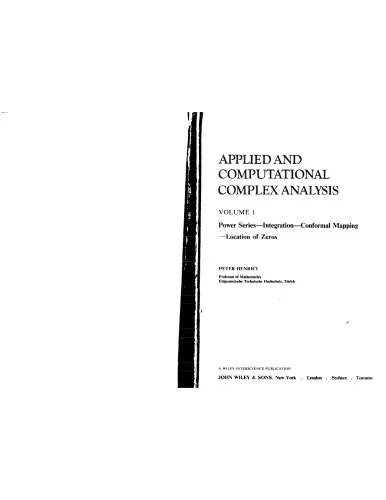
- Published Year: 1974
- Page count: 350
- File Size: 25 MB
- Language: English
- Published by: John Wiley & Sons
- Visited by: 192
- Rating/Review: 4.4
-
ISBN:
0-471-37244-7
9780471372448
Keywords:
Applied and Computational Complex Analysis: Power Series, Integration, Conformal Mapping, Location of Zeros
4.4
Reviews from our users

You Can Ask your questions from this book's AI after Login
Each download or ask from book AI costs 2 points. To earn more free points, please visit the Points Guide Page and complete some valuable actions.


![The Ultimate iOS Interview Playbook: Conquer Swift, frameworks, design patterns, and app architecture [Team-IRA]](https://s3.refhub.ir/images/thumb/The_Ultimate_iOS_Interview_Playbook__Conquer__29925.webp)





Introduction to "Applied and Computational Complex Analysis: Power Series, Integration, Conformal Mapping, Location of Zeros"
Written by Peter Henrici, "Applied and Computational Complex Analysis" is a comprehensive and accessible resource for students, educators, and professionals in applied mathematics, physics, and engineering. This book delves deeply into the theory and practical applications of complex analysis, bridging the gap between theoretical insights and computational efficiency. Focusing on topics such as power series, integration techniques, conformal mapping, and the location of zeros, it provides readers with tools to deal effectively with complex-valued functions in various scenarios.
This book is an essential guide for anyone seeking to understand the interface between computational algorithms and the intrinsic beauty of complex analysis. With meticulous explanations, concrete examples, and a clear writing style, Henrici offers insights to help readers apply complex analysis techniques in scientific computing, optimization problems, and modeling physical systems. Designed with students and applied mathematicians in mind, the book balances theoretical rigor with computational practicality.
Detailed Summary of the Book
The book covers a broad spectrum of essential topics in complex analysis, divided into easily digestible sections. It begins with an introduction to the fundamentals of power series, including convergence criteria and analytic continuation, before advancing to the theory of integration in the complex plane. Here, contour integration techniques, such as Cauchy's integral formula and residue calculus, are explored in great depth. These foundational topics are critical for understanding the mechanics of evaluating integrals and the singular behavior of functions.
One of the standout sections of the book is the discussion on conformal mappings. Henrici presents a robust treatment of this subject, emphasizing its practical importance in engineering and physics for solving boundary value problems. Using step-by-step examples, the text provides clarity on finding and applying conformal transformations to solve difficult geometric and differential problems.
Finally, the book delves into the intricate process of determining the location of zeros for complex functions. This section equips readers with computational strategies and theorems, such as Rouche's theorem, to identify zeros effectively. The emphasis on numerical methods underscores the book’s focus on computational approaches, making it a vital resource for practitioners developing algorithms to solve real-world problems involving complex analysis.
Key Takeaways
- Clear and rigorous exposition of fundamental topics in complex analysis, including power series, integration theorems, and analytic continuation.
- Emphasis on computational approaches to complex analysis, providing practical tools for scientists and engineers.
- A detailed exploration of conformal mapping techniques, focusing on their versatility and applications in solving boundary problems.
- Comprehensive discussion on locating the zeros of functions and the numerical methods used to approximate them.
- Practical examples and exercises that reinforce theoretical understanding and encourage hands-on problem-solving.
Famous Quotes from the Book
"Complex analysis, although abstract in its foundations, is a profoundly practical tool in science and engineering, offering unparalleled clarity in the visualization of physical systems."
"The real beauty of mathematics lies not just in abstract thought, but in the elegance of applying these ideas to solve concrete, real-world problems."
Why This Book Matters
Complex analysis has long been regarded as one of the cornerstones of applied mathematics. The subject's importance cannot be overstated in fields like fluid dynamics, electrostatics, image processing, aerodynamics, and more. What sets this book apart is its unique balance of theoretical clarity and computational applicability. Many texts on complex analysis focus on pure mathematics, providing little insight into numerical techniques and computational approaches. Peter Henrici's book fills this gap, offering a much-needed resource for individuals looking to apply complex analysis to solve real-life problems.
Whether you are a student encountering complex analysis for the first time, a researcher designing algorithms, or an engineer modeling physical systems, this book provides the tools and perspectives necessary to understand and apply this elegant branch of mathematics. Its focus on concrete examples, computational techniques, and optimization of algorithms for complex problems makes it indispensable in today’s data-driven world.
Free Direct Download
You Can Download this book after Login
Accessing books through legal platforms and public libraries not only supports the rights of authors and publishers but also contributes to the sustainability of reading culture. Before downloading, please take a moment to consider these options.
Find this book on other platforms:
WorldCat helps you find books in libraries worldwide.
See ratings, reviews, and discussions on Goodreads.
Find and buy rare or used books on AbeBooks.

1192
بازدید4.4
امتیاز0
نظر98%
رضایتReviews:
4.4
Based on 0 users review
Questions & Answers
Ask questions about this book or help others by answering
No questions yet. Be the first to ask!