

Book guide and evaluation
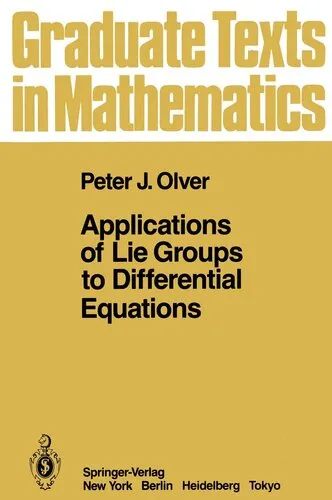
Applications of Lie Groups to Differential Equations (Graduate Texts in Mathematics)
Peter J. Olver
English
Beginner
Mathematics
4.3 / 5
0 reviews
-
Published
524
pages
153
views
Introduction to "Applications of Lie Groups to Differential Equations" "Applications of Lie Groups to Differential Equations" is an advanced and essential graduate-level text authored by Peter J. Olver. This book builds a deep, comprehensive connection between Lie group th
Before you read
What will you get from this book?
Introduction to "Applications of Lie Groups to Differential Equations"
"Applications of Lie Groups to Differential Equations" is an advanced and essential graduate-level text authored by Peter J. Olver. This book builds a deep, comprehensive connection between Lie group theory and the study of differential equations, offering rigorous insights and practical methodologies for both mathematicians and applied scientists. Written in the renowned Graduate Texts in Mathematics series, the book has become an indispensable resource for readers seeking to explore the profound interplay between symmetry, geometry, and differential equations.
Lie group theory, originally developed to unify disparate aspects of mathematics and physics, has become an essential tool in solving differential equations, both ordinary and partial. Through systematic exposition, detailed examples, and an engaging narrative, this book equips readers with both theoretical foundations and computational techniques.
Detailed Summary of the Book
The book starts with a comprehensive introduction to the fundamental ideas of Lie groups and their associated Lie algebras. Following this, the text focuses on their applications to ordinary differential equations (ODEs). The idea of symmetry plays a central role, as the author illustrates how infinitesimal transformations can simplify the study of differential equations by either reducing their order or providing exact solutions. Key notions like group-invariant solutions, reduction methods, and symmetry classification are explained in a meticulous yet accessible manner.
Moving to partial differential equations (PDEs), the book delves into techniques such as group-invariant solutions, similarity transformations, and how Lie group methods serve as a systematic tool to understand and solve various classes of PDEs. It explores additional advanced topics such as conservation laws, Noether's theorem, equivalence problems, and even touches upon topics in modern geometry and computational applications.
The second edition expands upon the strengths of the first by including new material, enhanced exercises, and a thorough update of modern developments in the application of Lie groups. Rich with examples from geometry, physics, and engineering, the book bridges abstract mathematical ideas with real-world applications. Its hands-on techniques and problem-driven approach make it a valuable resource for both theoretical researchers and applied practitioners.
Key Takeaways
- Master the use of Lie groups and Lie algebras in analyzing and solving both ordinary and partial differential equations.
- Learn reduction techniques and concepts like symmetry groups, which simplify complex differential equations.
- Understand the application of conservation laws, Noether's theorem, and similar invariance principles to physics and engineering problems.
- Explore both classical examples and cutting-edge developments in areas ranging from geometry to fluid dynamics.
- Develop a computational perspective on Lie group methods to integrate mathematical theory and practical implementation.
Famous Quotes from the Book
"Symmetry lies at the heart of science and mathematics. The study of differential equations through the lens of symmetry provides a profound and elegant approach to solving some of the most intricate problems."
"A successful application of Lie groups to a differential equation transforms a seemingly intractable mathematical problem into one whose structure is made transparent through symmetry."
"The methods described in this book are not just tools for computation but keys to understanding the underlying nature of the physical and geometric laws governing our world."
Why This Book Matters
"Applications of Lie Groups to Differential Equations" stands out as a masterpiece in mathematical literature for several reasons. First, it provides an authoritative and systematic foundation in using Lie groups to solve differential equations. The book is both rigorously mathematical and highly applicable, bridging the gap between pure and applied sciences. For researchers and students in fields like mathematics, physics, engineering, and computational modeling, this book serves as an essential reference.
Moreover, the text's emphasis on examples, computational techniques, and real-world applications ensures its relevance across a range of scientific disciplines. The infusion of geometric and algebraic insights enriches the study of differential equations, granting readers a more profound understanding of underlying structures. In an age where interdisciplinary approaches are increasingly valued, Olver's work equips its audience with tools and perspectives that transcend traditional boundaries.
This book is not just a textbook—it is a gateway to appreciating the elegance and power of mathematical symmetry in solving complex differential equations. Whether you are a graduate student, a researcher, or a professional, “Applications of Lie Groups to Differential Equations” offers not only practical techniques but also intellectual inspiration.
Ask this book
Your question is answered in the context of this title and author. Each answer uses 2 points.
Sign in to ask the book assistant.
Reader reviews
0 reviews, 4.3 average out of 5
No reviews yet
If you have read this book, help the next reader with your experience.
Write a review
Sign in to publish a review.
Reader questions and answers
Ask a focused question and learn from the community.
Sign in to ask or answer a question.
No questions yet
Be the first to ask a clear, useful question.
What to read next
Related references that continue this learning path.


Modern Computer Vision with PyTorch: A Practical Roadmap From Deep Learning Fundamentals to Advanced Applications and Generative AI, 2nd Edition
V Kishore Ayyadevara,Yeshwanth Reddy
2023
View book