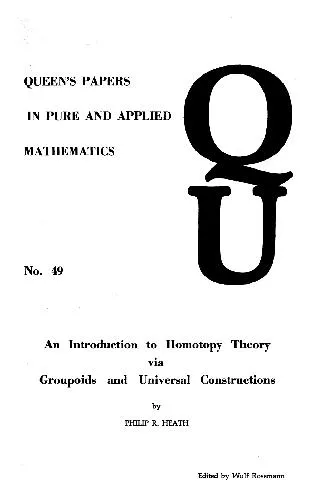
- Published Year: 1978
- Page count: 131
- File Size: 6 MB
- Language: English
- Published by:
- Visited by: 166
- Rating/Review: 4.9
- ISBN: ISBN information not found.
Keywords:
An introduction to homotopy theory via groupoids and universal constructions
4.9
Reviews from our users

You Can Ask your questions from this book's AI after Login
Each download or ask from book AI costs 2 points. To earn more free points, please visit the Points Guide Page and complete some valuable actions.


![The Ultimate iOS Interview Playbook: Conquer Swift, frameworks, design patterns, and app architecture [Team-IRA]](https://s3.refhub.ir/images/thumb/The_Ultimate_iOS_Interview_Playbook__Conquer__29925.webp)






Introduction
Welcome to 'An Introduction to Homotopy Theory via Groupoids and Universal Constructions', a comprehensive exploration into the fascinating world of homotopy theory. This book delves into abstract mathematical concepts with the aim of making them accessible and engaging to both novice and seasoned mathematicians alike.
Detailed Summary of the Book
In this book, we embark on an intellectual journey through homotopy theory using groupoids and universal constructions as our guiding principles. Homotopy theory, a fundamental part of algebraic topology, provides profound insights into the structures of spaces and maps between them.
This text rigorously introduces the core concepts of homotopy theory, explaining how they relate to groupoids—an efficient and versatile generalization of groups. Through a blend of theoretical exposition and practical examples, the book illustrates how groupoids provide a more flexible framework for describing homotopy types.
The narrative of the book is built upon the cornerstone of universal constructions. These constructions are pivotal in mathematics as they encapsulate the idea of 'best solutions' to a given problem. This book meticulously explains universal properties and how they naturally arise in homotopy theory, enhancing the reader's understanding of the interplay between algebra and topology.
Key Takeaways
- An in-depth understanding of homotopy theory through the lens of groupoids.
- Insight into universal constructions and their applications in algebraic topology.
- Enhanced comprehension of the relationship between algebraic structures and topological spaces.
- Practical examples and illustrations to solidify theoretical concepts.
Famous Quotes from the Book
"Homotopy reveals the hidden symmetries of geometry, much like a melody emerges from the notes of a symphony."
"In the tapestry of mathematics, universal constructions are the threads that weave disparate fields into a harmonious whole."
Why This Book Matters
'An Introduction to Homotopy Theory via Groupoids and Universal Constructions' stands out in the landscape of mathematical literature due to its unique approach of marrying groupoid theory with universal constructions. This book is not just about learning mathematical concepts but about understanding the fundamental ways these concepts are interconnected and applied in problem-solving.
The significance of the book extends beyond its academic value; it fosters a deeper appreciation for the elegance of mathematical thought processes, encouraging readers to see beyond memorization and formulae. It equips learners with a broader perspective, essential for tackling complex challenges in both pure and applied mathematics.
For educators, students, and professionals alike, this text serves as both a resource and an inspiration, igniting curiosity and enhancing analytical skills. Whether you are delving into homotopy theory for the first time or seeking to enrich your existing knowledge, this book presents viewpoints that inspire a lifelong exploration into the beautiful world of mathematics.
Free Direct Download
You Can Download this book after Login
Accessing books through legal platforms and public libraries not only supports the rights of authors and publishers but also contributes to the sustainability of reading culture. Before downloading, please take a moment to consider these options.
Find this book on other platforms:
WorldCat helps you find books in libraries worldwide.
See ratings, reviews, and discussions on Goodreads.
Find and buy rare or used books on AbeBooks.

1166
بازدید4.9
امتیاز0
نظر98%
رضایتReviews:
4.9
Based on 0 users review
Questions & Answers
Ask questions about this book or help others by answering
No questions yet. Be the first to ask!