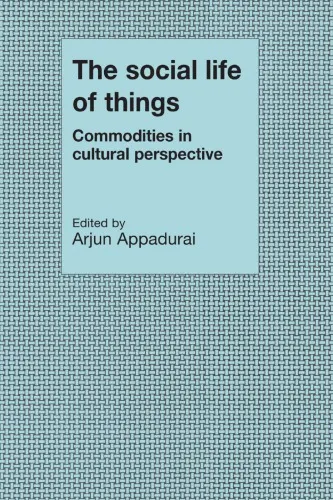
- Published Year: 1988
- Page count: 344
- File Size: 20 MB
- Language: English
- Published by: Cambridge University Press
- Visited by: 506
- Rating/Review: 4.5
-
ISBN:
0521357268
9780521357265
Keywords:
The Social Life of Things: Commodities in Cultural Perspective
4.5
Reviews from our users

You Can Ask your questions from this book's AI after Login
Each download or ask from book AI costs 2 points. To earn more free points, please visit the Points Guide Page and complete some valuable actions.










Analytical Summary
Published under the editorship of Arjun Appadurai, The Social Life of Things: Commodities in Cultural Perspective is considered a landmark in anthropological and cultural studies scholarship. This volume brings together a diverse range of essays by leading thinkers who collectively explore how commodities are not merely economic objects, but also carriers of cultural value, identity, and meaning.
At its core, the book reframes the understanding of commodities from static items of trade to dynamic entities embedded in social life. Contributors investigate the trajectories of objects—how they move through systems of exchange, how value is assigned, and how meaning transforms across contexts. These analyses bridge anthropology, sociology, history, and cultural economics, providing a multifaceted view of material culture.
Beyond a purely economic lens, the essays emphasize the symbolic and relational aspects of commodities. The collection challenges traditional market-centric perspectives by situating goods within ritual, heritage, colonialism, globalization, and everyday life. Through comparative case studies—spanning various times and geographies—the volume critiques simplified notions of value, exchange, and consumption.
Key Takeaways
For academics, professionals, and serious readers, this book offers several enduring insights that extend beyond anthropological theory into practical considerations for cultural analysis, economic history, and contemporary global trade studies.
First, commodities cannot be understood in isolation from their social and cultural contexts. Economic exchange is always intertwined with symbolic exchange, shaping identities and communities.
Second, the life cycle of a commodity—from production to consumption—includes stages where its meaning evolves, sometimes dramatically, depending on who possesses it and under what circumstances.
Third, the book illustrates how global flows of goods are deeply influenced by local traditions, political economies, and historical narratives.
Fourth, interdisciplinary approaches are crucial: understanding commodities invites collaboration between anthropologists, historians, economists, and cultural theorists.
Finally, the work demonstrates that value is not an inherent property of objects but is socially constructed, negotiated, and contested over time.
Memorable Quotes
Commodities, like persons, have social lives.Unknown
Economic value is never purely economic—it is always also cultural.Unknown
Objects are not inert; they actively participate in the social fabric.Unknown
Why This Book Matters
This book is widely recognized as a foundational text for anyone exploring the intersection of economy and culture. It stands out for its insistence that commodities must be analyzed through their social contexts, and for its integration of diverse disciplinary voices.
The Social Life of Things: Commodities in Cultural Perspective has influenced generations of scholars in anthropology and beyond. While Information unavailable regarding formal awards due to no reliable public source, its theoretical framework continues to shape research agendas in both academic and applied settings.
In an age of globalization, transnational flows of goods and ideas are accelerating. This makes the book's insights into cultural economics and commodity exchange anthropology especially timely. By foregrounding the narratives embedded within objects, it pushes readers to rethink simplistic divisions between the economic and the cultural.
Inspiring Conclusion
Whether you are an academic researcher, a professional in cultural policy, or a curious reader, The Social Life of Things: Commodities in Cultural Perspective offers a paradigm-shifting way to see the world of goods. It invites you to recognize that every object has a biography, shaped by human interactions, cultural meanings, and historical circumstances.
Approaching commodities as actors within social life challenges conventional economic narratives and opens the door to richer, more inclusive analysis. The book's thematic depth and interdisciplinary appeal make it an essential addition to any serious library on material culture or cultural economics.
Now is the perfect opportunity to read, share, and discuss the insights found within its pages. By engaging with its ideas, you contribute to a continuous, collective conversation about the ways in which the material world reflects and shapes our shared humanity.
Free Direct Download
You Can Download this book after Login
Accessing books through legal platforms and public libraries not only supports the rights of authors and publishers but also contributes to the sustainability of reading culture. Before downloading, please take a moment to consider these options.
Find this book on other platforms:
WorldCat helps you find books in libraries worldwide.
See ratings, reviews, and discussions on Goodreads.
Find and buy rare or used books on AbeBooks.

1506
بازدید4.5
امتیاز0
نظر98%
رضایتReviews:
4.5
Based on 0 users review
Questions & Answers
Ask questions about this book or help others by answering
No questions yet. Be the first to ask!