
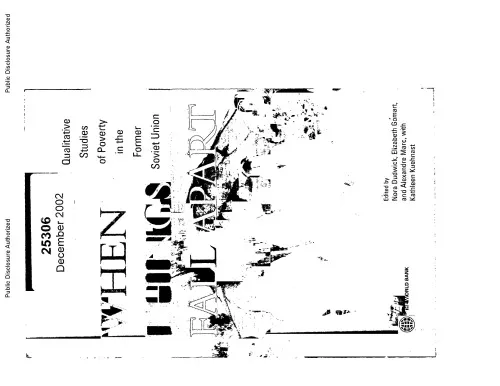
When things fall apart: Qualitative Studies of Poverty in the Former Soviet Union
Dudwick Nora,Comart Elisabeth,Marc Alexandre
2003
View book

Book guide and evaluation
Paul Davidson (auth.), Louise Davidson (eds.)
0 reviews
Published
pages
views
Inflation, Open Economies and Resources: The Collected Writings of Paul Davidson, Volume 2 macroeconomic policy in open economies, resource allocation and inflation dynamics Explore Inflation, Open Economies and Resources: The Collected Writings of Paul Davidson, Volume 2 for
Before you read
This authoritative volume, Inflation, Open Economies and Resources: The Collected Writings of Paul Davidson, Volume 2, brings together a selection of Paul Davidson’s most influential contributions to the understanding of macroeconomic policy, monetary theory, and the complexities of open economies. It serves not only as a testament to Davidson’s intellectual legacy but also as a critical resource for academics, policymakers, and serious students of economics seeking to grapple with the challenges of inflation and resource management in a globally interconnected world.
Davidson, a prominent voice in Post Keynesian economics, presents a nuanced examination of how inflationary pressures interact with international trade, capital flows, and domestic resource allocation. His essays go beyond conventional models to address real-world economic volatility, institutional structures, and long-term developmental strategies. This volume’s core themes are framed within the broader debates on economic theory, policy interventions, and the sustainability of growth in open economy contexts.
The book offers a meticulous blend of theoretical exposition and empirical observations, reflecting Davidson’s unwavering commitment to bridging the gap between abstract models and the lived realities that economic actors face. Readers are invited to explore the multi-dimensional relationship between money, markets, and resources, an approach that remains vital for interpreting contemporary economic phenomena.
At its heart, this collection distills decades of scholarship into pragmatic insights relevant for today’s interconnected financial systems and resource-constrained economies.
It emphasizes the importance of understanding inflation not just as a domestic issue but as an inherently global dynamic shaped by trade relations and capital mobility.
The work underscores the necessity of policy frameworks that balance price stability with sustainable resource allocation, highlighting tensions between short-term economic gains and long-term environmental stewardship.
A recurring theme is the inadequacy of purely neoclassical models in explaining the persistence of inflation in open economies, thereby advocating for alternative approaches rooted in Post Keynesian thought.
Davidson’s writings encourage interdisciplinary dialogue, integrating economic analysis with political science, history, and social considerations.
“Economic theory must always be tested against the institutional realities and imperfect markets of the real world.”Unknown
“In open economies, inflation is rarely a matter of isolated domestic policy—it is the product of intricate, global interactions.”Unknown
“Resource allocation decisions carry lasting consequences, demanding foresight beyond immediate fiscal horizons.”Unknown
For scholars, policymakers, and engaged readers, this volume is an indispensable guide to comprehending the intricacies of inflation, open economy interactions, and sustainable resource use.
It offers a rare synthesis of theoretical rigor and policy relevance, ensuring its applicability across academic research, governmental decision-making, and international organizational work. The essays challenge prevailing orthodoxies and encourage the adoption of pragmatic, context-sensitive solutions.
By advancing alternative paradigms and critiquing existing models, Davidson’s contributions remain highly relevant in a time when global economies face unprecedented structural shifts and environmental constraints.
Information unavailable on any awards or honors received for the book, as no reliable public source currently confirms such details.
In revisiting Inflation, Open Economies and Resources: The Collected Writings of Paul Davidson, Volume 2, readers not only encounter pivotal economic theories but also gain a roadmap for navigating the challenges of our era.
Through the lens of Post Keynesian analysis, Davidson equips readers with the intellectual tools needed to address both inflation and the intricacies of open economy dynamics. His insights on resource management underscore the urgency of coupling economic growth with sustainability principles, a message that resonates in today’s policy debates.
Those who value thought-provoking economic discourse will find this collection both challenging and rewarding. Engage with its content, share its ideas with peers, or incorporate its perspectives into your professional dialogues—each step helps extend the conversation that Davidson began and that continues to influence economic thinking worldwide.
Your question is answered in the context of this title and author. Each answer uses 2 points.
0 reviews, 5.0 average out of 5
Sign in to publish a review.
Ask a focused question and learn from the community.
Related references that continue this learning path.
Dudwick Nora,Comart Elisabeth,Marc Alexandre
Ingeborg Schwenzer;Christiana Fountoulakis;Mariel Dimsey
Djakhongir Saidov