

Book guide and evaluation
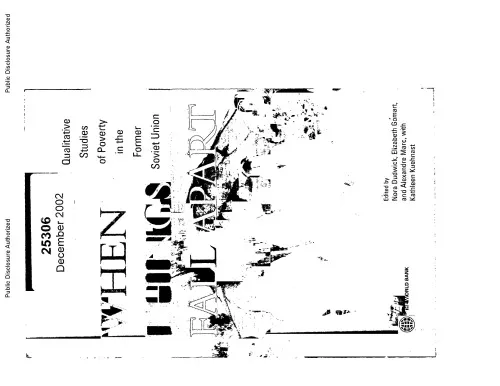
When things fall apart: Qualitative Studies of Poverty in the Former Soviet Union
Dudwick Nora,Comart Elisabeth,Marc Alexandre
English
Intermediate
novel
4.5 / 5
0 reviews
2003
Published
466
pages
792
views
Introduction to "When Things Fall Apart: Qualitative Studies of Poverty in the Former Soviet Union" Detailed Summary of the Book "When Things Fall Apart: Qualitative Studies of Poverty in the Former Soviet Union" offers a comprehensive, poignant examination
Before you read
What will you get from this book?
Introduction to "When Things Fall Apart: Qualitative Studies of Poverty in the Former Soviet Union"
Detailed Summary of the Book
"When Things Fall Apart: Qualitative Studies of Poverty in the Former Soviet Union" offers a comprehensive, poignant examination into the profound socio-economic transformations that shook the post-Soviet landscape. This book delves into the narratives of individuals across the former Soviet Union, revealing the complexities and the depth of poverty experienced by many in this tumultuous period. Through qualitative research, the authors unravel the human aspect of economic collapse, examining how individuals and families adapted—or failed to adapt—to the challenges of post-Soviet realities.
The study collects voices from various regions, each grappling with its unique post-Soviet identity. From rural areas that faced agricultural stagnation to urban centers struggling with industrial collapse, these narratives provide a mosaic of experiences shaped by historical, cultural, and social factors. The authors focus on capturing the resilience, aspirations, and daily struggles of those they interacted with, offering insights grounded in personal experiences rather than purely statistical analyses.
Key Takeaways
- Understanding Poverty: The book highlights how poverty in the former Soviet Union cannot be understood through economic metrics alone; it requires a deep dive into personal stories and social dynamics.
- Transition Challenges: The sudden shift from a centrally planned economy to market economies was chaotic, leading to widespread poverty and social disruption.
- Resilience and Adaptation: Amidst adversity, many individuals and communities demonstrated remarkable resilience and adapted in creative ways to survive and even thrive.
- The Role of Government: The narratives reveal mixed perspectives on the roles of governments and institutions during the transition, often seen as both enablers and inhibitors of progress.
Famous Quotes from the Book
"In the silence of economic downturn, the voices of the impoverished resonate loudly, narrating the untold stories of survival and dignity."
"Poverty is more than a lack of resources; it's the absence of opportunity and choice, amplified by systemic change."
Why This Book Matters
The significance of "When Things Fall Apart" lies in its ability to humanize the statistical data often associated with the fall of the Soviet Union. By prioritizing personal experiences over numbers, the book offers scholars, policymakers, and the general public a nuanced understanding of poverty and transition in the region. It underscores the importance of qualitative research in policy-making, advocating for solutions grounded in the lived realities of affected populations. This book is an essential read for anyone interested in socio-economic transformations, international development, and the profound impacts of historical change on everyday lives.
Ask this book
Your question is answered in the context of this title and author. Each answer uses 2 points.
Sign in to ask the book assistant.
Reader reviews
0 reviews, 4.5 average out of 5
No reviews yet
If you have read this book, help the next reader with your experience.
Write a review
Sign in to publish a review.
Reader questions and answers
Ask a focused question and learn from the community.
Sign in to ask or answer a question.
No questions yet
Be the first to ask a clear, useful question.
What to read next
Related references that continue this learning path.
The political economy of Stalinism: evidence from the Soviet secret archives
Paul R. Gregory
2004
View book
International Sales Law: A Guide to the CISG
Ingeborg Schwenzer;Christiana Fountoulakis;Mariel Dimsey
2019
View book

The Law of Damages in International Sales: The CISG and Other International Instruments
Djakhongir Saidov
2021
View book