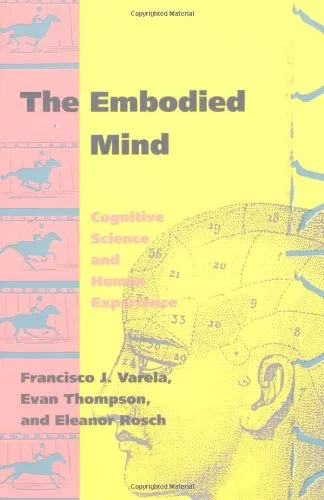
- Published Year: 1993
- Page count: 309
- File Size: 14 MB
- Language: English
- Published by: MIT Press
- Visited by: 322
- Rating/Review: 4.7
-
ISBN:
9780262720212
9780585020372
0262720213
The Embodied Mind: Cognitive Science and Human Experience
4.7
Reviews from our users

You Can Ask your questions from this book's AI after Login
Each download or ask from book AI costs 2 points. To earn more free points, please visit the Points Guide Page and complete some valuable actions.





Analytical Summary
The Embodied Mind: Cognitive Science and Human Experience stands as a seminal work in the interdisciplinary dialogue between modern cognitive science and rich traditions of human self-understanding. Published in 1991 (Information unavailable for later editions without reliable public source), it was authored by Francisco J. Varela, Evan T. Thompson, and Eleanor Rosch, three scholars whose expertise spans neuroscience, philosophy, and psychology.
This authoritative text offers a profound look at how mind and body are intrinsically intertwined, dismantling the outdated notion of cognition as a disembodied, computational process. Instead, the authors draw from the concept of embodied cognition—a framework where perception, action, and environmental context form a unified system of knowing.
The book engages deeply with phenomenology, especially the philosophy of Husserl, Merleau-Ponty, and Buddhist traditions of mindfulness. Through this synthesis, readers learn that cognitive science benefits from integrating first-person lived experience with third-person empirical methods. This approach challenges reductionist models and opens a more holistic path to understanding consciousness.
Notably, The Embodied Mind also examines the cultural and ethical implications of how we define and study the mind. Rather than treating consciousness as an object to be decoded by purely technical means, the authors advocate for science to embrace contemplative insights, recognizing subjective awareness as a source of knowledge.
Key Takeaways
In distilling the essence of this work, several central takeaways emerge that resonate for academics, professionals, and serious readers.
First, cognition is not merely “in the head”—it is a continuous interaction between brain, body, and world. This principle of embodied cognition redefines what counts as valid knowledge.
Second, phenomenology introduces a disciplined way of examining lived experience, providing nuance to the empirical data of cognitive science.
Third, contemplative practices such as mindfulness provide tangible, experiential insights that can inform and transform scientific inquiry.
Fourth, interdisciplinary frameworks foster richer, more accurate models of mind and consciousness.
Lastly, the book invites a reconsideration of the ethical dimensions of scientific research, emphasizing that knowledge is inseparable from the human values and contexts in which it is embedded.
Memorable Quotes
“Cognition is not the representation of a pre-given world by a mind; it is rather the enactment of a world and a mind on the basis of a history of interactions.” Unknown
“Phenomenology and cognitive science can meet in mutual illumination, each expanding the horizons of the other.” Unknown
“The study of the mind must recognize lived experience as a legitimate and necessary source of knowledge.” Unknown
Why This Book Matters
The Embodied Mind: Cognitive Science and Human Experience matters because it reshapes how we conceive of the mind, knowledge, and science itself.
Its integration of embodied cognition and phenomenology has paved the way for new research in neuroscience, artificial intelligence, psychology, and philosophy. Professionals in these fields gain a framework that honors both empirical rigor and introspective depth.
In a world increasingly dominated by data-driven models, this book serves as a counterbalance, reminding readers that meaning, context, and lived reality are vital to any complete understanding of human experience.
Inspiring Conclusion
In revisiting The Embodied Mind: Cognitive Science and Human Experience, readers are not simply engaging with a book—they are entering an ongoing dialogue about what it means to know and to be.
The synergy between embodied cognition, phenomenology, and contemplative insight presented here challenges conventional thinking while offering a compelling path forward for cognitive science. Whether you are an academic scholar, a professional in psychology or neuroscience, or a dedicated independent thinker, the work invites you to read, share, and discuss its transformative ideas.
Your next step is clear: immerse yourself in the text, connect its insights with your own experience, and contribute to the evolving conversation about mind, body, and world.
Free Direct Download
You Can Download this book after Login
Accessing books through legal platforms and public libraries not only supports the rights of authors and publishers but also contributes to the sustainability of reading culture. Before downloading, please take a moment to consider these options.
Find this book on other platforms:
WorldCat helps you find books in libraries worldwide.
See ratings, reviews, and discussions on Goodreads.
Find and buy rare or used books on AbeBooks.

1322
بازدید4.7
امتیاز0
نظر98%
رضایتReviews:
4.7
Based on 0 users review
Questions & Answers
Ask questions about this book or help others by answering
No questions yet. Be the first to ask!