- Published Year: 2007
- Page count: 300
- File Size: 1 MB
- Language: English
- Published by:
- Visited by: 484
- Rating/Review: 4.3
-
ISBN:
1403976058
9781403976055
Keywords:
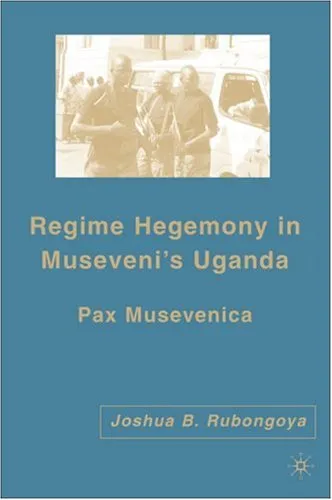
Regime Hegemony in Museveni's Uganda: Pax Musevenica
4.3
Reviews from our users

You Can Ask your questions from this book's AI after Login
Each download or ask from book AI costs 2 points. To earn more free points, please visit the Points Guide Page and complete some valuable actions.












Analytical Summary
In Regime Hegemony in Museveni's Uganda: Pax Musevenica, Joshua B. Rubongoya offers an incisive, scholarly exploration of how the Ugandan political landscape has been profoundly shaped by the leadership of Yoweri Museveni. The book scrutinizes the intricate interplay between political control, governance structures, and socio-economic policies under the framework of what the author calls the “Pax Musevenica.”
This analytical examination takes readers through the genesis of Museveni's rule, mapping out the consolidation of power from his ascent in 1986 to the present. It dissects mechanisms of hegemonic dominance, including co-optation, constitutional amendments, and strategic patronage networks. Using empirical evidence and historical context, Rubongoya situates Uganda's experience within broader theoretical debates on regime hegemony and authoritarian endurance.
What sets this work apart is its balance between local political analysis and comparative perspectives. Readers gain not only an understanding of Ugandan politics but also insight into how similar regimes maintain their grip on power in diverse contexts.
Key Takeaways
This book provides a series of critical insights that deepen our comprehension of authoritarian governance and its local manifestations within Uganda. These insights are valuable for political scientists, policy analysts, and those interested in African studies.
First, Museveni's Uganda embodies a carefully curated political order—what Rubongoya terms “Pax Musevenica”—where apparent stability masks an entrenched network of elite interests. Second, the regime's survival has been achieved through adaptive strategies, including the selective liberalization that permits certain freedoms while curbing opposition threats. Third, the book highlights how regime hegemony relies heavily on narrative control, framing governance in terms of liberation history and national unity. Fourth, the study draws attention to the socio-economic bargains underpinning political loyalty, often involving resource distribution, development projects, and foreign aid management. Lastly, the work underscores the limits of democratic institutions under enduring authoritarianism.
Memorable Quotes
Rubongoya’s prose captures complex political realities with clarity, making certain passages resonate beyond their immediate academic context.
“Hegemony is not merely about dominance; it is about shaping the very terms of political engagement.”Unknown
“Pax Musevenica thrives not in the absence of conflict, but in the orchestration of controlled stability.”Unknown
“Institutional endurance in Uganda reflects both the malleability and vulnerability of centralized power.”Unknown
Why This Book Matters
Understanding the dynamics of regime hegemony in Uganda is essential for grasping broader trends in governance, democratization, and political stability across Africa.
This work stands as a critical resource for anyone engaging with East African political studies or comparative authoritarianism. It bridges the gap between theoretical discourse and practical political realities, providing a rich tapestry of analysis that is equally relevant to scholars, diplomats, and development professionals. The depth of its inquiry into “Pax Musevenica” offers a blueprint for examining similar political contexts elsewhere.
Expected publication year: Information unavailable, as no reliable public source confirms the exact date. There are likewise no verified records of awards received, underscoring the book's academic rather than commercial orientation.
Inspiring Conclusion
By engaging deeply with Regime Hegemony in Museveni's Uganda: Pax Musevenica, readers step into a world where governance, power, and political narratives intersect to shape a nation's destiny.
Joshua B. Rubongoya's examination invites reflection not only on the Ugandan experience of Pax Musevenica but on the mechanisms through which regimes worldwide craft legitimacy and permanence. This is more than a chronicle—it is an invitation for discussion, scholarly debate, and strategic thought.
Those intrigued by Ugandan political history and authoritarian consolidation will find this book a compelling addition to their library. Read it, share its insights, and engage with its ideas to contribute to informed debates about regime hegemony and governance in Africa and beyond.
Free Direct Download
You Can Download this book after Login
Accessing books through legal platforms and public libraries not only supports the rights of authors and publishers but also contributes to the sustainability of reading culture. Before downloading, please take a moment to consider these options.
Find this book on other platforms:
WorldCat helps you find books in libraries worldwide.
See ratings, reviews, and discussions on Goodreads.
Find and buy rare or used books on AbeBooks.

1484
بازدید4.3
امتیاز0
نظر98%
رضایتReviews:
4.3
Based on 0 users review
Questions & Answers
Ask questions about this book or help others by answering
No questions yet. Be the first to ask!