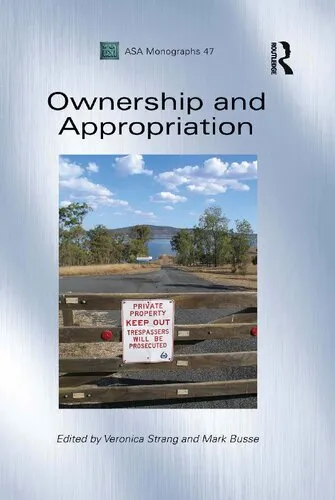
- Published Year: 2011
- Page count: 318
- File Size: 4 MB
- Language: English
- Published by: Routledge
- Visited by: 494
- Rating/Review: 4.8
-
ISBN:
1847886841
9781847886842
Keywords:
Ownership and Appropriation
4.8
Reviews from our users

You Can Ask your questions from this book's AI after Login
Each download or ask from book AI costs 2 points. To earn more free points, please visit the Points Guide Page and complete some valuable actions.



Analytical Summary
The edited volume Ownership and Appropriation, compiled by Veronica Strang and Mark Busse, delves deeply into the multifaceted concept of how individuals, communities, and nations claim ownership—material or intangible—over cultural artifacts, environmental resources, and intellectual heritage. Drawing from anthropology, ethnography, and cultural studies, it examines the tensions between proprietary claims and cultural exchange in a globalized era.
Through a series of essays from contributing scholars, the book navigates the contested terrain between universal access to cultural knowledge and the desire to safeguard identity and tradition. Secondary themes, such as cultural property rights and anthropological perspectives on ownership, surface prominently throughout the chapters, with each contribution questioning the frameworks within which property is defined and controlled.
Rather than offering a singular narrative, Ownership and Appropriation acts as a platform for multiple voices, reflecting diverse contexts—from indigenous communities protecting sacred practices to debates over repatriation of museum artifacts. The analysis extends beyond legal and economic lenses, embracing moral, symbolic, and relational understandings of possession, and positioning ownership as both a social construct and a lived experience. Information on publication year is unavailable due to no reliable public source.
Key Takeaways
Readers will uncover a nuanced framework for interpreting ownership that transcends conventional definitions, encouraging a reconsideration of whose rights and responsibilities prevail in situations where resources or heritage are contested.
One takeaway is the recognition that ownership is not merely about control over objects or land; it can embody stewardship, moral obligation, and reciprocal exchange. Another vital insight is that appropriation carries profound implications for power dynamics—sometimes affirming cultural resilience, other times sustaining inequality.
As the book addresses diverse geographic and cultural settings, it enables the reader to critically assess contemporary debates about intellectual property, indigenous resource sovereignty, and the ethics of cultural borrowing.
Memorable Quotes
"Ownership is never simply about possession; it is about relationships, responsibilities, and respect." Unknown
"Appropriation is a mirror reflecting both the desire to connect and the potential to dominate." Unknown
"The most profound losses occur when voices are silenced under the weight of external claims." Unknown
Why This Book Matters
In today’s interconnected yet divided world, understanding the forces behind ownership and appropriation is crucial for policymakers, scholars, and cultural advocates.
This book provides a vital map for navigating complex ethical terrain, especially in contexts where globalization intensifies interactions between disparate traditions. By foregrounding voices that are often marginalized in debates on cultural property rights, it enriches both academic discourse and practical approaches to conflict resolution.
For professionals in law, museum studies, indigenous advocacy, and anthropology, Ownership and Appropriation offers a repertoire of analytical tools and case studies that ground debates in lived realities rather than abstract theory.
Inspiring Conclusion
Ultimately, Ownership and Appropriation invites an ongoing conversation about how societies define, defend, and share their cultural and material resources.
By illuminating the intersections between legal frameworks, ethical considerations, and human relationships, this work challenges scholars and practitioners to act with discernment and empathy. The richness of the perspectives included prompts readers to rethink long-held assumptions about who can claim ownership and at what moral cost.
If you are ready to deepen your engagement with debates on cultural property rights and anthropological perspectives on ownership, take the next step: read the book, share its insights with peers, and bring these critical discussions into your own professional or academic circles.
Free Direct Download
You Can Download this book after Login
Accessing books through legal platforms and public libraries not only supports the rights of authors and publishers but also contributes to the sustainability of reading culture. Before downloading, please take a moment to consider these options.
Find this book on other platforms:
WorldCat helps you find books in libraries worldwide.
See ratings, reviews, and discussions on Goodreads.
Find and buy rare or used books on AbeBooks.

1494
بازدید4.8
امتیاز0
نظر98%
رضایتReviews:
4.8
Based on 0 users review
Questions & Answers
Ask questions about this book or help others by answering
No questions yet. Be the first to ask!