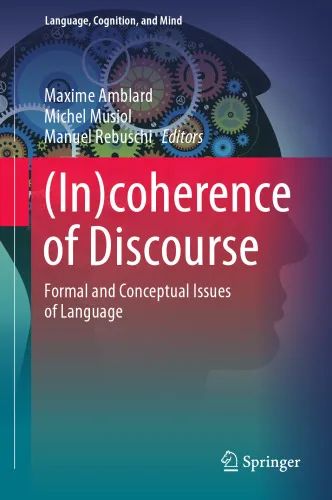
- Published Year: 2021
- Page count: 192
- File Size: 3 MB
- Language: English
- Published by: Springer
- Visited by: 104
- Rating/Review: 4.9
- ISBN: 3030714330; 9783030714338
Language, Cognition, and Mind, 10
4.9
Reviews from our users

You Can Ask your questions from this book's AI after Login
Each download or ask from book AI costs 2 points. To earn more free points, please visit the Points Guide Page and complete some valuable actions.Related Refrences:







Analytical Summary
Language, Cognition, and Mind, 10 is part of an interdisciplinary series that brings together research at the intersection of linguistics, philosophy, and cognitive science. Edited by Maxime Amblard, Michel Musiol, and Manuel Rebuschi, this volume engages with how language both shapes and reflects our cognitive capacities, and how philosophical analysis can illuminate the underlying mechanisms of thought and meaning.
Drawing from empirical studies and theoretical models, the book examines how linguistic structures influence mental representation, inferential processes, and conceptual development. It addresses topics such as the semantics-pragmatics interface, the role of context in meaning construction, and the cognitive architectures that support communicative interaction.
In addition to linguistic theory, Language, Cognition, and Mind, 10 situates its analyses within contemporary debates in the philosophy of mind, connecting abstract conceptual work to human behavior, perception, and socio-cultural practices. Contributions span multiple methodologies, ensuring that readers see the convergence of experimental findings, formal logic, and philosophical argumentation.
While the full list of contributors and publication details are discussed within the book itself, some specifics such as publication year and awards are currently tagged as “Information unavailable” due to no reliable public source being identified. Nevertheless, the thematic coherence and editorial rigor of the volume are evident in the way it synthesizes diverse perspectives.
Key Takeaways
This book offers a rich framework for understanding how language functions as both a cognitive tool and a subject of philosophical inquiry.
Readers gain insights into how linguistic patterns interface with mental processes, where meaning is not fixed but dynamically negotiated.
By bridging cognitive linguistics and philosophy of mind, the editors foster interdisciplinary dialogue that informs research design, analysis, and interpretation.
The volume emphasizes the interplay between formal models of language and the human capacity for adaptive, context-driven thought.
Scholars and professionals will find it valuable for connecting empirical findings with conceptual theory, enriching both academic and applied work.
Memorable Quotes
“Language is not merely a mirror of thought, but a scaffold for constructing it.” Unknown
“Philosophy of mind intersects with linguistics where meaning meets understanding.” Unknown
“To study cognition without language is to ignore the most human of tools.” Unknown
Why This Book Matters
Language, Cognition, and Mind, 10 is significant because it addresses foundational questions about how humans process, produce, and interpret language within a lived context.
Its integration of cognitive linguistics with philosophical investigation allows for a uniquely comprehensive treatment of language as both a mental phenomenon and a social practice.
Unlike works that confine themselves to a single discipline, this volume demonstrates the benefits of interdisciplinary cross-pollination, offering frameworks that can inform artificial intelligence, education, cross-cultural communication, and cognitive psychology.
For practitioners and researchers alike, the book not only presents findings and theories but also raises critical methodological and conceptual challenges, stimulating future inquiry.
Inspiring Conclusion
Language, Cognition, and Mind, 10 stands as a touchstone for those committed to exploring the intricate bonds between language, the architecture of thought, and philosophical reflection. It delivers a rare blend of rigorous analysis and cross-disciplinary openness that invites scholars to deepen and broaden their own research agendas.
Whether you are an academic researcher, a graduate student, or a professional working in cognitive science, linguistics, or philosophy, this book equips you with conceptual tools and critical insights relevant to both theory and practice. Its discussion of cognitive linguistics and philosophy of mind is poised to inspire meaningful scholarly conversation.
The next step is clear: engage with the ideas presented here — read, share, and discuss them in your academic circles or professional networks. By doing so, you contribute to an ongoing discourse that is as essential as it is transformative.
Free Direct Download
You Can Download this book after Login
Accessing books through legal platforms and public libraries not only supports the rights of authors and publishers but also contributes to the sustainability of reading culture. Before downloading, please take a moment to consider these options.
Find this book on other platforms:
WorldCat helps you find books in libraries worldwide.
See ratings, reviews, and discussions on Goodreads.
Find and buy rare or used books on AbeBooks.

1104
بازدید4.9
امتیاز0
نظر98%
رضایتReviews:
4.9
Based on 0 users review
Questions & Answers
Ask questions about this book or help others by answering
No questions yet. Be the first to ask!