
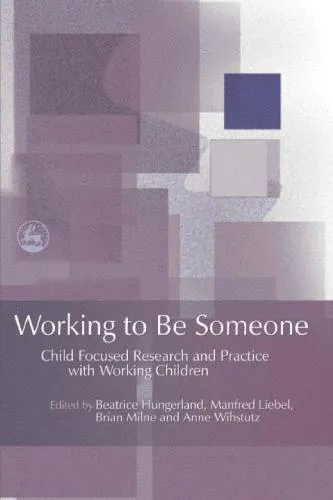
Working to be someone : child focused research and practice with working children
Beatrice Hungerland; et al
2007
View book

Book guide and evaluation
Peper, Martin; Markowitsch, Hans J.
0 reviews
Published
pages
views
Journal of the History of the Neurosciencespp.58—66 History of neuroscience, cognitive science evolution Explore the Journal of the History of the Neurosciencespp.58—66 with insights into neuroscience's development and scholarly analysis. Analytical Summary The Jo
Before you read
The Journal of the History of the Neurosciencespp.58—66 provides a rigorous exploration of the intellectual and historical currents that shaped modern neuroscience. Written by Peper, Martin and Markowitsch, Hans J., this work sits within a broader scholarly tradition that aims to trace the roots of our understanding of the human brain and mind. By situating contemporary neuroscience in the context of earlier debates, methodologies, and paradigm shifts, the book becomes a vital resource for anyone seeking a critically informed view of the discipline’s past.
This section of the journal offers an in-depth review of key milestones, from seminal experiments to theoretical frameworks that influenced successive generations of scientists. Readers will encounter detailed discussions on how the evolution of cognitive science intersects with the broader history of neuroscience, representing a confluence of interdisciplinary insights. Information unavailable regarding the exact publication year of this segment, as no reliable public source confirms it.
By weaving biographical details of influential figures with methodological analysis, the text not only documents the chronology but also provides context for the social, technological, and philosophical factors that propelled the field forward. The narrative grants academic and professional audiences the clarity needed to appreciate both the incremental advances and revolutionary leaps in our knowledge of neural function.
From the Journal of the History of the Neurosciencespp.58—66, readers can distill critical insights that illuminate the pathways science has taken in decoding the nervous system.
First, the history of neuroscience reveals a persistent interplay between empirical experimentation and theoretical speculation. This dynamic tension is central to understanding the intellectual climate that fostered breakthroughs.
Second, cross-disciplinary influences—from philosophy to emerging fields like cognitive science—have continually reshaped the questions asked and the methods employed. This underscores the necessity of thinking beyond narrow professional silos.
Third, the evolution of technology is inseparable from advances in neuroscience. Innovations in instrumentation have often catalyzed shifts in what could be measured and theorized about brain function.
Fourth, the narrative addresses the importance of historiography in science: how the telling of history itself affects public and academic understandings.
Finally, this work stands as a reminder of the value in examining past scientific endeavors to inform future research and ethical considerations.
Several passages in this journal segment stand out for their succinct encapsulation of complex ideas.
“Understanding the brain’s past is the key to unlocking its future potential.”Unknown
“Histories are not mere chronicles; they are frameworks that guide present inquiry.”Unknown
“Science advances not only through data but through the narratives we construct around it.”Unknown
The importance of the Journal of the History of the Neurosciencespp.58—66 rests in its ability to connect generations of scholarship, clarify intellectual trajectories, and inspire more nuanced approaches to both research and teaching.
For academics, this work serves as a case study in methodical historical analysis applied to a vibrant, continually evolving scientific domain. For professionals, it offers perspective—reminding practitioners that current clinical or technological advances are built atop foundations laid by earlier work.
In a time when the pace of innovation can eclipse memory, the history of neuroscience stands as an anchor, keeping critical thought tethered to proven principles while allowing for exploration beyond the known.
Engaging with the Journal of the History of the Neurosciencespp.58—66 is not merely an academic exercise; it is an invitation to connect with the lineage of thought that underpins modern neuroscience.
Whether you are a scholar, practitioner, or informed reader, this work invites you to trace the arc of discovery, understand its context, and contribute to its ongoing dialogue. The primary keyword here resonates as more than a title—it is a gateway to a deeper appreciation of science’s narrative.
Readers are encouraged to explore the text in full, share its insights with peers, and engage in discussions that bridge past and future perspectives. The next step is simple yet profound: dive in, and let history inform your innovation.
Your question is answered in the context of this title and author. Each answer uses 2 points.
0 reviews, 4.7 average out of 5
Sign in to publish a review.
Ask a focused question and learn from the community.
Related references that continue this learning path.
Beatrice Hungerland; et al


Sheldon Travin M.D.,Barry Protter Ph.D. (auth.)