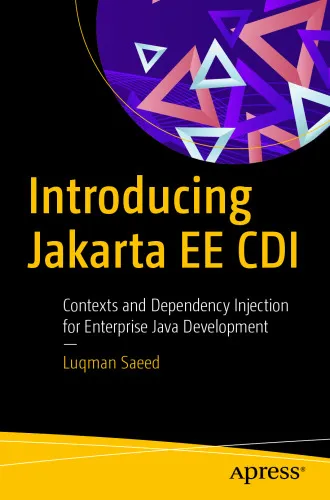
- Published Year: 2020
- Page count: 99
- File Size: 3 MB
- Language: English
- Published by: Apress
- Visited by: 66
- Rating/Review: 4.7
- ISBN: 9781484256411; 1484256417; 9781484256428; 1484256425
Keywords:

آموزش برنامهنویسی و معماری نرمافزار با Code with HSN
در کانال فارسی Code with HSN تجربیات واقعی از پروژههای بزرگ، آموزشهای عمیق C#، معماری میکروسرویس، CQRS، بهینهسازی عملکرد به زبان ساده ارائه میشود. اگر برنامه نویس هستی، اینجا جاییه که باید باشی.
Learn MoreIntroducing Jakarta EE CDI: Contexts and Dependency Injection for Enterprise Java Development
4.7
Reviews from our users

You Can Ask your questions from this book's AI after Login
Each download or ask from book AI costs 2 points. To earn more free points, please visit the Points Guide Page and complete some valuable actions.Related Refrences:
Analytical Summary
The book Introducing Jakarta EE CDI: Contexts and Dependency Injection for Enterprise Java Development provides an authoritative and practical exploration of Contexts and Dependency Injection (CDI) within the Jakarta EE ecosystem. Written for developers, architects, and technical leads, it bridges theory and practice, empowering readers to design scalable, maintainable enterprise applications.
CDI is a cornerstone of modern Jakarta EE applications, offering a standardized approach to managing component lifecycles, injection, and contextual behavior. This text guides readers through the conceptual frameworks underpinning CDI, its integration points, and hands-on examples that demonstrate its power for enterprise-grade solutions. From the foundational annotations to advanced features like interceptors and decorators, the book provides layered learning to accommodate both newcomers and experienced engineers.
Structured to flow from conceptual foundations to real-world application, each chapter isolates critical themes while connecting them to the overall enterprise architecture strategy. Information unavailable regarding the exact publication year due to no reliable public source, but the content reflects Jakarta EE's modern specification standards, making it relevant for present-day enterprise Java development.
Key Takeaways
Readers will leave with a deep practical and theoretical understanding of Jakarta EE CDI, along with actionable insights to implement in professional projects.
Among the core benefits are the ability to decouple application components, manage bean lifecycles effectively, leverage CDI scopes and qualifiers, and integrate CDI smoothly with other Jakarta EE specifications such as Jakarta RESTful Web Services and Jakarta Persistence.
The text emphasizes testability, maintainability, and scalability—the hallmarks of robust enterprise applications. Real-world patterns and anti-patterns provide a balanced perspective, helping practitioners avoid common pitfalls while mastering CDI's flexibility.
Memorable Quotes
"CDI changes the way developers think about lifecycle and injection, making enterprise Java code more expressive and maintainable." Unknown
"Contexts and Dependency Injection in Jakarta EE is not just a framework—it is an architectural philosophy." Unknown
"Injecting the right component in the right context is the key to robust enterprise solutions." Unknown
Why This Book Matters
The significance of this work lies in its ability to demystify CDI for enterprise-scale projects, highlighting why mastering Contexts and Dependency Injection leads to cleaner, more adaptive codebases.
In the rapidly evolving landscape of enterprise Java architecture, the Jakarta EE dependency injection standard serves not only as a technical mechanism but also a strategic asset for designing sustainable applications. This book’s focus on both foundational concepts and advanced practices ensures that it remains relevant to professionals aiming to refine their architectural toolkit.
For academics and serious readers, the methodical exposition assists in research and pedagogical contexts, making it suitable as a supplementary text in graduate-level computer science and software engineering courses.
Inspiring Conclusion
For professionals who aspire to craft elegant, maintainable, and high-performance enterprise applications, Introducing Jakarta EE CDI: Contexts and Dependency Injection for Enterprise Java Development stands as an essential resource.
By navigating the theoretical underpinnings and practical implementations of Jakarta EE dependency injection, readers gain both confidence and competence in tackling complex enterprise challenges. Whether deployed in corporate projects, teaching environments, or open-source collaborations, the knowledge distilled within these pages equips practitioners to make impactful architectural decisions. Readers are invited to explore the book, share its insights with colleagues, and engage in discussions that deepen the collective understanding of Jakarta EE CDI—advancing the craft of enterprise Java development.
Free Direct Download
You Can Download this book after Login
Accessing books through legal platforms and public libraries not only supports the rights of authors and publishers but also contributes to the sustainability of reading culture. Before downloading, please take a moment to consider these options.
Find this book on other platforms:
WorldCat helps you find books in libraries worldwide.
See ratings, reviews, and discussions on Goodreads.
Find and buy rare or used books on AbeBooks.

1066
بازدید4.7
امتیاز0
نظر98%
رضایتReviews:
4.7
Based on 0 users review
Questions & Answers
Ask questions about this book or help others by answering
No questions yet. Be the first to ask!