- Published Year: 2014
- Page count: 400 / 400
- File Size: 4 MB
- Language: English
- Published by: Wiley
- Visited by: 42
- Rating/Review: 4.7
- ISBN: 9781119942399; 111994239X
Keywords:
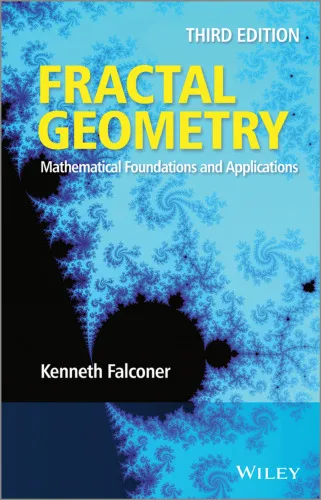
Fractal Geometry: Mathematical Foundations and Applications
4.7
Reviews from our users

You Can Ask your questions from this book's AI after Login
Each download or ask from book AI costs 2 points. To earn more free points, please visit the Points Guide Page and complete some valuable actions.






Analytical Summary
Fractal Geometry: Mathematical Foundations and Applications stands as one of the most comprehensive explorations of fractal theory, weaving mathematical rigor with intuitive understanding. Authored by Kenneth Falconer, this book serves as both a scholarly resource and an invitation to explore the patterns underlying irregular yet self-similar structures found throughout mathematics and nature.
This authoritative text delves into the mathematical principles that define fractals, offering a balance between pure theoretical insight and real-world application. From Hausdorff dimension and measure theory to geometric probability and stochastic processes, the work meticulously constructs a framework that supports the study of forms that defy traditional Euclidean models. It elucidates not only the formal structure of fractal sets but also the methods of analyzing their complexity through tools such as fractal dimensions, measures, and multifractal analysis.
The book addresses both classical foundations and modern developments, illustrating how these abstract ideas influence disciplines as varied as physics, biology, computer graphics, and economics. As part of its continuing relevance, Fractal Geometry: Mathematical Foundations and Applications bridges the gap between research-level detail and accessibility, making it an essential reference for anyone advancing in the study of geometric irregularity and complexity.
Key Takeaways
This book provides the conceptual clarity necessary to navigate the intricate landscape of modern fractal theory, emphasizing both mathematical depth and wide applicability.
Readers gain a structured understanding of how self-similarity in mathematics operates beyond visual aesthetics to embody foundational geometric principles. The text guides scholars through the rigorous definitions of fractal sets and metrics that allow for precise quantification of irregular forms.
Among the key insights are the roles of Hausdorff and box-counting dimensions in quantifying complexity, the extension of measure-theoretic frameworks to non-integer dimensions, and the significance of stochastic models in describing natural fractal phenomena. These insights empower mathematicians, physicists, and computational scientists alike to apply fractal concepts in analytical, modeling, and design contexts.
Memorable Quotes
“The geometry of fractals brings order to irregularity, revealing patterns where chaos seems to dominate.”Unknown
“Through fractal dimension analysis, one can quantify complexity that traditional geometry cannot grasp.”Unknown
“Mathematical rigor transforms the study of fractals from a visual curiosity into a foundational science.”Unknown
Why This Book Matters
Fractal Geometry: Mathematical Foundations and Applications remains a cornerstone for serious engagement with the mathematics of irregular forms, bridging theory and practice with precision.
For academics, this book offers a vital consolidation of proofs, theorems, and analytical techniques that underpin fractal study. For professionals, it connects those theories to applied systems—from modeling natural landscapes and signal variations to improving computational and network algorithms through self-similar modeling.
Information unavailable regarding specific awards or distinctions for this volume, as no reliable public source confirms such details. However, its continued citation and integration into university syllabi attest to its scholarly impact and enduring authority.
By presenting fractal geometry as a living, expanding field, the book encourages the development of new mathematical tools and deeper cross-disciplinary connections, ensuring its influence across diverse scientific domains.
Inspiring Conclusion
Fractal Geometry: Mathematical Foundations and Applications represents both a culmination of rigorous research and a forward-looking invitation to those who seek to understand the language of complexity through mathematics.
Through its precise definitions, structured proofs, and clear exposition, the book reveals how structures based on self-similarity in mathematics can explain natural and abstract phenomena alike. It calls to readers who desire mastery over the tools that measure irregularity and the insight that connects geometry with the infinite nuances of the real world.
To fully engage with the depth of fractal analysis and contribute to its advancing frontiers, readers are encouraged to explore, discuss, and share their interpretations of Fractal Geometry: Mathematical Foundations and Applications. This engagement ensures the continued evolution of a field that redefines how we see patterns, complexity, and the mathematical fabric of nature itself.
Free Direct Download
You Can Download this book after Login
Accessing books through legal platforms and public libraries not only supports the rights of authors and publishers but also contributes to the sustainability of reading culture. Before downloading, please take a moment to consider these options.
Find this book on other platforms:
WorldCat helps you find books in libraries worldwide.
See ratings, reviews, and discussions on Goodreads.
Find and buy rare or used books on AbeBooks.

1042
بازدید4.7
امتیاز0
نظر98%
رضایتReviews:
4.7
Based on 0 users review
Questions & Answers
Ask questions about this book or help others by answering
No questions yet. Be the first to ask!