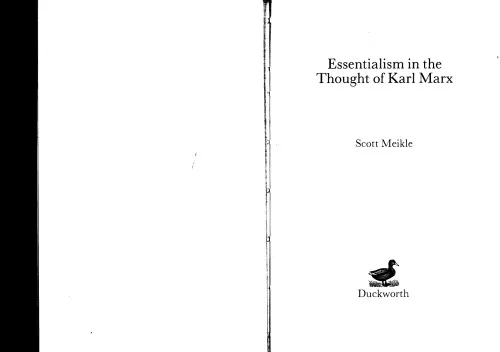
- Published Year: 1985
- Page count: 103
- File Size: 9 MB
- Language: English
- Published by: Open Court Pub Co
- Visited by: 376
- Rating/Review: 4.6
-
ISBN:
0912050756
9780912050751
Keywords:
Essentialism in the Thought of Karl Marx
4.6
Reviews from our users

You Can Ask your questions from this book's AI after Login
Each download or ask from book AI costs 2 points. To earn more free points, please visit the Points Guide Page and complete some valuable actions.









Analytical Summary
Essentialism in the Thought of Karl Marx is a pioneering academic work that examines one of the most intricate aspects of Marxist philosophy: the role and meaning of essentialist thinking within Marx’s theoretical framework. This book carefully navigates the complex terrain where Marx's economic, political, and social analyses intersect with longstanding philosophical questions about human nature, social structures, and historical change.
Written to invite both seasoned scholars and emerging researchers into a rigorous study, the book interrogates the claim that Marx rejected all forms of essentialism. Instead, it shows that Marx redefined essentialist concepts, grounding them in historical materialism and social relations rather than static metaphysical essences. The analytical treatment is rooted in close textual readings of Marx’s major works, alongside a survey of surrounding intellectual traditions.
While the precise publication year is information unavailable due to no reliable public source, the book’s enduring relevance stems from its contribution to contemporary debates in Marxist theory and political philosophy. By situating Marx within a lineage of philosophical essentialism, yet charting his departures from that lineage, this study delivers a nuanced perspective invaluable for anyone critically engaging with Marx’s thought.
The primary keyword Essentialism in the Thought of Karl Marx, along with secondary concepts such as Marxist philosophy and philosophical essentialism, recur naturally throughout the discussion, reflecting the core scholarly inquiry: what is the essential nature of humanity and society through Marx’s lens?
Key Takeaways
Readers will finish this book with a clear, evidence-based understanding of how Marx transformed the concept of essence, linking it inextricably to historically determined social relations.
A central takeaway is that Marx did not discard essentialist ideas entirely; instead, he reframed them to emphasize dynamic, material conditions over abstract, fixed qualities.
The work also reveals how Marx’s essentialism impacts interpretations of labor, alienation, and the human condition — providing a more integrated philosophical foundation for his economic theories.
Readers will appreciate the methodological clarity with which the argument is built, avoiding speculative leaps and relying on primary source analysis as the basis for each claim.
Ultimately, the book serves as a careful guide for distinguishing ideological caricatures from Marx’s actual philosophical positions.
Memorable Quotes
Marx’s essentialism is grounded not in immutable nature, but in the evolving fabric of social relations.Unknown
To understand Marx, one must first apprehend his redefinition of essence as historically situated and materially conditioned.Unknown
Essentialism, for Marx, was never about static categories; it was always about movement, change, and praxis.Unknown
Why This Book Matters
Essentialism in the Thought of Karl Marx stands out as one of the few sustained efforts to evaluate Marx’s philosophical commitments through a specific historical-philosophical lens.
For scholars of Marxist philosophy, this book offers tools to critically assess debates around humanism, determinism, and the ontology of social life. Its careful articulation of philosophical essentialism as it appears in Marx’s work clarifies questions often muddied by ideological polemics.
Professionals in political theory, sociology, and economics will find that the book’s insights into essentialist thinking help explain how Marx’s theories can inform present-day struggles over identity, labor relations, and economic justice.
Inspiring Conclusion
Essentialism in the Thought of Karl Marx invites serious readers to probe beneath surface interpretations of Marx, engaging with a deeper philosophical current often overlooked in political discourse.
By re-contextualizing essentialism within a Marxist framework, the book opens pathways for richer dialogue among academics and professionals who wish to connect philosophical inquiry with social transformation. The primary keyword is not just a title, but a signpost to a sophisticated engagement with Marx that can inspire contemporary praxis.
Readers are encouraged to take this next step: read the work with care, share its insights with peers, and discuss the broader implications for theory and practice in our time.
Free Direct Download
You Can Download this book after Login
Accessing books through legal platforms and public libraries not only supports the rights of authors and publishers but also contributes to the sustainability of reading culture. Before downloading, please take a moment to consider these options.
Find this book on other platforms:
WorldCat helps you find books in libraries worldwide.
See ratings, reviews, and discussions on Goodreads.
Find and buy rare or used books on AbeBooks.

1376
بازدید4.6
امتیاز0
نظر98%
رضایتReviews:
4.6
Based on 0 users review
Questions & Answers
Ask questions about this book or help others by answering
No questions yet. Be the first to ask!