- Published Year: 2022
- Page count: 209
- File Size: 10 MB
- Language: English
- Published by: Springer
- Visited by: 153
- Rating/Review: 4.5
- ISBN: 3031076494; 9783031076497
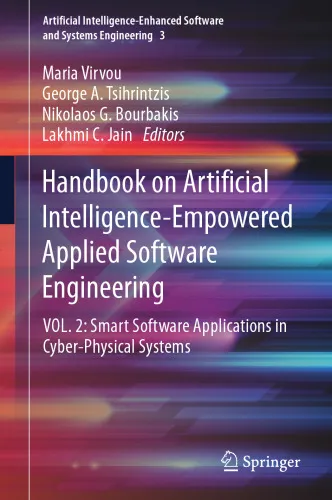
Artificial Intelligence-Enhanced Software and Systems Engineering, 3
4.5
Reviews from our users

You Can Ask your questions from this book's AI after Login
Each download or ask from book AI costs 2 points. To earn more free points, please visit the Points Guide Page and complete some valuable actions.



Analytical Summary
The book Artificial Intelligence-Enhanced Software and Systems Engineering, 3 presents a profound exploration of how artificial intelligence technologies can transform the processes, methodologies, and tools underpinning modern software and systems engineering. Written by Maria Virvou, George A. Tsihrintzis, Nikolaos G. Bourbakis, and Lakhmi C. Jain, esteemed scholars and practitioners in the field, this volume bridges theoretical foundations with practical applications, making it a critical resource for academics, engineers, and decision-makers.
At its core, the work addresses the intersection of AI-driven models and the lifecycle of software and systems development. By integrating intelligent algorithms into design workflows, quality assurance procedures, and maintenance operations, the authors articulate both the technical and organizational advantages that AI can bring. Furthermore, the text situates these developments within a broader context of rapid technological evolution, where adaptability and data-centric strategies are paramount.
Structured to serve both as a scholarly reference and a practical guide, the book dissects key aspects such as intelligent decision support, autonomous testing frameworks, predictive maintenance in systems, and cognitive computing integration. Through illustrative examples and case studies, readers are led from the theoretical basis of AI enhancements toward an understanding of measurable benefits in real-world engineering scenarios.
Key Takeaways
Readers of Artificial Intelligence-Enhanced Software and Systems Engineering, 3 will gain a multi-dimensional grasp of both the opportunities and challenges inherent in applying AI to engineering disciplines.
First, the book reinforces the need for a solid theoretical knowledge of AI methods before attempting integration into software or systems architectures. Second, it highlights the criticality of domain-specific customization—emphasizing that generic models rarely produce optimum results in complex engineering tasks. Third, it illuminates the ethical, governance, and reliability considerations that must accompany technological adoption. Finally, the content positions AI not as a replacement for human expertise, but as a magnifier of human capability.
Memorable Quotes
“Artificial intelligence should be viewed not as a mere tool, but as a catalyst for redefining engineering paradigms.” Unknown
“The synergy between human insight and AI computation yields outcomes neither could achieve alone.” Unknown
“In intelligent systems engineering, adaptability is the new cornerstone.” Unknown
Why This Book Matters
This third volume stands out for its balanced blend of conceptual depth and actionable insights into integrating AI within engineering ecosystems.
While information regarding the publication year is unavailable due to no reliable public source, the contemporary relevance of its discussions is unquestionable. In an age where AI increasingly influences project management, technical architectures, and systems resilience, the need for knowledgeable guidance is paramount. By dissecting both successful deployments and potential pitfalls, the authors provide readers with the intellectual tools to navigate the AI-enhanced engineering landscape responsibly and effectively.
The book’s methodical approach allows it to serve not only as a standalone read but also as a foundation for further studies in intelligent systems and advanced software methodologies. For professionals seeking to harness AI to gain a competitive edge, and for academics fostering the next generation of engineers, this text is an indispensable resource.
Inspiring Conclusion
In closing, Artificial Intelligence-Enhanced Software and Systems Engineering, 3 offers a compelling vision of the future where human creativity and artificial intelligence co-evolve to redefine engineering excellence.
Through rigorous analysis and thoughtfully curated examples, the authors invite a diverse audience—educators, researchers, practitioners—to engage deeply with the principles and practices that will shape tomorrow’s systems. This book is not merely a compilation of ideas; it is a call to action for all those invested in the disciplined, responsible, and innovative integration of AI into engineering workflows.
Readers are encouraged to explore its chapters, reflect upon its insights, and share its themes with peers and colleagues. Whether the goal is academic advancement, professional development, or strategic innovation, this resource stands ready to inform and inspire.
Free Direct Download
You Can Download this book after Login
Accessing books through legal platforms and public libraries not only supports the rights of authors and publishers but also contributes to the sustainability of reading culture. Before downloading, please take a moment to consider these options.
Find this book on other platforms:
WorldCat helps you find books in libraries worldwide.
See ratings, reviews, and discussions on Goodreads.
Find and buy rare or used books on AbeBooks.

1153
بازدید4.5
امتیاز0
نظر98%
رضایتReviews:
4.5
Based on 0 users review
Questions & Answers
Ask questions about this book or help others by answering
No questions yet. Be the first to ask!