Book guide and evaluation
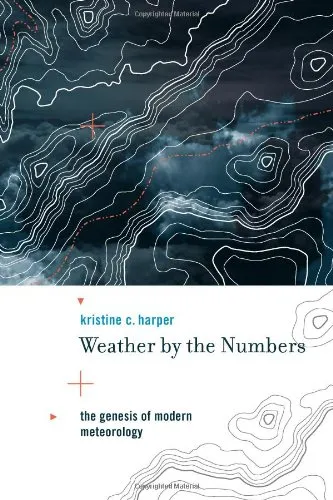
Weather by the numbers: the genesis of modern meteorology
Kristine C. Harper
English
Unordered
Software Engineering
4.6 / 5
0 reviews
2008
Published
321
pages
615
views
Winning entry, Professional Cover/Jacket Category, in the 2009 New England Book Show sponsored by Bookbuilders of Boston. and Winner, History Category, 2008 ASLI's Choice Award given by the Atmospheric Science Librarians International. For much of the first half of the twenti
Before you read
What will you get from this book?
Winning entry, Professional Cover/Jacket Category, in the 2009 New England Book Show sponsored by Bookbuilders of Boston. and Winner, History Category, 2008 ASLI's Choice Award given by the Atmospheric Science Librarians International. For much of the first half of the twentieth century, meteorology was more art than science, dependent on an individual forecaster's lifetime of local experience. In Weather by the Numbers, Kristine Harper tells the story of the transformation of meteorology from a "guessing science" into a sophisticated scientific discipline based on physics and mathematics. What made this possible was the development of the electronic digital computer; earlier attempts at numerical weather prediction had foundered on the human inability to solve nonlinear equations quickly enough for timely forecasting. After World War II, the combination of an expanded observation network developed for military purposes, newly trained meteorologists, savvy about math and physics, and the nascent digital computer created a new way of approaching atmospheric theory and weather forecasting. Harper examines the efforts of meteorologists to professionalize their discipline during the interwar years and the rapid expansion of personnel and observational assets during World War II. She describes how, by the 1950s, academic, Weather Bureau, and military meteorologists had moved atmospheric modeling from research subject to operational forecasting. Challenging previous accounts that give sole credit for the development of numerical weather prediction to digital computer inventor John von Neumann, Harper points to the crucial contributions of Carl-Gustav Rossby (founder of MIT's meteorology program and a member of the "Scandinavian Tag Team" working with von Neumann). This transformation of a discipline, Harper writes, was the most important intellectual achievement of twentieth-century meteorology, and paved the way for the growth of computer-assisted modeling in all the sciences.
Ask this book
Your question is answered in the context of this title and author. Each answer uses 2 points.
Sign in to ask the book assistant.
Reader reviews
0 reviews, 4.6 average out of 5
No reviews yet
If you have read this book, help the next reader with your experience.
Write a review
Sign in to publish a review.
Reader questions and answers
Ask a focused question and learn from the community.
Sign in to ask or answer a question.
No questions yet
Be the first to ask a clear, useful question.
What to read next
Related references that continue this learning path.


Head First design patterns: Includes index
Freeman, Eric;Sierra, Kathy;Bates, Bert;Robson, Elisabeth
2004
View book