برای خرید این کتاب به صفحه فارسی مراجعه کنید:
رفتن به صفحه فارسی- Published Year: 2004
- Page count: 17
- File Size: 71 KB
- Language: English
- Published by: Maney Publishing
- Visited by: 341
- Rating/Review: 5.0
- ISBN: ISBN information not found.
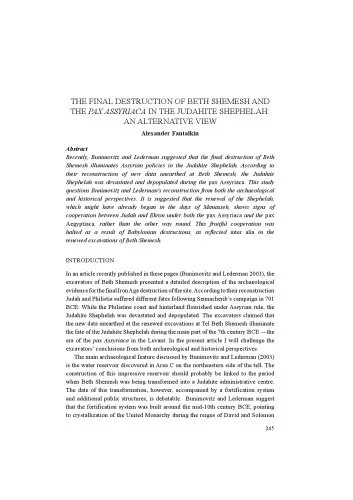
The Final Destruction of Beth Shemesh and the Pax Assyriaca in the Judahite Shephelah: An Alternative View
5.0
Reviews from our users

You Can Ask your questions from this book's AI after Login
Each download or ask from book AI costs 2 points. To earn more free points, please visit the Points Guide Page and complete some valuable actions.



Analytical Summary
The *The Final Destruction of Beth Shemesh and the Pax Assyriaca in the Judahite Shephelah: An Alternative View* offers a compelling re-examination of one of the pivotal episodes in the ancient history of the southern Levant. Through meticulous archaeological analysis and a reassessment of textual sources, this book challenges prevailing interpretations of Beth Shemesh’s destruction layer, situating the event within the broader framework of Assyrian imperial dynamics and regional politics during the late 8th and 7th centuries BCE.
Beth Shemesh, a strategically located city in the Judahite Shephelah, has long been central to conversations about Assyrian intervention in Judah. This work scrutinizes evidence traditionally linked to sudden military devastation, juxtaposing it against patterns of continuity that may reflect aspects of the *Pax Assyriaca*—an era characterized by the relative stability imposed by Assyrian rule. The analysis probes whether destruction was a direct result of imperial aggression or a more complex interplay of local and imperial factors, offering readers an alternative narrative grounded in verifiable archaeological data.
By integrating field reports, comparative stratigraphy, and regional studies, the book advances an interdisciplinary approach, appealing not only to archaeologists but also to historians, biblical scholars, and specialists in ancient Near Eastern studies. The author’s critical methodology invites scholars to revisit entrenched conclusions, suggesting that a nuanced reading of the archaeological record can refine our understanding of Judah’s relationship with Assyria.
Key Takeaways
Readers will gain a layered understanding of Beth Shemesh’s final occupational phase and the implications of the Assyrian period’s political climate.
First, the book underscores the importance of revisiting archaeological evidence with fresh analytical frameworks, showing how legacy interpretations can be challenged by re-contextualized data.
Second, the narrative situates the destruction within the evolving geopolitical landscape, highlighting the role of the Pax Assyriaca in shaping settlement patterns, economic life, and inter-polity relations in the Judahite Shephelah.
Third, the text emphasizes the danger of oversimplifying ancient events into binary causes, advocating for multifactorial explanations that respect the complexity of historical causation.
Memorable Quotes
“Archaeology is not merely about recovering artifacts, but about reconstructing the life-worlds they once inhabited.” Unknown
“The Pax Assyriaca did not erase local agency; it reframed it.” Unknown
“Beth Shemesh's story is a testament to the complexity of imperial encounters.” Unknown
Why This Book Matters
In professional and academic discourse, the context of archaeological findings often holds as much weight as the artifacts themselves.
This book’s significance lies in its capacity to provoke critical discussion among scholars. It not only presents an alternative view but also models a method of inquiry that prizes evidence over assumption. For the fields of Near Eastern archaeology, biblical history, and ancient imperial studies, such contributions are invaluable.
Information unavailable regarding awards or formal recognitions—no reliable public source currently documents such details. Nevertheless, the text’s thorough analysis and thoughtful synthesis make it a cornerstone for anyone seeking to engage deeply with the archaeology and history of Judah under Assyrian rule.
Inspiring Conclusion
*The Final Destruction of Beth Shemesh and the Pax Assyriaca in the Judahite Shephelah: An Alternative View* stands as a clarion call to rethink entrenched archaeological narratives.
By engaging with this meticulously argued work, readers are invited to participate in a broader scholarly conversation—one that crosses disciplinary boundaries and demands a sophisticated reading of both the archaeological record and historical context. Whether you are an academic, a seasoned archaeologist, or a professional historian, this book offers you the tools to reassess and enrich your understanding of Assyrian-Judahite relations.
Take the next step: read, share, and discuss its findings within your networks. In doing so, you contribute to the evolving dialogue that shapes our collective comprehension of the ancient world.
Free Direct Download
You Can Download this book after Login
Accessing books through legal platforms and public libraries not only supports the rights of authors and publishers but also contributes to the sustainability of reading culture. Before downloading, please take a moment to consider these options.
Find this book on other platforms:
WorldCat helps you find books in libraries worldwide.
See ratings, reviews, and discussions on Goodreads.
Find and buy rare or used books on AbeBooks.

1341
بازدید5.0
امتیاز0
نظر98%
رضایتReviews:
5.0
Based on 0 users review
Questions & Answers
Ask questions about this book or help others by answering
No questions yet. Be the first to ask!