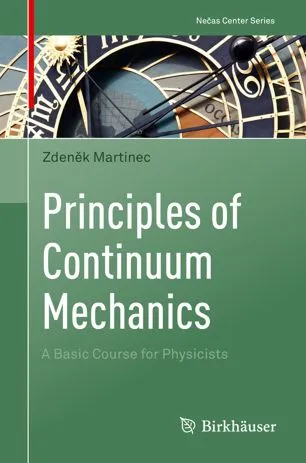
- Published Year: 2019
- Page count: 256
- File Size: 3 MB
- Language: English
- Published by: Springer International Publishing; Birkhäuser
- Visited by: 156
- Rating/Review: 4.5
- ISBN: 978-3-030-05389-5;978-3-030-05390-1
Principles of Continuum Mechanics: A Basic Course for Physicists
4.5
Reviews from our users

You Can Ask your questions from this book's AI after Login
Each download or ask from book AI costs 2 points. To earn more free points, please visit the Points Guide Page and complete some valuable actions.
Introduction to "Principles of Continuum Mechanics: A Basic Course for Physicists"
Written to bridge the understanding between classical physics and advanced concepts in continuum mechanics, "Principles of Continuum Mechanics: A Basic Course for Physicists" is a comprehensive textbook aimed at equipping physicists with the foundational knowledge they need to tackle real-world physics problems. This book is designed for students, educators, and professionals who seek to gain a profound understanding of the subject through a clear, methodical, and engaging learning experience.
A Detailed Summary of the Book
Continuum mechanics, as a discipline, addresses the behavior of materials and systems at macroscopic scales where the discrete nature of matter can be ignored. This book provides a detailed yet accessible treatment of the core principles, assumptions, and mathematical underpinnings that form the basis of continuum mechanics. Starting with the essential ideas surrounding the continuum hypothesis, the book systematically introduces concepts such as kinematics, stress, balance laws, constitutive relations, and thermodynamics in the context of a continuum.
Each chapter is carefully crafted to build upon the previous, enabling readers to progress at a steady pace. The text incorporates a variety of examples and exercises designed to deepen understanding and foster problem-solving skills. By emphasizing intuition and practicality, while maintaining a rigorous mathematical foundation, the book ensures that even complex topics become approachable to readers with varying levels of expertise.
Topics covered include strain and deformation, conservation laws (mass, momentum, and energy), the role of material symmetries, and nonlinear mechanics. The narrative culminates in discussing applications, such as fluid dynamics and solid mechanics, connecting the theoretical framework to its use in physics, engineering, and applied sciences.
Key Takeaways
- Comprehensive understanding of the continuum hypothesis and its importance in physics and engineering.
- An introduction to the mathematics of tensors, which are indispensable representations in continuum mechanics.
- Thorough exploration of kinematics and stress tensors, their relationship to governing physical laws, and how they are used to model the behavior of materials.
- A clear pathway to studying more advanced topics such as nonlinear elasticity, viscoelasticity, and fluid mechanics.
- An emphasis on developing physical intuition alongside mathematical rigor, making the book resonate with theoreticians and pragmatists alike.
Famous Quotes from the Book
"Continuum mechanics provides a language that allows us to describe the complexity of natural systems in terms of mathematical simplicity."
"The success of continuum mechanics lies not in the assumption of perfection, but in its ability to approximate reality closely enough to be practically useful."
"In physics, the most elegant theories provide not just explanations, but predictive power. Continuum mechanics epitomizes this philosophy."
Why This Book Matters
The study of continuum mechanics is indispensable not just to physicists, but also to engineers, applied mathematicians, and scientists across various domains. As a fundamental framework, it provides the tools needed to model and predict the behavior of physical systems ranging from fluid flows in aerodynamics to stress distributions in solid structures. Yet the subject can be daunting due to its mathematical complexity and multifaceted approach.
"Principles of Continuum Mechanics: A Basic Course for Physicists" stands out as a vital resource because it demystifies the subject with a balance of clarity and depth. By using this book, readers encounter a progressive learning curve where theoretical abstraction meets physical insight. Each concept is explained with an eye toward practical application, ensuring its value well beyond the classroom.
For postgraduate students in physics, this work provides a solid foundation for further research in areas such as material science, biomechanics, and geophysics. For working professionals, the book serves as a reference to enhance and solidify their understanding of the continuum descriptions of nature. It matters because it makes advanced theoretical concepts accessible to those eager to learn, and it serves as a testament to the enduring relevance of mechanics in solving scientific and industrial problems.
Free Direct Download
You Can Download this book after Login
Accessing books through legal platforms and public libraries not only supports the rights of authors and publishers but also contributes to the sustainability of reading culture. Before downloading, please take a moment to consider these options.
Find this book on other platforms:
WorldCat helps you find books in libraries worldwide.
See ratings, reviews, and discussions on Goodreads.
Find and buy rare or used books on AbeBooks.

1156
بازدید4.5
امتیاز0
نظر98%
رضایتReviews:
4.5
Based on 0 users review
Questions & Answers
Ask questions about this book or help others by answering
No questions yet. Be the first to ask!