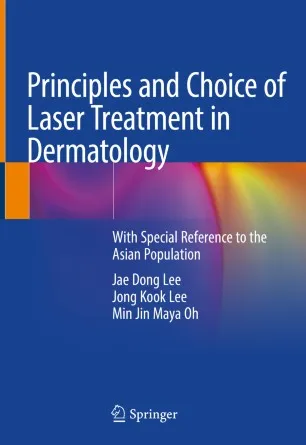
- Published Year: 2020
- Page count: 310
- File Size: 20 MB
- Language: English
- Published by: Springer Singapore;Springer
- Visited by: 376
- Rating/Review: 4.6
-
ISBN:
9789811565557
9789811565564
Keywords:
Principles and Choice of Laser Treatment in Dermatology: With Special Reference to the Asian Population
4.6
Reviews from our users

You Can Ask your questions from this book's AI after Login
Each download or ask from book AI costs 2 points. To earn more free points, please visit the Points Guide Page and complete some valuable actions.



![Rook's textbook of dermatology Volume 1 [...]](https://s3.refhub.ir/images/thumb/Rook_s_textbook_of_dermatology_Volume_1_3103.webp)



Analytical Summary
The book Principles and Choice of Laser Treatment in Dermatology: With Special Reference to the Asian Population offers an in-depth exploration of how laser technologies intersect with dermatological practice, with a deliberate focus on the nuances of treating Asian skin types. Written by Jae Dong Lee, Jong Kook Lee, and Min Jin Maya Oh, this work bridges the gap between clinical science and practical application, providing practitioners, researchers, and advanced students with a framework to make evidence-based decisions.
Laser dermatology has evolved into a cornerstone of aesthetic and therapeutic skin care. However, the physiological characteristics of Asian skin—including higher melanin content, unique healing profiles, and greater predisposition to certain pigmentary disorders—necessitate specialized strategies. This book acknowledges that while global laser technologies are often designed with a generalized skin typology in mind, optimal outcomes require tailoring approaches to specific populations.
Readers will discover carefully structured chapters detailing the physics of laser devices, indications for various dermatologic conditions, and comparative guidance on selecting wavelength, pulse duration, and energy density. By integrating data from clinical studies and real-world practice in Asian contexts, the authors address potential risks such as post-inflammatory hyperpigmentation and scarring, while also emphasizing methods to maximize efficacy and patient satisfaction.
Key Takeaways
Within this text, the convergence of dermatologic science and cultural specificity comes into sharp focus, promoting both clinical expertise and patient safety.
First, the authors underscore that "one-size-fits-all" approaches in laser dermatology neglect important variables like skin phototype and genetic predisposition. Clinicians must evaluate these variables before selecting equipment and protocols.
Second, the book breaks down decision-making into principle-driven categories—target chromophore identification, lesion depth assessment, and risk-benefit analysis tailored for Asian skin physiology.
Third, the authors contextualize these principles within broader dermatologic trends, acknowledging both established technologies and emergent innovations in laser therapy.
Finally, practical case examples illuminate how theory translates into measurable treatment outcomes, offering practitioners a realistic lens through which to anticipate both successes and complications.
Memorable Quotes
“Effective laser treatment is not simply about advanced technology, but about understanding the patient’s unique skin biology.” Unknown
“In Asian dermatology, precision is more than a virtue—it is a necessity.” Unknown
“Every wavelength carries both potential and risk; mastery lies in discernment.” Unknown
Why This Book Matters
This work transcends being a mere manual—it is an essential reference for anyone serious about integrating laser technology into dermatological care with a patient-centered approach.
In an increasingly globalized medical environment, clinicians face diverse patient populations. Yet the specific dermatologic needs of Asian patients remain underrepresented in many broad-spectrum texts. This book directly addresses that gap, helping dermatologists refine their methodology in line with both physiological realities and cultural expectations.
By articulating clear principles and offering decision-making guidance, the authors empower practitioners to navigate a complex technological landscape while minimizing adverse effects. For educators, the structure of the book facilitates curriculum integration, ensuring the next generation of clinicians is prepared with culturally competent strategies.
Information unavailable on whether the book has received awards, due to no reliable public source confirming such recognition.
Inspiring Conclusion
The depth and precision of Principles and Choice of Laser Treatment in Dermatology: With Special Reference to the Asian Population make it a cornerstone text for informed, ethical, and effective dermatology practice.
By engaging with this book, readers gain the competence to select and apply laser technologies responsibly—balancing innovation with patient-specific considerations. It invites professionals, academics, and advanced trainees to challenge assumptions, deepen their knowledge, and elevate their standards of care.
If your aim is to master the art and science of laser dermatology, particularly with respect to the diversity of Asian skin physiology, the next logical step is to read, share, and discuss this book within your professional community. Doing so not only enhances personal expertise but also advances the collective capacity of the field to deliver optimized, culturally attuned treatments.
Free Direct Download
You Can Download this book after Login
Accessing books through legal platforms and public libraries not only supports the rights of authors and publishers but also contributes to the sustainability of reading culture. Before downloading, please take a moment to consider these options.
Find this book on other platforms:
WorldCat helps you find books in libraries worldwide.
See ratings, reviews, and discussions on Goodreads.
Find and buy rare or used books on AbeBooks.

1376
بازدید4.6
امتیاز0
نظر98%
رضایتReviews:
4.6
Based on 0 users review
Questions & Answers
Ask questions about this book or help others by answering
No questions yet. Be the first to ask!