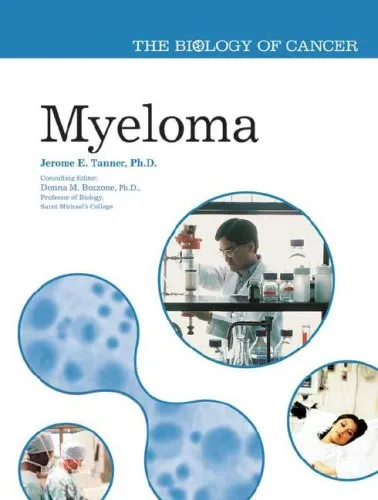
- Published Year: 2008
- Page count: 120
- File Size: 3 MB
- Language: English
- Published by:
- Visited by: 265
- Rating/Review: 4.8
-
ISBN:
0791088243
9780791088241
Keywords:
Myeloma (The Biology of Cancer)
4.8
Reviews from our users

You Can Ask your questions from this book's AI after Login
Each download or ask from book AI costs 2 points. To earn more free points, please visit the Points Guide Page and complete some valuable actions.









Analytical Summary
Myeloma (The Biology of Cancer) is an authoritative scientific work designed to bridge the gap between advanced oncology research and practical understanding among clinicians, biomedical researchers, and serious students of cancer biology. Written with academic precision and an inviting clarity, this book illuminates the intricate cellular and molecular pathways that drive multiple myeloma.
At its core, the text delves deep into plasma cell dysregulation, bone marrow microenvironment dynamics, and the genetic aberrations shaping disease progression. Readers are guided through mechanistic insights that punctuate the complexity of myeloma's pathophysiology—covering topics ranging from abnormal immunoglobulin production to angiogenesis and immune escape mechanisms.
The narrative also situates myeloma within the broader context of theories in cancer cell biology, drawing parallels with other hematologic malignancies to help the reader develop a systemic perspective. This measured approach ensures that professionals in oncology, hematology, and laboratory sciences can connect the specific knowledge to their broader cancer expertise.
While treatments and evolving research directions are discussed, this work remains rooted in the biological underpinnings rather than speculative therapeutics. Readers are reminded that while the book offers a current synthesis, scientific literature in oncology is rapidly advancing; therefore, they are encouraged to cross-reference this content with the latest peer-reviewed publications.
Key Takeaways
This book distills the complexity of myeloma into a handful of pivotal lessons that inform both academic inquiry and clinical acumen.
One major takeaway is the recognition that myeloma is not solely a disease of malignant plasma cells, but rather a disorder of their interaction with the supportive—and sometimes complicit—bone marrow niche. The interplay between stromal cells, cytokines, and extracellular matrix components is a recurring theme throughout the text.
Another is the significance of genetic heterogeneity. Chromosomal translocations, copy number variations, and mutations in key signaling pathways have profound implications for disease prognosis and therapeutic responsiveness. Understanding this heterogeneity aids in appreciating why myeloma presents variably among patients.
The third takeaway underscores the relationship between tumor evolution and immune surveillance. As myeloma progresses, the malignant clone adapts to evade immune detection—offering valuable lessons about the adaptive capacity of cancer cells.
Lastly, the volume reminds readers of the necessity of integrating molecular research with clinical patterns, emphasizing that biology must inform therapy decisions even in the face of emerging treatment modalities.
Memorable Quotes
The biology of myeloma cannot be understood in isolation; its roots are deeply entrenched in the ecosystem of the bone marrow.Unknown
Every cell tells a story. In myeloma, the narrative is one of adaptation, survival, and, ultimately, pathology.Unknown
Precision in understanding disease biology is the compass that guides effective therapy.Unknown
Why This Book Matters
For academics, clinicians, and researchers, Myeloma (The Biology of Cancer) stands out as a foundational reference that blends depth with clarity.
In a field where data overload can cloud understanding, this work offers a disciplined synthesis of the biological events that define and drive the disease. Its relevance spans medical education, research planning, and clinical strategy formulation, serving as a touchstone for evidence-based discourse.
Information on specific publication awards or recognition is unavailable due to a lack of reliable public sources. Nonetheless, the book's meticulous attention to scientific accuracy qualifies it as a must-have for serious engagement in oncology literature.
By maintaining a focus on core biological principles, readers are empowered to evaluate emerging studies with a discerning eye, situating novel findings within a robust conceptual framework.
Inspiring Conclusion
Myeloma (The Biology of Cancer) is more than a book—it is a deep academic voyage into the interplay of malignant cells and their environment.
In highlighting both the microscopic events and the systemic repercussions of myeloma, it invites every reader to not just absorb information but to engage with it critically. Whether you are a researcher seeking to chart new pathways in cancer cell biology, a clinician refining diagnostics, or a student building a career in oncology, this book provides a rigorous yet accessible foundation.
The next step is yours: read with curiosity, share with colleagues, and discuss its ideas in your academic circles. In doing so, you help advance the collective understanding and application of the science within Myeloma (The Biology of Cancer).
Free Direct Download
You Can Download this book after Login
Accessing books through legal platforms and public libraries not only supports the rights of authors and publishers but also contributes to the sustainability of reading culture. Before downloading, please take a moment to consider these options.
Find this book on other platforms:
WorldCat helps you find books in libraries worldwide.
See ratings, reviews, and discussions on Goodreads.
Find and buy rare or used books on AbeBooks.

1265
بازدید4.8
امتیاز0
نظر98%
رضایتReviews:
4.8
Based on 0 users review
Questions & Answers
Ask questions about this book or help others by answering
No questions yet. Be the first to ask!