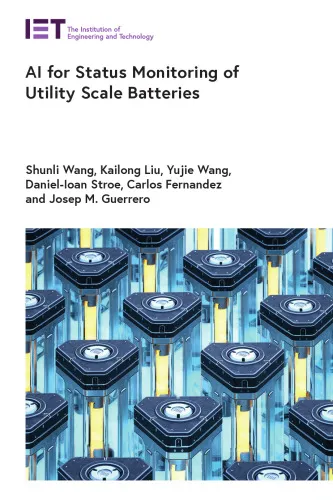
- Published Year: 2023
- Page count: 495
- File Size: 29 MB
- Language: English
- Published by: The Institution of Engineering and Technology
- Visited by: 202
- Rating/Review: 4.4
- ISBN: 1839537388; 9781839537387
Keywords:
IET Energy Engineering Series, 238
4.4
Reviews from our users

You Can Ask your questions from this book's AI after Login
Each download or ask from book AI costs 2 points. To earn more free points, please visit the Points Guide Page and complete some valuable actions.Related Refrences:





IET Energy Engineering Series, Volume 238 is a significant contribution to the field of modern energy systems, authored by Shunli Wang, Kailong Liu, Yujie Wang, Daniel-Ioan Stroe, Carlos Fernandez, and Josep M. Guerrero. This book represents a comprehensive exploration of cutting-edge advancements, methodologies, and applications in energy engineering, with a particular emphasis on power systems, renewable integration, and smart technologies. It serves as both an academic source and a practical guide for engineers, researchers, and energy policy makers seeking sustainable solutions for the future energy landscape.
Detailed Summary of the Book
The IET Energy Engineering Series, Volume 238 presents a meticulous analysis of contemporary challenges and innovations in energy engineering. It delves into topics such as advanced battery management systems, microgrid technologies, renewable energy optimization, and the role of artificial intelligence in energy management. The authors leverage their expertise to bridge the gap between theory and practice, offering in-depth coverage of modeling techniques, performance evaluation, and scalability issues.
Readers are introduced to real-world case studies that illustrate the integration of wind, solar, and storage systems into modern grids. The book also examines the technical and economic feasibility of deploying large-scale energy solutions, supported by data-driven approaches to enhance energy efficiency and reliability. Special attention is given to the evolution of decentralized energy systems, predictive maintenance strategies, and the interaction between distributed generation and smart grids.
The narrative balances technical rigor with accessibility, making it suitable for students, industry professionals, and decision-makers who require a holistic understanding of the energy engineering sector. By articulating current research trends alongside practical applications, the authors ensure that the reader gains not only knowledge but also actionable insights.
Key Takeaways
- Comprehensive understanding of advanced battery energy storage systems and their role in grid stability.
- Insights into modern microgrid design, operation, and control strategies to enhance resilience.
- Application of artificial intelligence and machine learning in predictive energy management.
- Technical and economic evaluation frameworks for renewable energy integration.
- Policy-oriented perspectives that link technological innovation to sustainable energy transitions.
Famous Quotes from the Book
"The future of energy systems is not simply renewable; it is intelligent, adaptive, and interconnected."
"Sustainability in power engineering lies at the intersection of innovation, policy, and societal needs."
"Decentralized energy systems represent a paradigm shift, empowering communities with control over their power source."
Why This Book Matters
Energy systems worldwide are undergoing rapid transformation due to climate change, evolving policy frameworks, and technological innovation. The IET Energy Engineering Series, Volume 238 addresses these global shifts with a clear focus on designing and maintaining systems that are not only efficient but also resilient and adaptable. This makes it highly relevant for professionals tasked with implementing future-ready energy solutions.
By capturing the complex interplay between renewable integration, distributed generation, and storage technologies, the book provides a blueprint for navigating the energy transition. Its multidisciplinary approach ensures that readers appreciate both the engineering and socio-economic dimensions of modern energy systems. This perspective is critical as stakeholders aim to achieve net-zero emissions while maintaining energy security and affordability.
Furthermore, the book serves an educational role, equipping upcoming engineers and researchers with the exact tools, frameworks, and methodologies needed to make impactful contributions in the energy sector. Both theoretical modeling and practical implementation strategies are addressed, ensuring its utility in academia, industry, and policy-making circles alike.
In an era where renewable adoption is accelerating and technological convergence is reshaping the global energy market, this work stands out as a definitive reference that blends comprehensive knowledge with actionable practices. Its SEO-rich content and structured approach make it a valuable resource for anyone searching for expertise in battery systems, microgrids, and AI-driven energy optimization.
Free Direct Download
You Can Download this book after Login
Accessing books through legal platforms and public libraries not only supports the rights of authors and publishers but also contributes to the sustainability of reading culture. Before downloading, please take a moment to consider these options.
Find this book on other platforms:
WorldCat helps you find books in libraries worldwide.
See ratings, reviews, and discussions on Goodreads.
Find and buy rare or used books on AbeBooks.

1202
بازدید4.4
امتیاز0
نظر98%
رضایتReviews:
4.4
Based on 0 users review
Questions & Answers
Ask questions about this book or help others by answering
No questions yet. Be the first to ask!