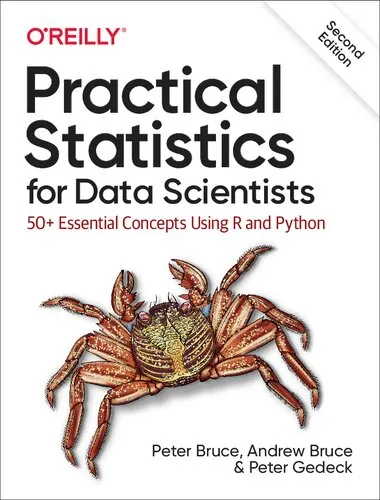
Practical Statistics for Data Scientists: 50+ Essential Concepts Using R and Python
Peter Bruce,Andrew Bruce,Peter Gedeck
2020
View book
Book guide and evaluation
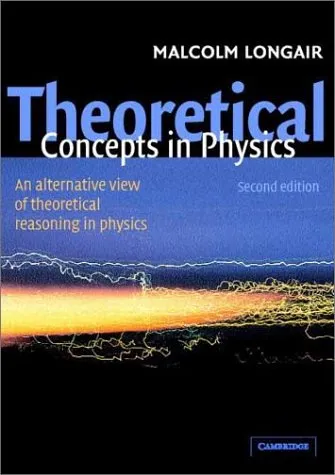
Malcolm S. Longair
0 reviews
Published
pages
views
Introduction to 'Theoretical Concepts in Physics: An Alternative View of Theoretical Reasoning in Physics, Second Edition' Welcome to an intellectual journey into the fascinating realms of theoretical physics. In this second edition of 'Theoretical Concepts in Physics', I aim
Before you read
Welcome to an intellectual journey into the fascinating realms of theoretical physics. In this second edition of 'Theoretical Concepts in Physics', I aim to provide readers with not just a historical overview of physics, but an exploration of the deep reasoning processes that underpin theoretical discoveries. This book is designed to challenge conventional frameworks and inspire novel ways of examining the intellectual history of physics, from its classical origins to its modern developments.
Physics, at its core, is not merely an accumulation of equations and laws—it is a way of thinking, a powerful methodology for deciphering the universe. Understanding the theoretical reasoning that drives the progress of this science is critical, not just for students of physics, but for anyone wishing to acquire insight into how humanity grapples with profound and complex questions. Through carefully chosen case studies, a historical lens, and an emphasis on conceptual clarity, this book offers an alternative view that prioritizes reasoning processes over mere technical formalism.
The second edition of Theoretical Concepts in Physics builds upon the foundation of the first edition, while incorporating new material, updated examples, and deeper insights to engage readers even further.
In essence, the book tackles the philosophy of theoretical physics, investigating the development and role of concepts that have revolutionized the field. Instead of focusing solely on the equations or experimental data, we examine the context, reasoning, and intellectual creativity that led to these discoveries. Case studies such as Newton's universal gravity, Maxwell's electromagnetism, quantum mechanics, and the theory of relativity are used to shed light on how physical theories are constructed.
This edition introduces advanced discussions of modern concepts, bridging classical physics with contemporary developments like quantum field theory and cosmology. It also emphasizes the interplay between mathematical elegance and physical insight, making clear that breakthroughs often emerge when these two facets of science align.
"Theoretical physics is not simply a collection of equations but a way of thinking that seeks to make sense of our universe at the deepest level."
"The great conceptual revolutions in physics arise not from incremental changes, but from rethinking the very foundations of our understanding of nature."
"There is a beauty to theoretical reasoning that transcends the mere utility of the laws it produces."
Physics, as a discipline, has been at the forefront of human efforts to understand the universe. But what often goes unnoticed is the intellectual and creative process behind it. This book fills a unique space in the scientific literature by parsing the reasoning and conceptualization that enable discoveries, rather than simply recounting established facts.
Moreover, this work is significant because it invites readers to think like physicists. While technical competence is indispensable, the essence of physics lies in its imaginative and theoretical underpinnings—something this book strives to impart. For students, researchers, and anyone curious about theoretical science, Theoretical Concepts in Physics offers a compelling alternative perspective that enriches understanding and fosters curiosity.
By situating physics in its historical and philosophical contexts, this book underscores the discipline's cultural and intellectual significance. Understanding where we have been helps illuminate where we might go. In an era of ever-accelerating scientific change, revisiting and reflecting upon the foundations of physics has never been more important.
Your question is answered in the context of this title and author. Each answer uses 2 points.
0 reviews, 4.6 average out of 5
Sign in to publish a review.
Ask a focused question and learn from the community.
Related references that continue this learning path.
Peter Bruce,Andrew Bruce,Peter Gedeck
Isaac Newton,I. Bernard Cohen,Anne Whitman,Julia Budenz