
Test Works
2025/06/28
5 / 5
the practical example are quite amazing. A must read if you are building bigger projects. Because without star=ts your model is nothing.
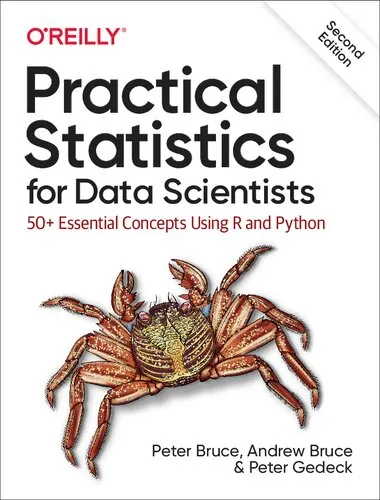
Book guide and evaluation
Peter Bruce,Andrew Bruce,Peter Gedeck
1 reviews
Published
pages
views
Welcome to the comprehensive guide to mastering practical statistics tailored specifically for data science enthusiasts seeking to enhance their skills using R and Python. "Practical Statistics for Data Scientists: 50+ Essential Concepts Using R and Python" serves as an inval
Before you read
Welcome to the comprehensive guide to mastering practical statistics tailored specifically for data science enthusiasts seeking to enhance their skills using R and Python. "Practical Statistics for Data Scientists: 50+ Essential Concepts Using R and Python" serves as an invaluable resource for both budding and seasoned data scientists who wish to integrate statistical methods more effectively into their data analysis practices. Designed to bridge the gap between theoretical statistical concepts and real-world applications, this book is an essential companion in every data scientist's journey.
The book dives into the core statistical techniques and their application in data science, presenting them across an array of relatable and practical scenarios. Focused extensively on two of the most powerful and popular programming languages in data science, R and Python, the text provides practical guidance on how to implement statistical methods in these environments. It covers a plethora of essential topics such as exploratory data analysis, statistics and probability, regression analysis, Bayesian methods, machine learning algorithms, and inferential statistics among others. Each topic is addressed with clarity, using code examples that help reinforce the concepts and demonstrate their application in typical data science projects.
The book also includes case studies and exercises designed to test your understanding, making the learning process interactive and engaging. By providing side-by-side code illustrations in both R and Python, this work not only aids in understanding the statistical concepts but also helps you compare and contrast how these languages can be utilized to approach similar problems, enhancing your versatility as a data scientist.
The book has three primary takeaways for its readers:
"Statistical thinking will one day be as necessary for efficient citizenship as the ability to read and write." This quote encapsulates the essence of the book, highlighting the importance of statistical thinking in the data-driven world. Another notable quote is, "In data science, understanding the data is often more important than building complex models." The authors emphasize that before diving into complex algorithms, you should first understand the data using statistical methods.
In today’s data-centric world, the ability to comprehend and apply statistical techniques is more critical than ever. "Practical Statistics for Data Scientists: 50+ Essential Concepts Using R and Python" stands out as a crucial resource because it directly addresses the need for practical skills in analyzing and interpreting data. This book fills the gap between the theoretical nature of statistics and the practical needs of data science practitioners. By focusing on real-world applications, it empowers readers to not only perform quantitative analysis but also communicate their insights effectively.
Furthermore, with the inclusion of both R and Python codes, it allows for flexibility in language preference, making it an inclusive guide for a broad audience. Whether you are a data analyst, a business intelligence professional, or an aspiring data scientist, this book will enhance your analytical toolkit, preparing you to tackle complex data challenges with confidence and precision.
Your question is answered in the context of this title and author. Each answer uses 2 points.
1 reviews, 5.0 average out of 5
2025/06/28
5 / 5
the practical example are quite amazing. A must read if you are building bigger projects. Because without star=ts your model is nothing.
Sign in to publish a review.
Ask a focused question and learn from the community.
Related references that continue this learning path.
Arthur Glenberg,Arthur M. Glenberg,Matthew Andrzejewski