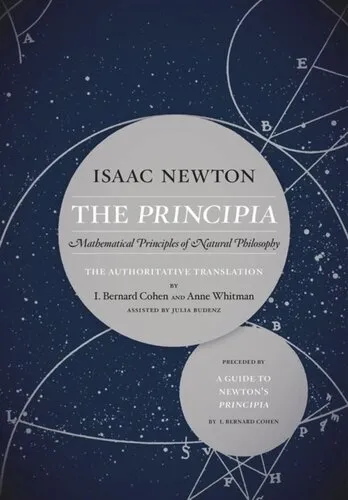
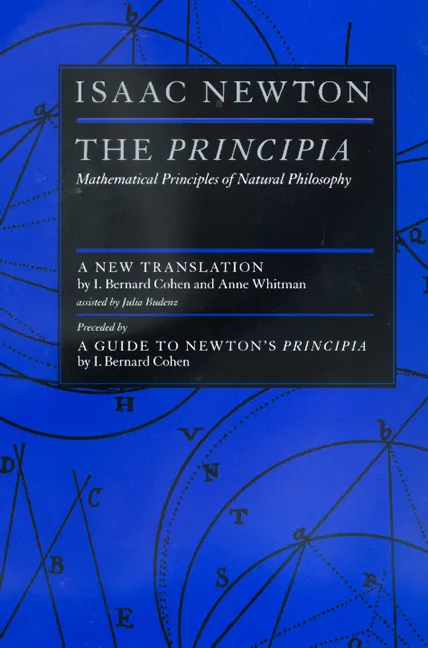
The Principia: Mathematical Principles of Natural Philosophy. The Authoritative Translation and Guide
Isaac Newton;Bernard Cohen, Anne Whitman (trans.)
Book guide and evaluation
Isaac Newton,I. Bernard Cohen,Anne Whitman,Julia Budenz
0 reviews
Published
pages
views
Welcome to an introduction to 'The Principia: Mathematical Principles of Natural Philosophy'—a groundbreaking work by Sir Isaac Newton, meticulously translated and annotated by I. Bernard Cohen, Anne Whitman, and Julia Budenz. This seminal text, first published in 1687, laid th
Before you read
Welcome to an introduction to 'The Principia: Mathematical Principles of Natural Philosophy'—a groundbreaking work by Sir Isaac Newton, meticulously translated and annotated by I. Bernard Cohen, Anne Whitman, and Julia Budenz. This seminal text, first published in 1687, laid the foundational bedrock for classical mechanics, providing a mathematical framework that has underpinned physics for centuries.
'The Principia' is comprised of three books, each presenting a cohesive and methodical approach to the laws that govern matter and motion. The first book posits Newton's famous three laws of motion, defining concepts like inertia, force, and acceleration. Here, Newton introduces the fundamental notions of calculus to explain planetary motions and orbits.
In the second book, Newton focuses on the motion of bodies through resistive mediums, but more than that, he presents an argument against René Descartes' vortex theory of planetary motion. His use of mathematics to disprove prior philosophical theories demonstrates the rigor and transformative nature of Newton's work.
The third book, often titled 'The System of the World', culminates in the universal law of gravitation. Newton elucidates how the same natural laws apply both on Earth and in space, asserting a universality to these principles.
"To every action, there is always opposed an equal reaction."
"I can calculate the motion of heavenly bodies but not the madness of people."
'The Principia' is not merely a book about mathematics or physics; it represents a monumental shift in human thought and scientific methodology. Newton's work exemplifies the power of logical reasoning, making it a cornerstone of the Enlightenment. It provided the tools for later pioneering work in physics and engineering, influencing a myriad of disciplines including astronomy, engineering, and mathematics.
This treatise has not only educated generations of scientists and mathematicians but has inspired countless innovations that have profoundly shaped the modern world. By grounding celestial and terrestrial phenomena in one unified theory, 'The Principia' dismantled barriers between science and philosophy, enhancing our understanding of the cosmos.
Through the lens of modern science, Newton's 'Principia' invites continual reflection, debate, and exploration. It challenges current and future thinkers to expand upon its principles, driving innovation while upholding the quest for knowledge and truth.
Your question is answered in the context of this title and author. Each answer uses 2 points.
0 reviews, 4.7 average out of 5
Sign in to publish a review.
Ask a focused question and learn from the community.
Related references that continue this learning path.
Isaac Newton;Bernard Cohen, Anne Whitman (trans.)