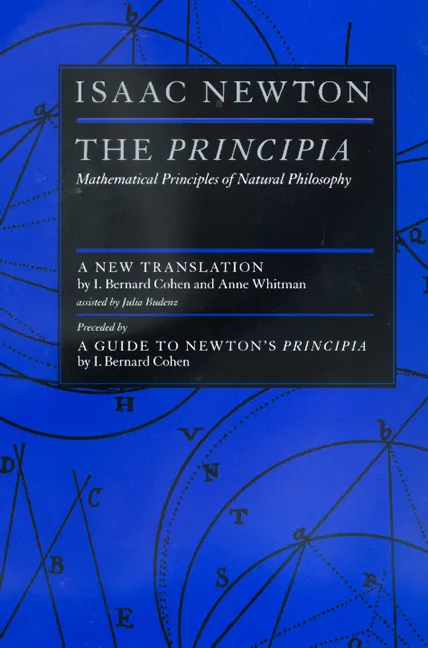
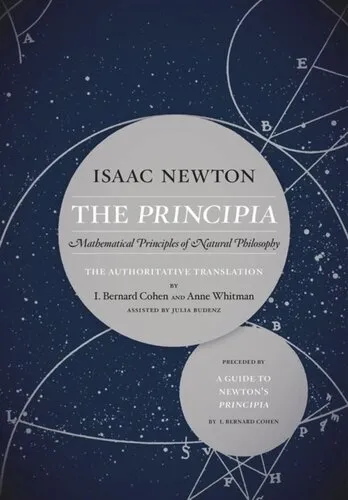
The Principia: Mathematical Principles of Natural Philosophy
Isaac Newton,I. Bernard Cohen,Anne Whitman,Julia Budenz
1999
View book
Book guide and evaluation
Isaac Newton
0 reviews
Published
pages
views
Introduction to 'The Principia: The Authoritative Translation and Guide' Sir Isaac Newton's 'The Principia: The Authoritative Translation and Guide: Mathematical Principles of Natural Philosophy' is a seminal work that laid the foundational principles of classical mechanics. T
Before you read
Sir Isaac Newton's 'The Principia: The Authoritative Translation and Guide: Mathematical Principles of Natural Philosophy' is a seminal work that laid the foundational principles of classical mechanics. This masterpiece is a translation of Newton's 'Philosophiæ Naturalis Principia Mathematica,' in which he formulates the laws of motion and universal gravitation. This book is an essential read for anyone keen on understanding the principles that have shaped modern physics and the way we perceive the universe.
The Principia is structured in three books. Book I, 'The Motion of Bodies,' deals with the mathematical principles of how bodies move in space and time. Newton introduces the concept of absolute time and space, leading to the formulation of the three laws of motion, which form the basis for classical mechanics.
Book II, 'The Motion of Bodies (In Resisting Media),' expands on the motion of objects through fluids, discussing the impact of resistance. Here, Newton examines how bodies succeed in resisting media like air and water, providing fundamental insights into fluid dynamics.
Book III, 'The System of the World,' is where Newton applies the laws of motion and gravitation to explain the solar system's mechanics. By using these principles, Newton elaborates on the movement of celestial bodies and establishes a coherent framework that unifies terrestrial physics and the cosmos.
"To every action, there is always opposed an equal reaction."
"I can calculate the motion of heavenly bodies, but not the madness of people."
'The Principia' is more than just a scientific treatise; it represents a pivotal moment in scientific history where mathematics is used to understand the physical world. The work of Isaac Newton was revolutionary, influencing centuries of research and discovery in physics and beyond.
His clarity and rigor in addressing the motion of celestial and terrestrial bodies laid the groundwork for later developments by scientists such as Albert Einstein. Despite the advances in physics over the years, Newton’s laws of motion continue to be a fundamental aspect of physics education.
This book has not only been instrumental in the development of physics but also in influencing how scientific inquiry has evolved, emphasizing the importance of empirical evidence and mathematical verification. For anyone interested in the sciences, 'The Principia' is a timeless piece that enriches the understanding of the universe.
Your question is answered in the context of this title and author. Each answer uses 2 points.
0 reviews, 4.8 average out of 5
Sign in to publish a review.
Ask a focused question and learn from the community.
Related references that continue this learning path.
Isaac Newton,I. Bernard Cohen,Anne Whitman,Julia Budenz

Budenz, Julia;Cohen, I. Bernard;Newton, Isaac;Whitman, Anne Miller
Isaac Newton;Bernard Cohen, Anne Whitman (trans.)