
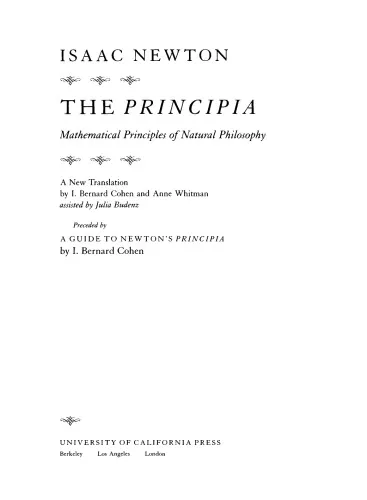
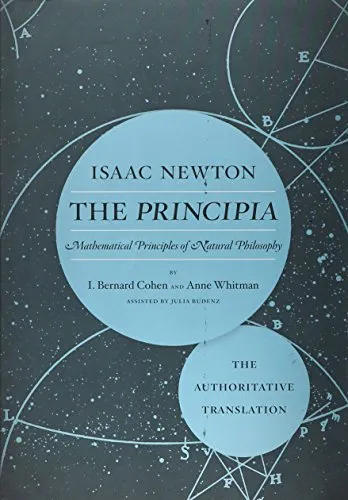
The Principia. Preceded by a guide to Newton's Principia by I. Bernard Cohen: mathematical principles of natural philosophy
Cohen, Ierome Bernard;Whitman, Anne;Newton, Isaac
1999
View book

Book guide and evaluation
Budenz, Julia;Cohen, I. Bernard;Newton, Isaac;Whitman, Anne Miller
0 reviews
Published
pages
views
The Principia: Mathematical Principles of Natural Philosophy Translated by Budenz, Julia; Cohen, I. Bernard; Newton, Isaac; Whitman, Anne Miller Published as "The Principia: Mathematical Principles of Natural Philosophy", the authoritative translation, this remarkable work st
Before you read
Translated by Budenz, Julia; Cohen, I. Bernard; Newton, Isaac; Whitman, Anne Miller
Published as "The Principia: Mathematical Principles of Natural Philosophy", the authoritative translation, this remarkable work stands as one of the most influential books in the history of science. Originally authored by Sir Isaac Newton in 1687, the Principia sets the foundation for classical mechanics, presenting Newton's laws of motion and the law of universal gravitation. This comprehensive translation by Budenz, Cohen, and Whitman is designed to capture the intricacies of Newton's original Latin text with clarity and precision.
Newton's Principia is structured into three books. The first book, "The Motion of Bodies," introduces the foundational principles of dynamics, outlining Newton's laws of motion and discussing fluid mechanics and celestial mechanics. The second book, "The Motion of Bodies in Resisting Mediums," focuses primarily on different types of motion and examines the behavior of bodies moving through a medium, such as air or water.
The third book, "The System of the World," applies the principles established in the first two books to the movements of celestial bodies. Here, Newton elaborates on his groundbreaking law of universal gravitation, illustrating how this force governs the motion of planets and comets. This book also showcases Newton's ingenuity in explaining phenomena such as the tides and the perturbations in planetary orbits.
"To every action, there is always opposed an equal reaction."
"I deduce that the forces of gravity toward the several particles of any homogeneous and solid body are inversely as the squares of the distances of the places from the particles."
Newton's Principia is not merely a cornerstone for physics and astronomy; it is a paradigm of scientific methodology. The mathematical modeling and empirical proof approach set forth in the Principia continue to influence numerous disciplines, including engineering, physics, and beyond. Notably, the book marks the beginning of the Scientific Revolution's culmination, merging mathematics with physics to understand natural phenomena.
Moreover, Newton's Principia has transformative historical and philosophical significance, taking human inquiry into the natural world from a qualitative perspective to a precise, quantitative endeavor. This work also laid the groundwork for future theoretical advancements by scientific luminaries such as Albert Einstein.
Your question is answered in the context of this title and author. Each answer uses 2 points.
0 reviews, 4.7 average out of 5
Sign in to publish a review.
Ask a focused question and learn from the community.
Related references that continue this learning path.
Cohen, Ierome Bernard;Whitman, Anne;Newton, Isaac
Thibault Damour,Bertrand Duplantier,Vincent Rivasseau (auth.)