

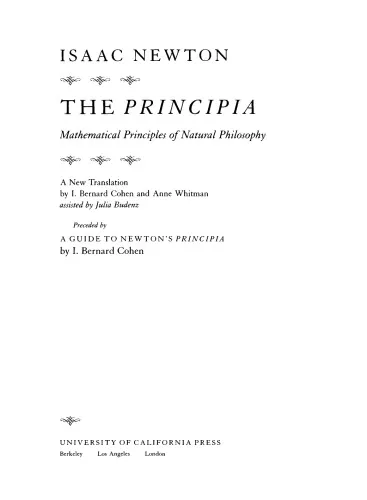
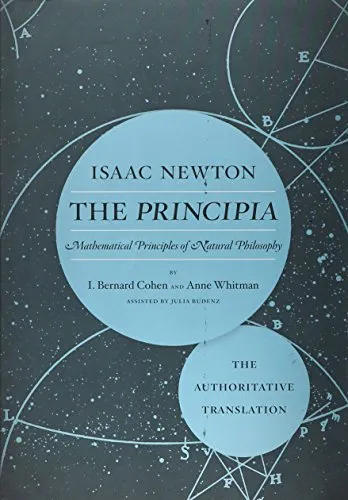
The principia: mathematical principles of natural philosophy: the authoritative translation
Budenz, Julia;Cohen, I. Bernard;Newton, Isaac;Whitman, Anne Miller
2016
View book
Book guide and evaluation
Cohen, Ierome Bernard;Whitman, Anne;Newton, Isaac
0 reviews
Published
pages
views
Introduction to "The Principia. Preceded by a Guide to Newton's Principia by I. Bernard Cohen: Mathematical Principles of Natural Philosophy" Isaac Newton's "The Principia" is not just a cornerstone of scientific literature but a monumental work that laid the f
Before you read
Isaac Newton's "The Principia" is not just a cornerstone of scientific literature but a monumental work that laid the foundation for classical mechanics. It is a compendium of mathematical ingenuity combined with deep insights into the natural world. This edition, preceded by a guide by I. Bernard Cohen, offers a comprehensive view into Newton's genius and the groundbreaking revelations that followed. The book serves as both an entry point for novices and a detailed study for scholars of Newton's profound contributions.
The book "The Principia" essentially captures Isaac Newton's scientific vision and his envisioning of the universe governed by natural laws. Newton succeeds in synthesizing the principles of motion and universal gravitation, redefining humanity’s understanding of the natural world. In this edition, the introductory guide by I. Bernard Cohen meticulously sets the stage for understanding Newton's work by breaking down his methods, interpretations, and the historical context within which Newton conceived his theories.
The book is divided into three books. Book I discusses the fundamentals of motion and dynamics, exploring concepts like the laws of motion and centripetal forces. Book II extends these ideas into fluid dynamics and the motion of bodies through resistive mediums, positing early ideas that would later influence hydrodynamics and thermodynamics. Book III synthesizes these results and applies them to celestial bodies, thus forming the basis for what would become known as celestial mechanics. It is here that Newton articulated his law of universal gravitation, revolutionizing astronomy.
Newton's prose is as remarkable as his mathematics, imbued with philosophical insights. Some of the most famous quotes from "The Principia" include:
"I can calculate the motion of heavenly bodies, but not the madness of people."
"To every action, there is always opposed an equal reaction."
Newton's "The Principia" stands as a beacon of scientific thought, laying the groundwork for much of modern science and engineering. It linkages with the Enlightenment era and represents a shift from qualitative natural philosophy to quantitative science. Newton’s ability to describe physical phenomena mathematically transformed science, impacting generations of scientists including the likes of Albert Einstein.
The inclusion of I. Bernard Cohen's guide adds modern insights and analytical depth, making this edition invaluable for researchers and enthusiasts who seek to understand the intricacies of Newton's contributions and how they continue to influence technology and scientific thought today.
Your question is answered in the context of this title and author. Each answer uses 2 points.
0 reviews, 4.5 average out of 5
Sign in to publish a review.
Ask a focused question and learn from the community.
Related references that continue this learning path.
Budenz, Julia;Cohen, I. Bernard;Newton, Isaac;Whitman, Anne Miller
Giovanna Corsi,Maria Luisa Dalla Chiara,Gian Carlo Ghirardi (Editors)