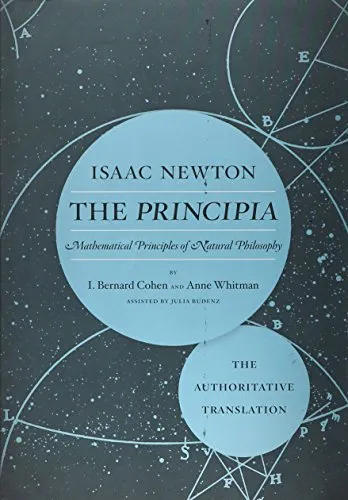
The principia: mathematical principles of natural philosophy: the authoritative translation
Budenz, Julia;Cohen, I. Bernard;Newton, Isaac;Whitman, Anne Miller
2016
View book
Book guide and evaluation
Sir Isaac Newton
0 reviews
Published
pages
views
Introduction to The Principia Welcome to the world of 'The Principia: The Authoritative Translation: Mathematical Principles of Natural Philosophy', a seminal work by Sir Isaac Newton that has profoundly influenced the landscape of science and mathematics. This masterpiece
Before you read
Welcome to the world of 'The Principia: The Authoritative Translation: Mathematical Principles of Natural Philosophy', a seminal work by Sir Isaac Newton that has profoundly influenced the landscape of science and mathematics. This masterpiece delves into the laws governing motion, gravity, and the intricate tapestry of the cosmos. Designed to engage the curious mind and enlighten the learned scholar, this book lays the foundation for modern physics and astronomy.
'The Principia' is divided into three books, each serving as a cornerstone in the edifice of classical mechanics. The first book, 'De Motu Corporum', explores the mathematics of motion in a vacuum. Newton introduces his three laws of motion, which form the backbone of this treatise. The second book, 'De Motu Corporum in Gyrum', examines the motion of bodies in resistive mediums, such as air or water, refining the abstract notions introduced in the first book. The third book, 'De Systemate Mundi', known as the 'The System of the World', expands upon these principles to address celestial phenomena, laying the groundworks for Newton's law of universal gravitation. Throughout 'The Principia', Newton utilizes geometric methods, preferring them over the algebraic approaches commonly used today. He meticulously builds upon axioms and lemmas to prove his propositions, applying them to phenomena such as the tides, the trajectories of comets, and the precession of the equinoxes.
Throughout 'The Principia', several passages stand out for their clarity and insight. Here are a few of the most memorable quotes:
“I can calculate the motion of heavenly bodies, but not the madness of people.”
“Truth is ever to be found in the simplicity, and not in the multiplicity and confusion of things.”
'The Principia' is more than just a book; it is a keystone in the arch of human knowledge. By establishing the mathematical principles that govern the movement of all objects in the universe, whether earthly or celestial, Newton catalyzed a scientific revolution. This work not only laid the groundwork for modern physics but also inspired future explorations and discoveries. The methodologies espoused in 'The Principia' highlight the importance of logical reasoning and empirical evidence, principles that remain cornerstones of the scientific enterprise today. For scholars, scientists, and thinkers, this book embodies a timeless testament to the power of human curiosity and the relentless pursuit of truth.
Your question is answered in the context of this title and author. Each answer uses 2 points.
0 reviews, 4.7 average out of 5
Sign in to publish a review.
Ask a focused question and learn from the community.
Related references that continue this learning path.
Budenz, Julia;Cohen, I. Bernard;Newton, Isaac;Whitman, Anne Miller
Cohen, Ierome Bernard;Whitman, Anne;Newton, Isaac