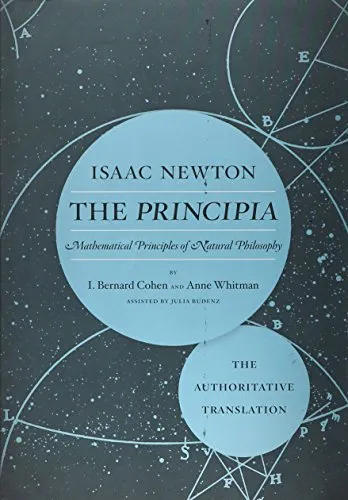
The principia: mathematical principles of natural philosophy: the authoritative translation
Budenz, Julia;Cohen, I. Bernard;Newton, Isaac;Whitman, Anne Miller
2016
View book

Book guide and evaluation
Isaac Newton,Translated by Motte
0 reviews
Published
pages
views
Introduction to 'The Mathematical Principles of Natural Philosophy (1687)' Widely considered one of the most influential works in the history of science, Sir Isaac Newton's The Mathematical Principles of Natural Philosophy, often referred to by its Latin title Philosophiæ Natu
Before you read
Widely considered one of the most influential works in the history of science, Sir Isaac Newton's The Mathematical Principles of Natural Philosophy, often referred to by its Latin title Philosophiæ Naturalis Principia Mathematica, laid the foundation for classical mechanics. Published in 1687, this groundbreaking book not only defines gravitation and the laws of motion but also introduces the mathematical framework that underpins the modern understanding of the physical world. Written in Latin and later translated into English, the Principia continues to inspire scientists, philosophers, and mathematicians alike with its profound insights and timeless principles.
The Principia is divided into three books, each addressing different aspects of motion, gravity, and planetary movement in great detail. Newton derived his findings using rigorous geometric arguments, providing logical proof of his laws and their applications. As a cornerstone of modern physics, this book represents a monumental moment in the intellectual history of humanity.
The Principia is structured into three major books, each focusing on distinct scientific concepts:
Each of these books builds upon the other, culminating in a unified and revolutionary scientific worldview. Newton's unique ability to marry deductive reasoning and empirical observation makes The Principia a timeless masterpiece that profoundly altered the trajectory of science.
Newton's Principia puts forth ideas that remain central to physics, engineering, and astronomy. The key takeaways are:
The principles expounded in this book continue to guide scientific thought and remain relevant to this day, despite the later development of Einstein’s theory of relativity, which extends and refines Newtonian mechanics.
Several statements from Principia have become iconic in scientific literature. Here are a few that highlight Newton’s genius:
"To explain all nature is too difficult a task for any one man or even for any one age. 'Tis much better to do a little with certainty and leave the rest for others that come after than to explain all things."
"I do not feign hypotheses. For whatever is not deduced from the phenomena must be called a hypothesis, and hypotheses, whether metaphysical or physical, have no place in experimental philosophy."
The Mathematical Principles of Natural Philosophy is much more than a textbook or a collection of observations; it is a profound leap forward in human comprehension of the universe. Newton's Principia matters because it:
Ultimately, Newton’s Principia symbolizes the power of human reason and its ability to unlock the secrets of the natural world through careful observation and rigorous proof.
Your question is answered in the context of this title and author. Each answer uses 2 points.
0 reviews, 4.6 average out of 5
Sign in to publish a review.
Ask a focused question and learn from the community.
Related references that continue this learning path.
Budenz, Julia;Cohen, I. Bernard;Newton, Isaac;Whitman, Anne Miller
Cohen, Ierome Bernard;Whitman, Anne;Newton, Isaac