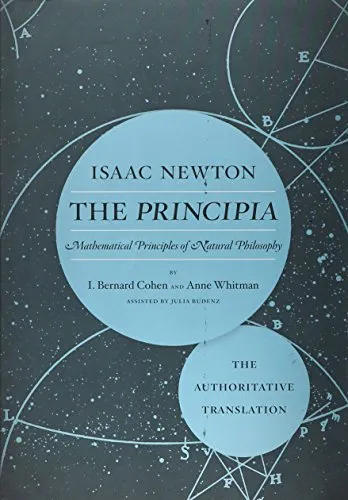
The principia: mathematical principles of natural philosophy: the authoritative translation
Budenz, Julia;Cohen, I. Bernard;Newton, Isaac;Whitman, Anne Miller
2016
View book
Book guide and evaluation
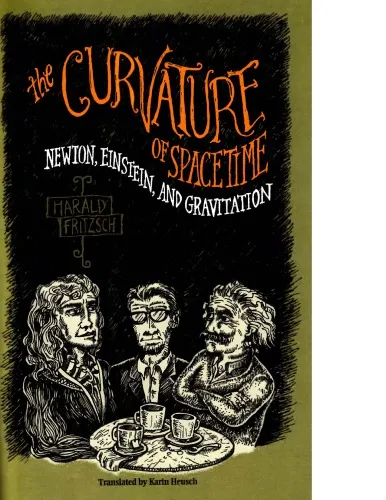
Harald Fritzsch;Karin Heusch
0 reviews
Published
pages
views
The Curvature of Spacetime: Newton, Einstein, and Gravitation - Introduction Explore the depths of our universe, the very fabric of existence, and the profound theories that shaped our understanding of gravitation with "The Curvature of Spacetime: Newton, Einstein,
Before you read
Explore the depths of our universe, the very fabric of existence, and the profound theories that shaped our understanding of gravitation with "The Curvature of Spacetime: Newton, Einstein, and Gravitation". This book is a compelling journey through the pivotal advancements in physics—from the elegant simplicity of Newtonian mechanics to the groundbreaking complexities of Einstein's Theory of General Relativity. Written by Harald Fritzsch and Karin Heusch, it bridges the gap between classical physics and modern cosmology for readers captivated by the mysteries of the cosmos.
Accessible and authoritative, the book beautifully illustrates how our understanding of spacetime has evolved, guided by two of history’s most influential physicists. It incorporates key scientific concepts, historical developments, and the philosophical implications of understanding forces and matter. You’ll appreciate not only the scientific rigor but also the authors' clarity in presenting sophisticated ideas to both scientists and enthusiasts alike.
At its core, this work celebrates humanity’s intellectual curiosity and relentless quest for knowledge. If you've ever been fascinated by the interplay between space, time, and gravity—or pondered how the cosmos operates—this book should be on your shelf. Let us delve into an overview of what makes this literary piece an outstanding contribution to science writing.
The book is divided into several sections, each exploring key milestones in the history and theories of gravitation. It begins by painting a vivid picture of Isaac Newton's revolutionary work, which introduced the world to the laws of motion and universal gravitation. Newton's vision of the universe as an orderly mechanism governed by deterministic laws laid the foundation for centuries of scientific thought.
The narrative then transitions into Albert Einstein's groundbreaking contributions. General Relativity redefined our understanding of gravity—not as a force but as the curvature of spacetime influenced by mass and energy. The authors carefully guide readers through Einstein’s field equations, his thought experiments, and the philosophical implications of relativity. Real-world phenomena such as black holes, gravitational waves, and the cosmological constant are explained with precision and clarity.
What sets this book apart is its ability to connect scientific advancements with their historical context. From the early debates about the nature of the universe to the modern era of precise astronomical observations, the authors highlight how the scientific process builds upon previous knowledge. Contemporary developments, such as the detection of gravitational waves and the exploration of dark energy, emphasize how General Relativity continues to shape modern physics.
"Einstein taught us that space and time are not fixed and immutable. They are instead dynamic, bending, stretching, and warping in response to matter and energy."
"Newton gave us a universe of order; Einstein gave us a universe of wonder."
"The curvature of spacetime is not just a theoretical construct but a measurable reality shaping the motion of stars, planets, and galaxies."
Understanding the nature of gravity is pivotal to unlocking the universe's secrets. This book is not merely a recounting of physics' history but an invitation to rethink our fundamental assumptions about nature. By examining the achievements of Newton and Einstein, the authors provide an invaluable perspective on how scientific progress is made and the questions that remain.
Readers of all backgrounds will find the book thought-provoking, as it encourages us to marvel at humanity's intellectual triumphs. Moreover, the insights offered here are not restricted to theoretical physics; they influence our grasp of fundamental questions about existence, time, and the cosmos. The authors present these profound topics with clarity and passion, making an otherwise complex subject accessible to curious readers.
Your question is answered in the context of this title and author. Each answer uses 2 points.
0 reviews, 4.0 average out of 5
Sign in to publish a review.
Ask a focused question and learn from the community.
Related references that continue this learning path.
Budenz, Julia;Cohen, I. Bernard;Newton, Isaac;Whitman, Anne Miller
Cohen, Ierome Bernard;Whitman, Anne;Newton, Isaac