

DNA Microarrays and Related Genomics Techniques: Design, Analysis, and Interpretation of Experiments (Biostatistics)
David B. Allison (Editor),Grier P. Page (Editor),T. Mark Beasley (Editor),Jode W. Edwards (Editor
2005
View book
Book guide and evaluation
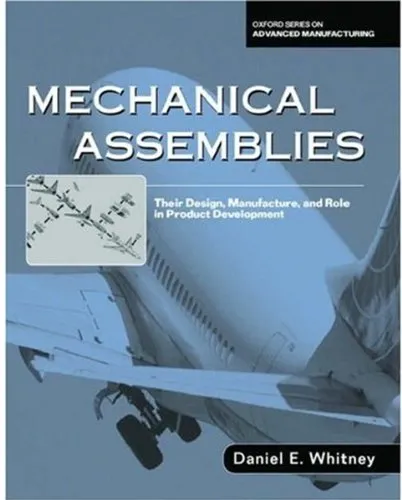
Daniel E. Whitney
0 reviews
Published
pages
views
Introduction to "Mechanical Assemblies: Their Design, Manufacture, and Role in Product Development" Mechanical assemblies are at the heart of modern engineering and manufacturing. From complex machinery to simple devices, the process of designing, manufacturing, and assemb
Before you read
Mechanical assemblies are at the heart of modern engineering and manufacturing. From complex machinery to simple devices, the process of designing, manufacturing, and assembling components is a cornerstone of successful product development. In "Mechanical Assemblies: Their Design, Manufacture, and Role in Product Development," I aim to demystify the science and art of mechanical assemblies for students, engineers, and industry professionals. This book provides a rich blend of theoretical frameworks, practical examples, and insights gleaned from decades of research and collaboration in the field.
Throughout the chapters, this book highlights the critical role that assemblies play at every stage of product development. It explores how the right engineering choices can influence product performance, cost-efficiency, and customer satisfaction. By offering a systems-based perspective, "Mechanical Assemblies" caters not only to engineers specializing in manufacturing but also to professionals in product design, supply chain management, and operations.
The book begins by establishing the fundamental principles of mechanical assemblies, such as force transmission, fixation, and tolerances. It delves into the physics and mechanics that dictate how parts fit and function together. Emphasizing practical engineering constraints, it offers real-world examples of successful (and unsuccessful) assembly designs, helping readers grasp the nuances of design choices.
A significant portion of the book is devoted to understanding how manufacturing processes impact assembly outcomes. Topics like material selection, dimensional accuracy, and statistical quality control are presented in a way that links the design phase with manufacturing realities. Readers will also explore the concept of Design for Assembly (DFA)—an approach aimed at making products easier and cheaper to assemble without compromising performance.
The book also addresses the economic implications of assembly design. Beyond technical feasibility, decisions made during the design phase often determine a product's manufacturability, time to market, and overall cost. This analysis is supported by case studies, illustrating how companies have integrated assembly considerations into strategic decision-making.
Toward the end, the book discusses advancements such as automation and software tools, which are reshaping how assemblies are designed and produced. These discussions not only provide a glimpse into future trends but also prepare the reader to adapt to a fast-evolving industry.
"To design a mechanical assembly is to choreograph the interaction of parts into a seamless performance."
"Assemblies are not just the sum of their parts; they are a reflection of the designer's understanding of physics, constraints, and economy."
"Design is not merely about aesthetics—it's about ensuring that products assemble correctly, perform reliably, and meet customer expectations."
"Mechanical Assemblies: Their Design, Manufacture, and Role in Product Development" matters because it bridges the gap between engineering theory and real-world practice. For students, it provides foundational knowledge that is crucial to understanding the field of mechanical engineering. For professionals, it serves as a guide and reference to navigate the ever-present challenges of assembly design and manufacturing.
In today’s hyper-competitive global marketplace, where speed and efficiency are paramount, mastering the intricacies of mechanical assemblies can set companies apart. This book underscores the importance of thinking holistically—evaluating not only mechanical functionality but also manufacturability, cost implications, and the practical realities of production.
Whether you are a seasoned engineer seeking deeper insights or a newcomer eager to learn, this book provides a comprehensive and accessible roadmap to mastering mechanical assemblies. Its enduring relevance lies in its ability to connect theory to practice, preparing readers to meet the challenges of modern engineering with confidence and creativity.
Your question is answered in the context of this title and author. Each answer uses 2 points.
0 reviews, 4.7 average out of 5
Sign in to publish a review.
Ask a focused question and learn from the community.
Related references that continue this learning path.
David B. Allison (Editor),Grier P. Page (Editor),T. Mark Beasley (Editor),Jode W. Edwards (Editor

Frank C. Hoppensteadt,Charles S. Peskin (auth.)

Howard R. Moskowitz PhD,Sebastiano Porretta,Matthias Silcher