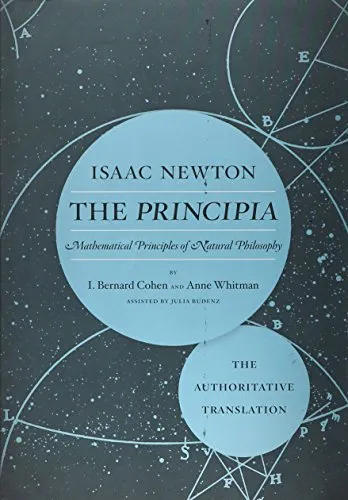
The principia: mathematical principles of natural philosophy: the authoritative translation
Budenz, Julia;Cohen, I. Bernard;Newton, Isaac;Whitman, Anne Miller
2016
View book
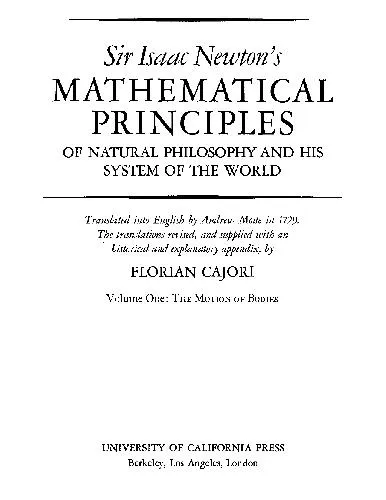
Book guide and evaluation
I. Newton
0 reviews
Published
pages
views
Introduction to 'Mathematical Principles of Natural Philosophy I: The Motion of Bodies' Sir Isaac Newton’s pioneering work, often referred to by its Latin title "Philosophiæ Naturalis Principia Mathematica," lays the foundation of classical mechanics. This monumental text
Before you read
Sir Isaac Newton’s pioneering work, often referred to by its Latin title "Philosophiæ Naturalis Principia Mathematica," lays the foundation of classical mechanics. This monumental text is not only a landmark in scientific thought but also an extraordinary testament to the power of mathematical reasoning in understanding the natural world. Widely regarded as one of the most important scientific books ever written, "The Motion of Bodies" is the first section of this masterpiece, presenting the laws of motion and universal gravitation that revolutionized the study of physics and astronomy. This introduction provides a detailed exploration of the core concepts, key takeaways, timeless quotes, and the book's unparalleled significance in shaping modern science.
In "The Motion of Bodies," Newton articulates a comprehensive mathematical framework to describe the motion of objects under the influence of external forces. Beginning with a systematized axiomatic approach, he introduces his famous three laws of motion, which form the cornerstone of classical mechanics. These laws govern the behavior of objects in motion and brought clarity to centuries-old questions about how and why objects move as they do.
Newton meticulously applies his principles to celestial and terrestrial phenomena, proving that the same set of universal laws governs both. By rigorously deriving Kepler's laws of planetary motion and formulating the law of universal gravitation, Newton demonstrated how mathematical principles unify the cosmos. He also tackled complex problems, including the orbits of celestial bodies, projectile motion, pendulums, and even the effects of air resistance.
The book's mathematical rigor is unparalleled, using tools like calculus and geometric analysis to model physical behaviors. While occasionally dense, Newton’s ability to bridge theory and practical application ensures the work remains fundamentally accessible to scholars. His proofs and equations illuminate the clockwork nature of the universe, solidifying the enduring relevance of the text across scientific disciplines.
“Every body continues in its state of rest, or of uniform motion in a right line, unless it is compelled to change that state by forces impressed upon it.”
“To every action there is always opposed an equal reaction.”
“The motions of the planets and comets are perpetually governed by the same principles.”
"Mathematical Principles of Natural Philosophy" is a cornerstone of science, marking the beginning of modern physics and astronomy. Newton’s articulation of universal laws transformed humanity’s understanding of the universe and laid the groundwork for countless technological and scientific advancements, from space exploration to engineering.
Beyond its scientific contributions, the book exemplifies the extraordinary power of human reasoning and the ability to uncover nature's secrets through diligent inquiry. It stands as an enduring reminder of the interconnectedness of mathematics, physics, and philosophy in our quest to make sense of the cosmos.
The enduring legacy of this work cannot be overstated—it continues to inspire scientists, educators, and students around the world, remaining an essential text in the study of physics, astronomy, and the history of science.
Your question is answered in the context of this title and author. Each answer uses 2 points.
0 reviews, 4.8 average out of 5
Sign in to publish a review.
Ask a focused question and learn from the community.
Related references that continue this learning path.
Budenz, Julia;Cohen, I. Bernard;Newton, Isaac;Whitman, Anne Miller
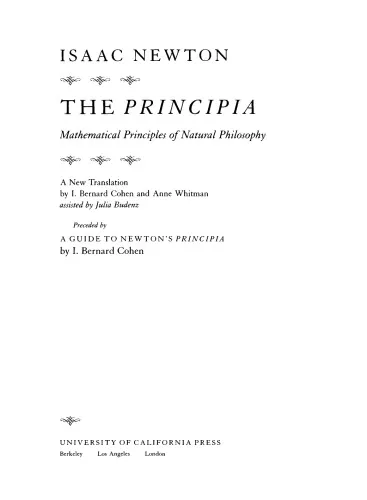
Cohen, Ierome Bernard;Whitman, Anne;Newton, Isaac