

DNA Microarrays and Related Genomics Techniques: Design, Analysis, and Interpretation of Experiments (Biostatistics)
David B. Allison (Editor),Grier P. Page (Editor),T. Mark Beasley (Editor),Jode W. Edwards (Editor
2005
View book
Book guide and evaluation
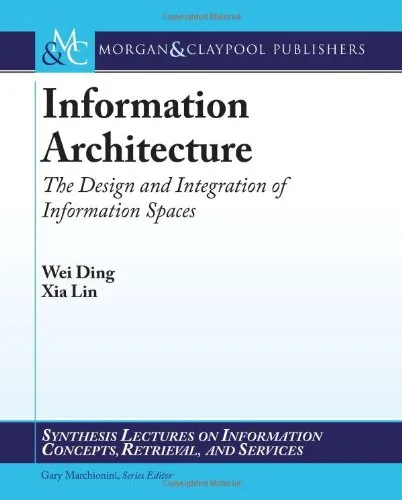
Wei Ding,Xia Lin
0 reviews
Published
pages
views
Introduction In a world dominated by the explosion of digital data and ever-evolving technologies, the importance of organizing and structuring information effectively cannot be overstated. "Information Architecture: The Design and Integration of Information Spaces" dives
Before you read
In a world dominated by the explosion of digital data and ever-evolving technologies, the importance of organizing and structuring information effectively cannot be overstated. "Information Architecture: The Design and Integration of Information Spaces" dives deep into the principles, methodologies, and challenges of creating meaningful and efficient information spaces. Written as part of the Synthesis Lectures on Information Concepts, Retrieval, and Services series, this book provides both theoretical foundations and practical applications for designing, managing, and integrating information systems across a variety of domains.
The book aims to bridge the gap between information science, user-centered design, and robust system development, making it an essential guide for information architects, researchers, UX professionals, and anyone involved in the design and organization of information. Whether you're crafting a digital library, structuring a website for optimal usability, or designing metadata for complex systems, this book equips you with the tools and insights to succeed.
The book unfolds into a comprehensive exploration of the field of information architecture (IA) and its multifaceted nature. It begins by introducing the reader to the core principles and terminologies of IA, establishing a solid foundation for understanding its objectives: to make information accessible, usable, scalable, and meaningful across diverse contexts.
One of the key strengths of the book is its focus on interdisciplinary collaboration. Drawing from information retrieval, cognitive psychology, systems design, and human-computer interaction (HCI), the book explains how these disciplines converge in practice to shape the design and integration of information spaces. Through real-world examples, you’ll discover how principles of IA are applied to address issues such as searchability, navigability, user satisfaction, and system interoperability.
Key chapters delve into how IA fosters usability by structuring content in ways that align with user goals and preferences. By exploring concepts like classification, navigation design, metadata, and taxonomies, the book provides a roadmap for creating systems that balance user needs and organizational objectives. It also touches upon the changing landscape of IA, assessing the challenges and opportunities introduced by advanced technologies like AI, machine learning, and big data analytics.
The book provides actionable guidance for information architects, including methodologies for IA planning, prototyping, iterative testing, and post-deployment refinement. Additionally, it addresses the ethical implications of organizing information, urging professionals to consider how systems can impact individuals and society at large.
"Information is not just about content; it is also about the pathways and narratives users take to find meaning within that content."
"Good information architecture bridges the gap between chaos and clarity—it transforms data into actionable knowledge."
"Every design choice has an impact—not only on usability and effectiveness but also on the ethical dimensions of the information space."
The importance of "Information Architecture: The Design and Integration of Information Spaces" cannot be overstated in today’s data-driven world. As organizations, institutions, and designers grapple with increasingly complex information systems, this book serves as a timely and indispensable resource. It not only demystifies the technical and theoretical aspects of information architecture but also emphasizes its importance in solving real-world problems.
By shedding light on how information systems can fundamentally improve human interaction with technology, the book underscores the value of designing information spaces that are both intuitive and purposeful. Especially as the digital world becomes more interconnected and reliant on vast datasets, a robust understanding of IA principles has universal relevance.
Whether you are a professional aiming to refine your craft or a student exploring the field for the first time, this book provides the insight, tools, and frameworks necessary to excel. More than just technical guidance, it challenges readers to think critically about how information systems influence perceptions, decision-making, and access to knowledge.
Your question is answered in the context of this title and author. Each answer uses 2 points.
0 reviews, 4.6 average out of 5
Sign in to publish a review.
Ask a focused question and learn from the community.
Related references that continue this learning path.
David B. Allison (Editor),Grier P. Page (Editor),T. Mark Beasley (Editor),Jode W. Edwards (Editor

Frank C. Hoppensteadt,Charles S. Peskin (auth.)

Howard R. Moskowitz PhD,Sebastiano Porretta,Matthias Silcher