

DNA Microarrays and Related Genomics Techniques: Design, Analysis, and Interpretation of Experiments (Biostatistics)
David B. Allison (Editor),Grier P. Page (Editor),T. Mark Beasley (Editor),Jode W. Edwards (Editor
2005
View book
Book guide and evaluation
Pendleton-Jullian, Ann M;Brown, John Seely
0 reviews
Published
pages
views
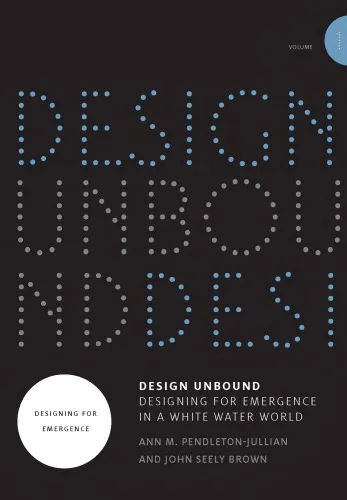
Introduction to "Design Unbound: Designing for Emergence in a White Water World, Volume 2: Ecologies of Change" "Design Unbound" presents a transformative approach to understanding and addressing the complexities of our world, especially as it faces the turbulent disruptio
Before you read
"Design Unbound" presents a transformative approach to understanding and addressing the complexities of our world, especially as it faces the turbulent disruptions characterized as white water. This book equips readers with the tools and frameworks to navigate and design effectively within such dynamic environments.
"Design Unbound: Designing for Emergence in a White Water World, Volume 2: Ecologies of Change" builds upon the foundation laid in Volume 1. While the first volume introduces readers to the core concepts and methodologies of design thinking in unpredictable environments, Volume 2 delves into the practical applications and intricate ecologies that drive change. Through a meticulous exploration of real-world scenarios, the authors illustrate how design processes can foster resilience and adaptability in the face of uncertainty. The central theme revolves around understanding and leveraging ecological principles of change, emphasizing the interconnectedness of systems, whether social, biological, or technological.
The authors examine various case studies, showcasing how these principles operate in diverse contexts. By using a design approach that's unbounded by traditional constraints, they advocate for a shift in mindset—one that perceives chaos not as a hindrance but as an opportunity for innovation. The narrative interweaves insights from ecology, complexity science, and cybernetics to provide readers with a holistic view of emergent systems and their potential for fostering sustainable change.
"Recognizing the unseen connections in an ecology of change is as crucial as recognizing the visible elements."
"In a white water world, the ability to pivot with insight rather than stumble in uncertainty sets the successful apart."
"Design is not just a tool but a mindset—a way of approaching complexity with curiosity and humility."
In a global landscape characterized by rapid technological advancements, environmental challenges, and social upheaval, the ability to navigate unpredictability has never been more vital. "Design Unbound" offers a comprehensive guide to engage with such volatility constructively. The authors, Ann Pendleton-Jullian and John Seely Brown, bring together a wealth of expertise from their respective fields to present a compelling narrative that not only informs but also empowers readers. By equipping individuals and organizations with strategies to design for emergence, the book serves as a crucial resource for fostering innovation and sustainable change in today's white water world.
Ultimately, "Design Unbound" matters because it shifts the conversation from managing chaos to harnessing it, inviting a future where design is both adaptive and generative. As we stand at the crossroads of unprecedented change, this work provides a beacon for those seeking to not just survive, but thrive.
Your question is answered in the context of this title and author. Each answer uses 2 points.
0 reviews, 4.5 average out of 5
Sign in to publish a review.
Ask a focused question and learn from the community.
Related references that continue this learning path.
David B. Allison (Editor),Grier P. Page (Editor),T. Mark Beasley (Editor),Jode W. Edwards (Editor


Frank C. Hoppensteadt,Charles S. Peskin (auth.)

Howard R. Moskowitz PhD,Sebastiano Porretta,Matthias Silcher